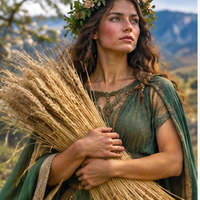
 Tailtiu is a significant figure in medieval Irish tradition, remembered as the foster-mother of Lugh and associated with the landscape and assembly site that bears her name. In the traditional account, she cleared the great plain of Brega for cultivation, exhausting herself through the labour. After her death, Lugh is said to have established funeral games in her honour at Tailtiu, the gathering that became associated with Lughnasadh.
The stories connect Tailtiu with land, labour, cultivation, fosterage, remembrance and communal gathering. They also link her memory to one of the major seasonal assemblies of early Ireland. The details come through medieval literary tradition, and the precise antiquity of individual elements should not be assumed.
Qualities associated with Tailtiu:
• Land and cultivation: making the ground productive through labour
• Fosterage: care, teaching and the bonds formed beyond birth
• Endurance: effort given for the benefit of others
• Remembrance: honouring those whose work sustains a community
• Gathering: the social and ceremonial life of seasonal assemblies
Tailtiu, Lugh and the Clearing of the Plain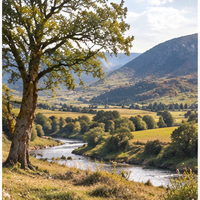 In the medieval Irish tradition, Tailtiu is described as the foster-mother of Lugh. She is associated with the clearing of the plain of Brega, a vast undertaking that made the land suitable for cultivation. The story presents this work as so demanding that Tailtiu dies from exhaustion.
Lugh is then said to have established an annual assembly and funeral games in her honour at the place called Tailtiu. These games are linked with the festival of Lughnasadh, traditionally held at the beginning of August. The gathering was not simply a sporting event: early Irish assemblies could combine games, trade, political and legal business, and communal celebration.
The story gives Tailtiu a place in the seasonal cycle through memory and collective activity. Her association with the land is expressed through work that prepares it to sustain life, while the assembly preserves her name through the community’s return.
Land, Harvest and the Assembly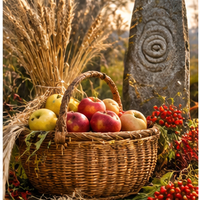 Tailtiu’s symbolism arises principally from the stories and place-name traditions connected with her, rather than from a fixed set of surviving cult objects. The most grounded associations are the cleared plain, cultivated land, harvest, fosterage and the gathering held in her memory.
The plain:
The clearing of Brega represents work that changes a landscape and makes it capable of supporting a community.
Grain and harvest:
These provide a natural contemporary visual language for cultivation and the results of sustained labour. They are interpretive symbols, not a documented list of sacred attributes.
The assembly:
The gathering at Tailtiu connects memory with games, exchange and public life. It suggests that remembrance can be expressed collectively, not only privately.
Fosterage:
Tailtiu’s role as Lugh’s foster-mother draws attention to care, teaching and relationships formed through commitment.
Working with Tailtiu: Labour, Care and Gratitude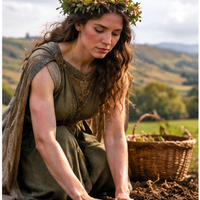 A modern reflection inspired by Tailtiu can focus on the work that makes life possible. Much of what sustains us is easy to overlook: preparing food, maintaining a home, caring for others, teaching, tending a garden or passing on a skill. Tailtiu’s story invites attention to the effort behind what later appears to be abundance.
Recognise the work:
Choose one ordinary part of your life that depends on regular effort. Write down what it takes to maintain it and what would be lost if that work went unseen.
Consider fosterage:
Think of someone who helped you learn or grow, whether or not they were family. What did their care make possible?
Make something more fertile:
Choose a small task that will benefit you or someone else in the future: prepare a space, repair something, plant something or share a useful skill.
These are contemporary reflective practices inspired by the themes of the story, not claims about ancient rites.
Tailtiu and the Value of Work Remembered Tailtiu’s story brings attention to a kind of contribution that can be overlooked: the work that prepares the ground for other people to flourish. The plain is cleared, the land becomes productive, and the community gathers to remember the person whose labour made that possible.
There is also a human dimension in her relationship with Lugh. Fosterage reminds us that care and influence are not limited to biological family. People shape one another through time, attention, teaching and practical support.
A modern reflection on Tailtiu can therefore ask two simple questions: what are we helping to make possible for others, and whose earlier work has made our own lives easier? Remembering both can give ordinary effort a wider meaning.