Notifications (Click to mark read)
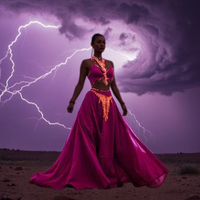 Oya is one of the most powerful Orisha in the Yoruba religious tradition — the divine force of wind, storm, lightning, and radical transformation. Like Oshun and Yemoja, she is a living deity in an active religious tradition, not a mythological figure or historical archetype. This distinction carries practical implications for how she is approached: the publicly shared dimensions of her mythology and associations are available for learning, while the specific initiated practices of the Yoruba tradition and its diaspora traditions belong to those communities.
Oya governs the domain of wind in all its forms — from the gentle breeze that carries seeds to the tornado that reshapes the landscape. Through wind, she governs change itself: the force that clears away what is stagnant, that carries seeds of new possibility into territory where nothing was growing, that illuminates through lightning what the ordinary light of day cannot show. She is associated with the marketplace — the place of rapid exchange, of meeting and transaction, of the social winds that change community direction — and with the cemetery gates, the threshold between the living and the ancestral worlds.
Her name is related to the Yoruba word for "she tore" — reflecting her connection to the sudden, tearing quality of storm. She is not a gradual goddess; she is associated with the sudden, the decisive, the complete transformation that happens all at once rather than incrementally. This makes her the appropriate Orisha for situations where incremental change has been tried and has not worked, where something fundamental needs to shift rather than merely adjust.
As the Yoruba tradition was carried into the diaspora through the slave trade, Oya's energy became particularly significant for those who had to survive radical, violent disruption — communities forcibly transplanted into entirely different environments, required to remake their lives while maintaining their religious and cultural identity. She was syncretised with Our Lady of Candelaria and Santa Teresa in various Caribbean and South American traditions. Her domain of radical transformation made her directly relevant to lives that had been subjected to radical transformation not of their own choosing.
Oya in Yoruba Mythology

Oya appears in the Yoruba mythological corpus — preserved through the Ifá divination tradition and through the oral transmission of initiated practitioners — in several significant narratives that illuminate her character and domain.
Oya and Chango:
Oya's most celebrated mythological relationship is with Chango, the Orisha of thunder, lightning, and justice. Their relationship is frequently described as one of the great love stories of Yoruba mythology — passionate, equal, and occasionally turbulent in ways that reflect the nature of both their energies. Significantly, Oya is one of the few Orisha understood as equal in power to Chango, and in some versions of the mythology she is the only one who can truly manage his lightning energy. They are distinct forces who are strongest together — wind and thunder cooperating in the storm.
Oya as Warrior:
Unlike Oshun, who operates primarily through the flowing, persuasive power of love and sweetness, Oya is explicitly a warrior Orisha. She fights alongside Chango and other Orisha; she carries weapons; she is understood as fierce and direct in her confrontations. This warrior dimension reflects the understanding that some things cannot be resolved through patience and sweetness — they require the direct, clearing power of the storm.
Guardian of the Cemetery:
Oya's role as guardian of the gates between the living and the ancestral worlds makes her a crucial figure in Yoruba understandings of death, transition, and ancestral communication. She does not govern death itself — that is Iku's domain — but she governs the threshold, the passage between the two realms. This makes her the appropriate Orisha to work with when seeking to connect with ancestral wisdom or to facilitate the transition of those who are dying.
Sacred Symbols:
Oya's colours are the nine colours of traditional Yoruba practice — she encompasses all — but particularly deep purple, burgundy, and copper. Her sacred metal is copper, which conducts both electricity and spiritual energy. Her number is nine. Her offerings include purple grapes, red wine, and eggplant. Her symbols include the iruke (a flywhisk made of horse hair, carried by Yoruba royalty and Orisha), swords and warrior tools, and the whirlwind. She is also associated with the buffalo — whose power she wears as a masquerade costume in some of her appearances.
Working with Oya's Energy

The qualities that Oya's mythology concentrates — the courage to embrace radical change, the willingness to clear away what is stagnant even when comfortable, the honest reckoning with what needs to end, the fierce protection of what is genuinely threatened — are accessible through contemplative and practical engagement with her symbolism, understood as engaging with the publicly shared dimensions of a living tradition.
Working with Wind:
Oya's most accessible natural dimension is the wind itself. Spending time in genuinely windy conditions — outdoors in strong wind, at the shore where the air moves constantly, during the leading edge of a storm (safely) — provides a direct physical engagement with the element she governs. The quality of wind — its variability, its capacity to carry things both toward and away, its relationship to change — is a contemplative resource.
The Practice of Clearing:
Oya's domain specifically includes the clearing of what is stagnant. This translates practically into the deliberate practice of identifying what in one's life has become stagnant — habitual patterns that no longer serve, relationships that have run their course, emotional material that has been held rather than processed — and taking the steps necessary to clear it. This is not dramatic; it is the consistent, sometimes uncomfortable practice of not allowing accumulation.
Radical Change:
Oya is the appropriate archetype for situations where incremental adjustment is insufficient — where what is needed is a fundamental shift rather than a modification. Working with her energy in these situations involves developing the capacity to commit to complete change rather than partial change, which requires honest assessment of what is actually being asked and genuine willingness to accept the disruption it entails.
Courage and Direct Action:
Unlike the flowing, patient energy of Oshun, Oya's energy is direct, decisive, and willing to confront. Working with her archetype means developing the capacity for honest confrontation — with oneself, with situations, with other people when necessary — without the softening or delay that avoidance produces. This is not aggression; it is the willingness to address what needs addressing without waiting for a more comfortable moment.
Ancestral Work:
Oya's role as guardian of the cemetery threshold makes her relevant for any serious engagement with ancestral work — the practice of maintaining conscious relationship with those who have died and with the inheritance (positive and negative) they have left. Working with her archetype in this context involves developing honest relationship with what has been inherited rather than either idealising or dismissing it.
Truth-Telling:
Oya's lightning illuminates what the ordinary light of day does not show. Working with her energy means developing the capacity to see clearly — and to say what is seen — even when the seeing is uncomfortable. This is not cruelty; it is the kind of honest perception that genuine change requires.
Explore More Goddess Archetypes →
Select your Oya work:
Oya belongs to a living religious tradition. The practices here engage with the publicly shared dimensions of her mythology.
Full participation in Yoruba and diaspora traditions requires initiation and community relationship — not self-study alone.