Notifications (Click to mark read)
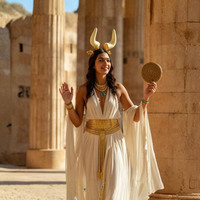 Hathor is one of the oldest, most beloved, and most widely worshipped goddesses in the entire Egyptian religious tradition — a deity whose cult spans more than three thousand years of continuous practice, from the earliest dynastic period through to the Roman occupation of Egypt. Her name in Egyptian, Hwt-Hr, means "House of Horus" — the goddess who contains and protects the sky god — but this etymology barely hints at the extraordinary breadth of her domain.
Hathor governs love, beauty, music, dance, fertility, motherhood, the sky, the sun, gold, turquoise, foreign lands, the dead in the afterlife, and the arts of civilised life. She is simultaneously one of the most joyful and one of the most dangerous goddesses in the Egyptian pantheon — her gentle, pleasure-giving nature and her fierce, destructive aspect are not contradictions but two expressions of the same fundamental force. The Egyptians understood this duality clearly: the same sun that makes the Nile Valley fertile can kill with heatstroke; the same goddess who brings love and music can, when sent as the Eye of Ra, nearly destroy all of humanity.
She is depicted in several forms: as a woman wearing the sun disk between cow horns, as a cow, as a woman with cow ears, and in her sistrum-bearing form as the patroness of music and celebration. The sistrum — a rattling musical instrument — is one of her primary sacred objects, its sound understood to both please the gods and drive away evil. At the great temple of Dendera in Upper Egypt, which is dedicated to Hathor and is one of the best-preserved temples in Egypt, her face appears on the columns in a form called the Hathor-headed capital — simultaneously human and divine, serene and knowing.
 Hathor's breadth of domain means she appears in different theological roles that can initially seem unrelated. Understanding her as a single coherent divine force — rather than as a collection of unrelated attributes — requires attending to the Egyptian theological logic that connects them.
Hathor as Sky Goddess and Eye of Ra:
In her cosmic role, Hathor is the sky itself — the celestial cow whose body arches over the earth, whose belly is the vault of heaven, whose four legs are the pillars at the corners of the world. She is also the Eye of Ra — the daughter and feminine extension of the solar god, the fierce solar force that Ra sends against the enemies of divine order. In the myth of the Destruction of Mankind (shared in a different form with Sekhmet, with whom she is identified in this role), Ra sends his Eye — here as Hathor — to punish humanity for plotting against him. She nearly destroys all human life before Ra intervenes, flooding the earth with red-dyed beer that she mistakes for blood, drinks, and falls into a stupor. The myth is structurally identical to the Sekhmet version, reflecting the Egyptian understanding that Hathor and Sekhmet are the same divine force in different expressions — the gentle and the fierce faces of the same solar feminine power.
Hathor as Goddess of Love and Music:
In her most immediately accessible aspect, Hathor is the Egyptian goddess of love, beauty, sexuality, music, and dance. She was patron of artists, musicians, and dancers; her temples were centres of sacred music and celebration. The rattling of the sistrum in her temples was understood as the sound of her presence, and her festivals were among the most joyous in the Egyptian religious calendar, involving music, dance, wine, and the open celebration of pleasure as a sacred act.
Hathor as Goddess of Foreign Lands and Trade:
Hathor was specifically associated with the places from which Egypt obtained luxury goods — Sinai (turquoise and copper), Punt (incense and gold), Byblos (cedar timber). Her title "Mistress of Turquoise" reflects this connection; the mines at Serabit el-Khadim in Sinai contained an important Hathor shrine. This association with foreign lands and precious materials reflects the Egyptian understanding that the pleasures and beauties of civilised life — perfume, jewellery, fine materials — came from Hathor's domain.
Hathor as Goddess of the Dead:
In her funerary role, Hathor receives the dead in the western desert — she is the Lady of the West, the divine force that receives souls at the threshold of death and offers them refreshment and nourishment for their journey through the Duat (the underworld). She appears in funerary texts as the celestial cow who suckles the deceased with divine milk, restoring their vitality for eternal life. This role connects her life-giving maternal aspect to her domain over death — she gives life in birth, sustains it in pleasure, and receives it at death.
 The Temple of Hathor at Dendera — situated on the west bank of the Nile approximately 60km north of Luxor — is among the most remarkable sacred sites in Egypt and the most important surviving monument to Hathor's cult. The current temple complex, though built primarily in the Ptolemaic period (the last three centuries BCE) and completed under Roman rule, stands on a site of Hathor worship that goes back to the Old Kingdom and possibly earlier.
Dendera is exceptionally well preserved by Egyptian standards — its reliefs retain much of their original colour, and its roof and crypts, which are rarely preserved elsewhere, are largely intact. The temple's exterior is dominated by the famous Hathor-headed columns and the monumental facade with its carved images of the goddess. Inside, the ceiling of the hypostyle hall bears one of the most celebrated astronomical ceilings in Egypt, depicting the sky, the constellations, and the decans (the thirty-six star groups that mark the Egyptian calendar).
The Dendera Zodiac — a circular bas-relief depicting the twelve zodiacal constellations along with Egyptian astronomical figures — was removed from the temple's roof by French archaeologists in 1820 and is now in the Louvre in Paris. Its removal remains a source of significant tension between Egyptian cultural heritage authorities and the French institution that holds it.
The temple's crypts contain some of the most unusual sacred objects in Egyptian religious art — including the famous Dendera "light" reliefs that have attracted considerable alternative history speculation (the reliefs most likely depict lotus flowers from which serpents emerge, a standard Egyptian religious image, not ancient electrical technology). The crypts also contain extraordinarily detailed ritual texts and images that were seen only by initiates.
The New Year festival at Dendera — in which Hathor's statue was carried to the roof of the temple to be reunited with the solar disk at the first light of the new year — was one of the most significant celebrations in the Egyptian sacred calendar. The goddess was literally brought to meet the sun, the union of feminine divine and solar masculine energy renewing the world for another year.
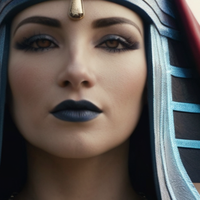 Hathor's most immediately accessible quality is joy — the genuine, embodied, unashamed celebration of pleasure as a sacred rather than a guilty dimension of human life. This is not the thin, performed positivity of contemporary wellness culture but something more substantial: the Egyptian theological conviction that music, beauty, love, and the pleasures of the body are not distractions from the sacred but expressions of it.
Music and Dance as Devotion:
Hathor's temples were places of music and dancing; her priests and priestesses were musicians. The sistrum — whose sound was understood to please the gods — was shaken in her honour at festivals and in daily temple ritual. Working with Hathor's energy through music and dance means taking seriously the idea that these are not merely recreational but genuinely devotional activities: that making music with genuine attention and skill, dancing with genuine presence and joy, is a form of worship.
Beauty as Sacred Practice:
Hathor was patron of beautification — of cosmetics, jewellery, fine clothing, and the arts of adorning the body. Mirror cases found in Egyptian tombs were frequently decorated with Hathor's image, reflecting her association with the act of seeing one's own reflection with appreciation rather than anxiety. Working with her energy means developing a relationship with beauty — both in the external world and in one's own person — as something sacred rather than vain.
The Dual Nature:
The understanding that Hathor contains both the gentle and the fierce — that the same goddess who brings music and love is also the Eye of Ra who nearly destroyed humanity — is theologically important. Working with her archetype means holding the possibility that gentleness and fierceness are not opposites but expressions of the same fundamental force; that the capacity for genuine joy and the capacity for genuine rage come from the same depth.
Sacred Symbols:
The sistrum — her musical rattle. The cow and cow horns with the sun disk. Turquoise and gold — her sacred stones. The mirror. Malachite — Egyptian eye paint, associated with her domain of beauty. The sycamore fig tree, in whose branches she was said to dwell in the western necropolis. Red wine, associated with the blood-beer that stopped her destruction.
Explore Sekhmet — Hathor's Fierce Aspect →
The Egyptians understood Hathor and Sekhmet as two aspects of the same divine force.
In the Destruction of Mankind myth, it is Hathor (in some versions) or Sekhmet (in others) who is sent by Ra to punish humanity — and who is stopped by the same ruse of red-dyed beer.
Joy and fury. Music and destruction. The gentle and the fierce. The same goddess, two faces.
Lady of the West — receiver of the dead
Mistress of Turquoise — patron of Sinai mines
Golden One — goddess of gold and luxury
Eye of Ra — fierce solar force
Lady of Dendera — her great temple city
Mother of Light — celestial cow of the sky