Notifications (Click to mark read)
 Saraswati is a revered Hindu goddess associated with knowledge, speech, learning, music and the arts. Her history is layered: in the Vedic literature Sarasvatī is both a mighty river and a divine presence associated with inspired speech; over time, her identity develops into the goddess widely honoured as a source of learning and creative understanding. Her imagery often shows her dressed in white, holding a veena and sacred texts, with a swan or other water bird nearby. She represents knowledge not as possession alone, but as something cultivated, expressed and shared.
Qualities associated with Saraswati:
• Learning and disciplined study: A theme for reflection and understanding
\n • Clear speech and communication: A theme for reflection and understanding
\n • Music and artistic expression: A theme for reflection and understanding
\n • Discernment and understanding: A theme for reflection and understanding
\n • Curiosity and intellectual growth: A theme for reflection and understanding
\n • The sharing of knowledge: A theme for reflection and understanding
\n
Saraswati is especially meaningful for students, teachers, writers, musicians, researchers and anyone developing a skill or seeking to communicate with greater clarity. As a living Hindu deity, she should be approached with respect for the traditions and communities in which she is worshipped.
From Sacred River to Goddess of Knowledge

The name Sarasvatī is associated in early Vedic sources with a river as well as divine power. Scholarship traces a complex development in which the river goddess becomes associated with Vāc, the divine principle of speech, and increasingly with knowledge and learning. This history matters: Saraswati's identity is not a single timeless list of attributes but the result of centuries of religious and literary development.
The Veena, Books and White Lotus
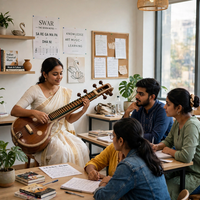
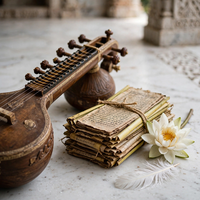
In widely recognised images, Saraswati holds or plays the veena, a stringed instrument associated with musical knowledge and disciplined practice. Books or palm-leaf manuscripts represent learning and sacred knowledge. White clothing and the lotus suggest clarity and refinement, while the swan is a familiar vehicle in her iconography. The precise arrangement of attributes varies by region and artistic tradition.
Speech, Music and the Discipline of Learning

Saraswati's association with speech is central to understanding her. Knowledge becomes useful when it can be articulated, questioned, taught and passed on. Music adds another dimension: it requires listening, timing, repetition and sensitivity to pattern. Both language and music show that expression is not merely inspiration; it is also a discipline developed through practice.
Reflecting with Saraswati: Learning Through Practice

Choose something you genuinely want to understand or learn. Break it into a manageable daily practice, and give attention to both the process and the result. Read, listen, make notes, practise, and explain what you have learned in your own words. If you are creating art or music, allow experimentation while returning regularly to the fundamentals.
Saraswati in Contemporary Life
Saraswati's symbolism remains relevant wherever people seek knowledge and creative expression. Her stories invite reflection on the difference between information and understanding, talent and practice, speaking and communicating. A respectful modern engagement can recognise the living religious significance of the goddess while drawing personal inspiration from the values of study, clarity and artistic discipline.
Symbols and Attributes
Veena (music and disciplined expression); books or manuscripts (learning); white clothing (clarity and purity in devotional symbolism); lotus (spiritual refinement); swan (discernment in many traditions). Iconography varies across regions and periods.
A Simple Reflective Practice
Select one subject or creative skill. Spend twenty focused minutes learning, then write a short explanation of what you understood without looking at your notes. Identify one question that remains. Return to it tomorrow. This combines attention, recall and curiosity.
Offerings and Contemporary Observance
Saraswati Puja and Vasant Panchami are important devotional observances in many Hindu communities, with practices varying by region and tradition. Books, instruments and learning materials may be placed before the goddess in worship. Those outside the tradition can show respect by learning about the festival and the goddess without presenting a personal exercise as an equivalent ritual.
Explore More Goddess Archetypes →
Select a theme for reflection:
What does this goddess's story bring into focus for you?
Read the myths in their historical and cultural context. Different ancient authors and communities sometimes tell different versions of the same story.