Notifications (Click to mark read)
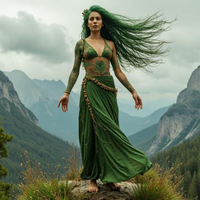 Gaia is the primordial Greek goddess of the Earth — not a goddess who rules the earth from above it, but the earth itself, understood as a living, conscious being. In Hesiod's Theogony, composed in the eighth century BCE, Gaia is the first entity to emerge from Chaos, arising before Tartarus (the deep underworld) and Eros (the generative principle of desire). She is the foundation upon which everything else rests — the ground of being in both the literal and the philosophical sense. From herself alone she generates the sky (Ouranos), the mountains (Ourea), and the sea (Pontus), and from her union with Ouranos she brings forth the Titans, the Cyclopes, and the Hundred-Handed Ones.
What is theologically distinctive about Gaia is her identification with the earth itself rather than with a divine figure who stands apart from it. She is not the goddess of the earth in the way that Artemis is the goddess of the hunt — an anthropomorphic figure with a specific domain. She is the earth. This means that every encounter with the living world — soil, stone, root, river, the weight of the body settling into the ground — is an encounter with Gaia directly. Worship of her required no temple; the earth itself was her altar.
Gaia was also the original oracular presence at Delphi. Before Apollo claimed the site, it belonged to Gaia, and her sacred python guarded the omphalos — the navel-stone believed to mark the centre of the earth. This association with prophecy reflects the ancient understanding that the earth's deep knowing — expressed through the rustling of leaves, the behaviour of animals, the patterns of seasons and weather — was a form of divine communication available to those with the attention to receive it.
The name Gaia is the origin of the site you are currently visiting. Wisdom of Gaia takes its name from this goddess — the understanding that the earth itself is a source of wisdom, not merely a resource to be used, and that developing a conscious relationship with the living planet is one of the most significant spiritual tasks of our time.
 Gaia's role in Greek mythology extends well beyond her origin as the primordial earth. She is a deeply active figure — intervening in the affairs of gods and mortals with a persistence and authority that reflects her status as the most ancient of all divine beings.
The Overthrow of Ouranos: When Ouranos imprisoned Gaia's children the Titans within her body — literally, within the earth — Gaia experienced this as an unbearable physical burden and an injustice against her offspring. She fashioned a great sickle from grey flint and called upon her children to act. It was Kronos who accepted the task, castrating Ouranos and releasing the imprisoned Titans. This myth establishes Gaia as a figure who will not accept injustice against her children, even at the cost of radical action, and who has the strategic intelligence to plan and execute what brute force alone cannot accomplish.
The Prophecy Against Kronos: When Kronos swallowed each of his children fearing a prophecy that one would overthrow him, it was Gaia who, with Rhea, devised the plan to save Zeus — substituting a stone wrapped in cloth for the infant god and hiding him in Crete. Gaia's role here is the archetypal grandmother who preserves what the generation above her would destroy, maintaining the continuity of divine order across catastrophe.
The Gigantomachy: In the war between the Olympians and the Giants, Gaia sided with the Giants — her own children — against the gods. She sought an herb that would make the Giants invulnerable, and Zeus prevented its growth by forbidding the sun, moon, and dawn from shining until he could harvest it himself. Even in opposition to the Olympian order, Gaia acts as a protective mother.
Antaeus: The giant Antaeus, son of Gaia and Poseidon, could not be defeated so long as he remained in contact with his mother the earth. Heracles defeated him only by lifting him into the air, cutting off his connection to Gaia's strength. This myth encapsulates something important about Gaia's wisdom: connection to the earth is a source of genuine power, and that power is lost when we are separated from the ground.
The Delphic Oracle: Gaia's original ownership of Delphi is theologically significant. The earth's deep patterns — expressed through volcanic fumes, the movements of the seasons, the behaviour of the natural world — were understood in ancient Greek thought as a form of knowledge available to those trained to receive and interpret them. When Apollo claimed the oracle, he inherited this tradition rather than creating a new one.
 In the 1970s, atmospheric scientist James Lovelock and microbiologist Lynn Margulis developed what Lovelock named the Gaia Hypothesis — the proposal that the Earth's biosphere, atmosphere, oceans, and soils function together as a single self-regulating system that maintains the conditions necessary for life. The name was suggested by novelist William Golding, who recognised the parallel with the ancient Greek earth goddess.
The hypothesis began with Lovelock's observation, while working for NASA on methods to detect life on Mars, that the Earth's atmosphere is in a highly improbable chemical disequilibrium — maintained not by physics alone but by the continuous activity of living organisms. The concentration of oxygen in the atmosphere, the regulation of ocean salinity at levels compatible with life, the maintenance of global temperature within a narrow range despite a 30% increase in solar luminosity since life began — all of these appear to be actively regulated by the interactions of living systems with their physical environment.
This was a controversial proposal when first made, resisted by many biologists on the grounds that it seemed to imply intentionality or purpose in what are actually blind physical and biological processes. The contemporary, more widely accepted version of the idea — sometimes called Earth System Science — makes no claims about intentionality but does maintain that the Earth's biological, chemical, and physical processes interact in ways that produce self-regulation at the planetary scale.
What is striking about this scientific development is not that it proves what the ancient Greeks believed — it does not — but that it arrives at a description of the earth that has more in common with the ancient understanding than with the early modern conception of the earth as inert matter. The earth is not dead; it is a system of extraordinary complexity whose internal dynamics have maintained the conditions for life for approximately four billion years. Whether one calls this a living system or a self-regulating system, the practical implication is the same: what we do to the earth's systems matters, and the disruption of those systems has consequences that extend beyond any single species or ecosystem.
The climate and ecological crises of the present moment are, in Gaia's terms, the consequences of treating the earth as a collection of separable resources rather than as an integrated living system. The spiritual insight embedded in Gaia's mythology — that the earth is not background to human activity but the very ground of our being, and that actions against it are actions against ourselves — turns out to be not merely poetic but functionally accurate.
Gaia's sacred symbols are, in a sense, everything that constitutes the living earth — but certain associations are particularly strong in her mythology and in subsequent earth spirituality traditions.
The Earth Itself: Gaia's most fundamental symbol is the ground underfoot — soil, stone, clay, the bedrock beneath the surface. Working with earth directly — gardening, walking barefoot, handling soil — is the most immediate form of contact with her.
Trees and Forests: Trees are among the oldest living things on earth and among the most ecologically significant — producing oxygen, holding soil, regulating water, providing habitat. Ancient Greek tradition associated oracles and divine communication with specific sacred trees, particularly oaks at Dodona, where the rustling of leaves was interpreted as Gaia's voice.
Serpents: The serpent is one of Gaia's oldest sacred animals — the python that guarded her oracle at Delphi, and the chthonic serpents of Greek earth religion generally. The serpent lives in the earth, moves along the ground, sheds its skin in cyclical renewal, and was understood as a mediator between the surface world and the deep earth.
The Omphalos: The navel-stone at Delphi, originally associated with Gaia, marked the mythological centre of the earth. It represents the earth's deep centre of gravity — the point from which all directions extend — and by analogy the centre of one's own being.
Colors: Deep green (vegetation and growth), rich brown (soil and fertility), blue (oceans and water), and gold (sunlight and abundance).
Sacred Stones: All stones that come directly from the earth carry her resonance, but green stones — malachite, green aventurine, moss agate — are particularly associated with her life-giving aspect.
Gaia is unusual among goddess archetypes in that practice with her does not require invocation, ritual tools, or ceremony — though all of these have their place. Because she is the earth itself, contact with her is available in every moment of contact with the living world. The challenge is not accessing her but bringing genuine attention to the access that already exists.
Direct Earth Contact: The simplest and most powerful Gaia practice is spending time in direct physical contact with the earth — walking barefoot on soil or grass, sitting against a tree, working with hands in garden soil, lying on the ground and feeling its weight bearing you. This is not metaphorical; there is physiological research suggesting that direct earth contact affects the body's electrical state in measurable ways. Whether or not this is the mechanism of the spiritual experience, the experience itself is real and worth attending to.
Seasonal Awareness: Gaia's consciousness expresses itself through the turning of the seasons. Developing genuine awareness of the seasonal cycle — not the calendar season but the actual state of the living world in your location — builds relationship with her over time. This means noticing when local plants emerge and when they go dormant, attending to the quality of light at different times of year, observing the behaviour of birds and animals through the seasons, and adjusting one's own rhythms in response to what the natural world is doing.
Local Ecology: Gaia is not an abstract planetary principle; she is also the specific ecosystem you inhabit. Learning the names and habits of the plants, animals, fungi, and soil organisms in your immediate environment builds a relationship with the earth that is particular rather than generic. This kind of local knowledge — once common in all human cultures — is increasingly rare and increasingly necessary.
Earth Meditation: Sit or lie directly on the ground. Feel the earth's weight supporting you. Breathe slowly and imagine roots extending from your body into the soil, reaching down into the bedrock. With each exhale, release what you no longer need into the earth. With each inhale, draw up the earth's steadiness and patience. This practice does not need to be long to be effective; even five minutes of genuine attention to the contact between your body and the earth can shift the nervous system toward greater groundedness.
Environmental Action as Spiritual Practice: Working to protect and restore the living earth — through whatever form of engagement is appropriate to your situation and capacity — is itself a form of Gaia practice. The separation between spiritual practice and environmental engagement is a false one if Gaia is genuinely understood as the living earth. Reducing consumption, supporting ecological restoration, participating in local environmental stewardship, and making choices that reduce harm to earth systems are practical expressions of the relationship.
Offerings: The most appropriate offering to Gaia is care for the earth itself. Planting trees, removing invasive species, creating habitat for pollinators, composting organic material and returning it to the soil, reducing pollution — these acts of care and restoration are offerings to her in the most direct sense possible.
Explore More Goddess Archetypes →
Proposed by James Lovelock and Lynn Margulis in the 1970s, the Gaia Hypothesis describes Earth as a self-regulating system in which biological, chemical, and physical processes interact to maintain conditions suitable for life. Contemporary Earth System Science continues to develop this understanding.
The ancient understanding that the earth is alive and that human wellbeing is inseparable from the earth's health turns out to be functionally accurate.