Notifications (Click to mark read)
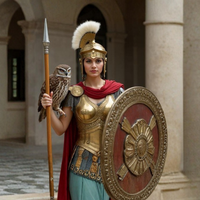 Minerva is the Roman goddess of wisdom, the arts, and strategic warfare — the Roman counterpart of the Greek Athena, though like Venus before the Greek influence arrived, she had a distinct identity and history of her own. Her origins were Etruscan rather than Latin: the Etruscan goddess Menrva — whose cult was well established in the cities of Etruria before the rise of Roman power — was brought to Rome as the Etruscan civilisation was absorbed into the expanding Roman state, and she eventually merged with the Greek Athena to become the Minerva of classical Roman religion.
This Etruscan origin matters because it means Minerva was a significant theological presence in the Italian peninsula before the Romans began systematically identifying their gods with their Greek counterparts. She was not invented to fill a space that Athena occupied; she was a real and established deity who was subsequently identified with Athena because of the genuine overlap in their domains. The identification was natural: both were virgin goddesses, both were associated with wisdom and the arts, both were depicted helmeted and armed, both were connected to the crafts and to the intelligence required to practise them well.
In the Roman religious system, Minerva holds one of the most exalted positions available to any deity: she is the third member of the Capitoline Triad — the three great gods whose temple on the Capitoline Hill was the most important sacred site in Rome. The Triad consists of Jupiter (king of the gods, patron of Roman sovereignty), Juno (queen of the gods, patron of Roman women and the state), and Minerva. Her inclusion in this supreme trio reflects the importance of wisdom, craft, and skilled intelligence to the Roman understanding of what made Rome great.
 The Temple of Jupiter Optimus Maximus on the Capitoline Hill — the most sacred and most politically significant temple in Rome — was dedicated to the Capitoline Triad: Jupiter, Juno, and Minerva. The temple was said to have been founded by the Etruscan king Tarquinius Superbus and dedicated in 509 BCE, the year the Roman Republic was traditionally held to have been established. Its rebuilding and rededication after various destructions was one of the most important symbolic acts a Roman leader could undertake.
The inclusion of Minerva in the supreme triad alongside Jupiter and Juno reflects several things about how the Romans understood divine power. Jupiter provided sovereignty, law, and the sky; Juno provided protection of the Roman people, particularly women and the processes of birth and civic life; Minerva provided the wisdom, the skill, and the strategic intelligence that made Rome's achievements possible. A civilisation built on law, military power, and practical genius needed all three divine dimensions equally.
The association of Minerva with the arts and crafts — specifically with the skilled trades that required intelligence and training — was expressed in the Quinquatria, her major festival held from March 19–23. The Quinquatria began as a day for purifying weapons (its martial dimension) and became a major festival for artisans of all kinds: sculptors, painters, cobblers, teachers, doctors, and the guilds of skilled craftspeople who gathered at her temples to celebrate. This breadth reflects the Roman understanding that all skilled work — all techne, to use the Greek term — was under Minerva's patronage, because all skilled work required the intelligence and wisdom she embodied.
The March dates of the Quinquatria placed it in the traditional Roman month of war preparation — Mars's month — and reflected Minerva's connection to strategic military intelligence. Unlike Mars, who governed the brute force of combat, Minerva governed the planning, the strategy, and the cunning that won wars as much as strength did. The Roman military valued both, and their divine pantheon reflected that.
 The relationship between Minerva and Athena is worth examining with the same care we applied to Venus and Aphrodite — because treating them as simply identical misses something about both.
The Greek Athena has a rich mythological biography: born fully armed from the head of Zeus after he swallowed her mother Metis, patron of Athens, victor over Poseidon in the contest for the city, helper of Perseus and Odysseus, weaver who competed with Arachne. Her mythology is extensive and well-developed, her personality distinct — she is clever, strategic, protective of her favourites, capable of cruelty to those who cross her (as Medusa and Arachne discovered), and genuinely engaged in the affairs of the world in ways that the Olympian gods sometimes are not.
The Roman Minerva, by contrast, has a sparser mythological biography. The Romans were less interested in the narrative elaboration of their deities' personal lives than the Greeks were, and Minerva appears less frequently in specifically Roman literary mythology. What she has instead is a more directly functional religious presence: she is the goddess you invoke before undertaking skilled work, the divine patroness of the guilds, the figure presiding over education and the transmission of knowledge. She is more institution than personality.
This distinction reflects a genuine difference in how Greek and Roman religious cultures related to their gods. Greek religion was heavily narrative — the gods had stories, personalities, and relationships that were explored in literature, drama, and art. Roman religion was heavily functional — the gods had specific domains that they governed, and the relationship between worshipper and deity was more contractual (do ut des — I give so that you may give) than personal. Minerva is, in this sense, characteristically Roman: less a character than a power.
Ovid, who was thoroughly Hellenised in his literary approach, gives Minerva more narrative texture than most Roman sources — particularly in the Arachne story in the Metamorphoses, which he borrowed from the Greek tradition. But even Ovid's Minerva is somewhat cooler and more judicial than Athena: she gives Arachne every chance before punishing her, and her punishment — transformation rather than death — carries a philosophical dimension that the purely punitive reading misses.
 Minerva's archetype speaks to anyone engaged in work that requires intelligence, skill, strategic thinking, and the discipline of genuine expertise. Unlike some goddess archetypes whose domain is primarily inner or relational, Minerva is specifically associated with excellence in the external world — with the practical application of wisdom to the challenges of craftsmanship, strategy, and teaching.
Strategic Intelligence:
Minerva's martial aspect is specifically strategic rather than combative — she governs the thinking that precedes and shapes battle rather than the battle itself. Working with her archetype in any domain that requires strategy means developing the capacity to think clearly before acting, to plan for multiple contingencies, to understand the terrain before committing to a direction. This is as relevant in business, creative work, or personal decision-making as in military contexts.
The Skilled Crafts:
Minerva's patronage of the guilds — of all the skilled trades that required training, apprenticeship, and the development of genuine mastery — reflects the Roman understanding that skilled work has a sacred dimension. Working with her energy means taking seriously the development of genuine skill in whatever craft one practises: not the dilettante's dabbling but the sustained, disciplined commitment to excellence that characterises true craftsmanship.
Teaching and Transmission:
Minerva was also patron of teachers — those whose work is the transmission of knowledge and the development of skill in others. Working with her archetype in educational or mentoring contexts means attending to both the content of what is taught and the precision with which it is transmitted: Minerva's domain includes both wisdom and the discipline of communicating it accurately.
Sacred Symbols:
The owl — her sacred bird, symbol of wisdom and of seeing in darkness. The helmet and spear — strategic war. The aegis — the divine shield, often featuring Medusa's head. The olive tree — shared with Athena, symbol of peace and civilised life. The colour grey-blue — the colour of wisdom and of the owl's feathers.
Explore Athena — Minerva's Greek Form →
The three supreme gods of Rome, sharing the most sacred temple on the Capitoline Hill:
Jupiter — king of gods, sovereignty, sky and law
Juno — queen of gods, patron of Roman women and civic life
Minerva — wisdom, craft, strategic intelligence
Minerva's presence in this supreme trio reflects how central skill and wisdom were to Roman self-understanding.
Minerva's major festival, March 19–23. Originally for purifying weapons; it became the great festival of artisans — sculptors, painters, cobblers, teachers, doctors, all skilled craftspeople.
The breadth reflects the Roman understanding that all skilled work requiring intelligence and training is under Minerva's patronage.
Minerva derives from the Etruscan goddess Menrva — not from a Roman imitation of Athena.
She was a real, established deity in Etruscan religious life before Rome absorbed Etruscan culture.
This makes her identification with Athena a genuine recognition of shared domain rather than simple copying.