Notifications (Click to mark read)
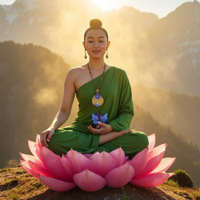 Tara is one of the most widely venerated figures in Mahayana and Vajrayana Buddhism — a bodhisattva who has chosen to remain accessible to beings in need rather than passing beyond into the nirvana she has fully earned. Her name means "star" or "she who crosses" — the one who ferries beings across the ocean of suffering to the shore of liberation. She is known as the Mother of all Buddhas, understood to be the primordial feminine wisdom from which enlightenment itself is born.
Tara's origins are traced in Buddhist tradition to the tears of the bodhisattva Avalokiteshvara — the bodhisattva of compassion — who wept at the vastness of suffering in the world. From those tears of compassion arose Tara, who addressed him directly and promised to work for liberation in female form until not a single being remained in suffering. This origin story is theologically significant: Tara is not a derivative or secondary figure but a bodhisattva who has made an explicit vow, in explicit female form, to continue the work of compassion.
The significance of Tara's vow to work in female form deserves attention. When the monks suggested that she would progress more effectively in male form, she rejected this framing explicitly — pointing out that there is no male or female in ultimate reality, that the distinction belongs to confused minds, and that since beings are caught in this confusion, she would work in female form to demonstrate that enlightenment is equally available from that form. This is one of the earliest and most direct challenges to the subordination of the feminine in Buddhist institutional practice.
Tara is distinguished from Quan Yin (her Chinese Buddhist counterpart) primarily by her active, dynamic quality. Where Quan Yin is depicted in serene contemplation, Green Tara — the most widely venerated form — is shown with one foot extended, poised to rise and respond immediately to calls for help. Her compassion does not wait; it moves.
 Of Tara's many forms, Green Tara and White Tara are the most widely known and most broadly practiced outside the specifically Tibetan Buddhist context.
Green Tara — Swift Active Compassion:
Green Tara is the primary form of Tara in Tibetan Buddhism and the one most associated with swift response, immediate protection, and the removal of obstacles. She is depicted green — the colour of spring growth and active vitality — seated on a lotus with one foot extended and one raised, ready to spring into action at a moment's notice. Her right hand is in the gesture of giving, extended toward those who call to her; her left hand holds a blue utpala lotus at her heart. She is invoked for protection from the eight great terrors (lions, elephants, fire, serpents, robbers, water, imprisonment, and demons — which are also understood symbolically as pride, ignorance, anger, jealousy, wrong views, attachment, doubt, and delusion).
White Tara — Longevity and Healing:
White Tara is the form associated with longevity, healing, compassionate motherly care, and peaceful death and rebirth. She is depicted white — the colour of purity and clarity — with seven eyes: the two ordinary eyes, one on her forehead, and one on each of her hands and the soles of her feet. These seven eyes symbolise her capacity to perceive and respond to suffering in all directions and dimensions simultaneously. She is invoked for healing, for the extension of life when life is needed, and for peaceful passage when death comes.
The Twenty-One Taras:
Tara manifests in twenty-one primary forms, each associated with specific qualities and specific forms of protection or benefit. These include Red Tara (magnetising positive circumstances), Yellow Tara (abundance and prosperity), Blue Tara (transmuting anger), Black Tara (powerful protection), and seventeen others. The Praise to the Twenty-One Taras is one of the most widely recited texts in Tibetan Buddhism, offering devotion to Tara in all her aspects.
 The Lotus:
The lotus appears consistently in Tara's iconography — she sits on a lotus, holds a lotus, and is depicted arising from the lotus that grew from Avalokiteshvara's tear. The lotus, rooted in mud and rising through water to bloom in air and light, is the Buddhist symbol of the spiritual path: arising from the mud of samsara, moving through the waters of practice, blooming in enlightenment without being stained by the conditions from which it arose.
The Utpala Flower:
The blue utpala or night-blooming lotus that Tara holds at her heart is specifically associated with her compassion — blue, the colour of the sky and of the infinite, blooming in the darkness of night when others cannot see.
The Mantra — Om Tare Tuttare Ture Soha:
Tara's mantra is one of the most widely recited in Tibetan Buddhism and is often the first mantra taught to practitioners. The syllables address different dimensions of her activity: Tare liberates from samsara (ordinary, suffering-filled existence); Tuttare liberates from the eight great terrors (inner and outer dangers); Ture liberates from disease and grants the fulfilment of wishes; Soha plants the mantra's meaning in the heart. The mantra can be recited at any time and requires no special initiation for ordinary practice.
Colours:
Green (vitality, active compassion, spring growth), white (purity, clarity, peaceful healing), blue (infinite space, the sky, the depth of compassionate vision).
Working with Tara:
The simplest and most broadly accessible practice is mantra repetition: sitting quietly and repeating Om Tare Tuttare Ture Soha while visualising Tara's compassionate presence. For those drawn to a specific form — Green Tara for active protection, White Tara for healing and longevity — visualisation practices accompany mantra repetition. Tara responds to sincere calling; the practice does not require elaborate ceremony to begin.
Explore More Goddess Archetypes →
Tare — liberation from samsara
Tuttare — liberation from the eight fears
Ture — liberation from disease, granting wishes
Soha — plants the meaning in the heart
This mantra requires no special initiation for ordinary daily practice.
💚 Green Tara:
Swift action, immediate protection, removing obstacles. Foot extended — ready to move. Invoked in danger and difficulty.
🤍 White Tara:
Longevity, healing, peaceful care. Seven eyes seeing suffering in all directions. Invoked for healing and peaceful passage.
When monks suggested she progress in male form, Tara replied: there is no male or female in ultimate reality — but since beings are confused by this distinction, she vowed to work in female form until not a single being remained in suffering.
This is one of Buddhism's earliest explicit challenges to the subordination of the feminine in spiritual practice.