Notifications (Click to mark read)
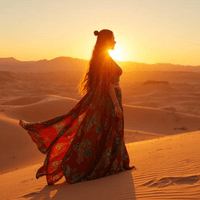 Changing Woman — Asdzą́ą́ Nádleehé in Diné Bizaad (the Navajo language) — is one of the most important Holy People in the Diné (Navajo) spiritual tradition. She is not a historical figure from a distant past; she remains a living presence at the centre of Diné religious life, ceremony, and cultural identity today. The Diné people are a living nation of over 300,000 enrolled citizens whose religious traditions are practised, transmitted, and actively maintained across generations.
This page offers substantive informational context about Changing Woman drawn from publicly available scholarly and cultural sources. It does not provide practices, invocations, or rituals for non-Diné people to adopt. The reasons for that choice are explained below and are worth understanding rather than simply accepting as a policy.
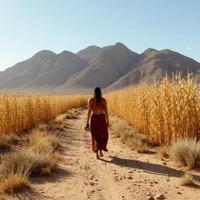 Understanding Changing Woman requires first understanding something about who the Diné people are and what they have survived, because these things are not separable from the religious tradition.
The Diné — the People, as the name translates — are the largest federally recognised Native American nation in the United States by land area and one of the largest by population, with the Navajo Nation spanning approximately 17.5 million acres across Arizona, New Mexico, and Utah. Their oral tradition is among the most extensive in North America, encompassing cosmological narratives, ceremonial knowledge, ethical teaching, and historical memory that has been transmitted across hundreds of generations.
The history of contact between the Diné and the United States government includes the Long Walk of 1864–1868 — in which Kit Carson led a scorched-earth campaign that forced the Diné from their land and killed thousands, followed by forced march to and imprisonment at Bosque Redondo, New Mexico. The Treaty of 1868 that ended this imprisonment and returned some of their land is still in force and is the legal foundation of the Navajo Nation's sovereignty. This is not distant history; there are Diné alive today whose grandparents survived the Long Walk's direct aftermath.
Subsequent decades brought forced boarding school attendance designed to suppress the Diné language and culture ("Kill the Indian, save the man"), livestock reduction programmes that destroyed a significant proportion of Diné wealth and food security, uranium mining on Navajo land whose legacy of radiation poisoning continues today, and ongoing struggles over land rights, water rights, and economic development. The context of this history is essential for understanding why the appropriation of Diné religious traditions by outsiders is not a neutral act of cultural curiosity but something that takes from a community that has already had much taken.
The Diné Nation today is a sovereign government with its own legal system, educational institutions (including Diné College, the first tribally chartered college in the United States), cultural institutions, and actively practised ceremonial traditions. Changing Woman exists within this living context.
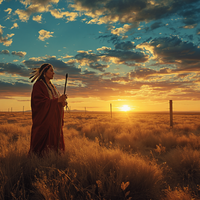 Within Diné cosmology, the universe is understood as having emerged through a series of worlds, with the Diyin Dine'é — the Holy People — shaping and ordering those worlds before human beings came to exist. Changing Woman is among the most significant of the Holy People, and her role in Diné theology is both foundational and ongoing.
Her Name and Nature:
The Navajo name Asdzą́ą́ Nádleehé carries meanings that the English translation "Changing Woman" can only partially convey. The root nádleehé relates to cyclical transformation — the kind of change that is renewal rather than loss, that returns rather than simply departs. She embodies this quality: she ages through the four seasons — young maiden in spring, mature woman in summer, elder in autumn — and returns to youth at winter. This is not metaphor alone; in Diné understanding it is a cosmological fact about the nature of her being.
Creator of the Diné People:
In Diné oral tradition, Changing Woman created the first human beings — the ancestors of the Diné — from the skin she rubbed from her own body, mixed with sacred corn pollen. This origin story is theologically and culturally significant in a way that cannot be overstated: she is not an archetype that the Diné have adopted to represent their values; she is the source from which they understand themselves to have literally come. She is mother of the people in the most direct and consequential sense.
Corn and the Sacred:
Corn — maize — holds a sacred and irreplaceable place in Diné cosmology and ceremonial life. Corn pollen (tádídíín) is used in prayer, in blessing, in ceremony, and in the daily expression of Diné religious life. Changing Woman's connection to corn situates her at the intersection of the sacred and the sustaining — she is the source of both the people and the sacred substance through which they maintain relationship with the Holy People.
Her Union with the Sun and the Hero Twins:
Changing Woman's relationship with Jóhonaa'éí, the Sun, is central to the mythological cycle. Their union produced twin sons: Naayéé' Neizghání (Monster Slayer) and Tó Bájísh Chíní (Born for Water), known collectively as the Hero Twins. Their story — the quest to find their father, receive weapons, and rid the world of the Naayéé' (monsters) who threatened the existence of human life — is one of the central narratives of the Diné ceremonial tradition and informs a significant portion of Diné ritual practice.
The Four Sacred Mountains:
Diné cosmology defines the traditional homeland (Dinétah) through the four sacred mountains — Blanca Peak (Sisnaajiní) in the east, Mount Taylor (Tsoodził) in the south, the San Francisco Peaks (Dook'o'oosłííd) in the west, and Hesperus Mountain (Dibé Ntsaa) in the north. Changing Woman is associated with this bounded, sacred landscape — she is not a universal goddess available to all but a being specifically and intimately connected to a particular land and people.
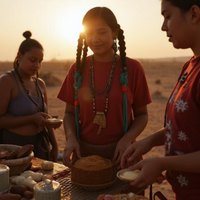 One of the most direct connections between Changing Woman and contemporary Diné life is the Kinaaldá — the coming-of-age ceremony performed for young Diné women at their first menstruation. The Kinaaldá is not a historical tradition that has been revived or reconstructed; it is a continuously practised, living ceremony that is performed in Diné communities today.
In the Kinaaldá, the young woman temporarily embodies Changing Woman — she runs at dawn (emulating Changing Woman's journey), grinds corn, bakes a large ceremonial cake (alkaan) that is shared with the community, and is dressed and adorned by elder women who sing traditional songs and offer prayers. The ceremony lasts approximately four days and involves the extended family and community in ways that transmit values, strengthen relationships, and connect the young woman to the tradition she is entering.
The Kinaaldá encodes teachings about womanhood, responsibility, beauty (hózhó — beauty-harmony-balance, one of the central concepts of Diné philosophy), hard work, community, and the relationship between the individual and the Holy People. These are not abstract teachings but practical and spiritual instruction transmitted through ceremony rather than lecture.
The existence and continuity of the Kinaaldá is one of the clearest demonstrations that Changing Woman is not a figure from mythology alone but a presence that actively shapes Diné life in the present. Any engagement with Changing Woman that treats her as an available archetype or universal goddess is, knowingly or not, disregarding the living community whose ceremonies she anchors.
Many goddess and spirituality websites treat Changing Woman as an archetype available for general adoption — providing practices, invocations, and rituals that draw on her name and stories. This site has chosen not to do that, and the choice is worth explaining honestly.
What appropriation costs:
When a living tradition's sacred figures are extracted from their context and offered as generic spiritual tools, several things happen. The authority of the tradition's own practitioners is displaced — suddenly anyone can claim knowledge of Changing Woman without the years of learning, relationship, and ceremonial participation that actual knowledge requires. Inaccurate and sometimes actively harmful versions of the tradition proliferate. The figure becomes associated with the commercialised spirituality market rather than with the living community. And the message sent to that community is that their sacred things can be taken without asking — which echoes a very long and painful history.
The distinction between learning and adopting:
There is a real difference between reading about a tradition with genuine curiosity and respect — which is what this page aims to support — and constructing personal practices using elements of that tradition without cultural standing or relationship. The first is scholarship and respectful engagement. The second is extraction, however well-intentioned.
On the themes themselves:
The themes associated with Changing Woman — cyclical renewal, the wisdom of natural rhythms, the honouring of life's stages, the relationship between human beings and specific land — are themes that appear richly across many traditions. They are not owned by any culture. What is owned — in the sense of being inextricably embedded in specific relationships, histories, ceremonies, and communities — are the particular forms those themes take in Diné tradition. Those particular forms belong to the Diné people and are not available for appropriation, however respectfully intended.
What you can do:
If you are genuinely drawn to Diné spiritual teachings, the most respectful path is to seek out Diné authors, scholars, and teachers. Support Navajo-owned cultural institutions. Learn Diné history — including the Long Walk, the boarding school era, the uranium mining legacy, and the ongoing work of Navajo sovereignty. Read work by Diné academics and authors who have chosen to share aspects of their tradition publicly. These are appropriate routes. They are also, in many ways, more genuinely enriching than extracting a practice from its context.
Explore More Goddess Archetypes →
Changing Woman is a sacred figure from the living Diné (Navajo) Nation — a sovereign people with over 300,000 citizens whose ceremonies are actively practised today.
This page offers substantive context without providing practices for adoption. The reasons are explained in the final section and are worth reading.
Asdzą́ą́ Nádleehé — her Diné name; "the woman who changes/transforms cyclically"
Diyin Dine'é — the Holy People; the divine beings of Diné cosmology
Hózhó — beauty, harmony, balance; a central concept of Diné philosophy
Kinaaldá — the coming-of-age ceremony for young Diné women; still actively practised
Tádídíín — corn pollen; used in prayer and ceremony throughout Diné life
Dinétah — the traditional Diné homeland, defined by the four sacred mountains
If the themes of cyclical renewal, seasonal alignment, and the honouring of life's stages resonate with you, these traditions have specifically invited wider engagement: