Notifications (Click to mark read)
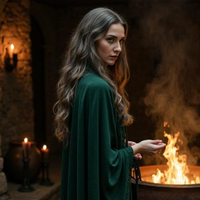 Ceridwen is one of the most compelling figures in Welsh mythology — a enchantress and goddess associated with the magical cauldron, with poetic inspiration (the Awen), and with the fierce, unglamorous work of transformation. She appears primarily in the tale of Taliesin, one of the foundational texts of Welsh bardic tradition, where her role is neither simply benevolent nor simply malevolent but something more psychologically interesting: the force that, in pursuing its own purposes, inadvertently creates the very thing it seeks to prevent.
Ceridwen is not a comfortable goddess. She is not associated with love, abundance, or gentle nurturing — she is associated with the cauldron that brews wisdom through a year of labour, with the relentless pursuit that drives transformation, with the dark feminine intelligence that sees and knows and does not flinch from difficult knowledge. In the triple-goddess framework sometimes applied to Welsh tradition, she is often associated with the Crone aspect — not in the sense of decline but in the sense of the deep, earned, unsentimental wisdom that comes from having passed through the full cycle of experience.
Her primary source is the late medieval Welsh tale known as Hanes Taliesin (The Story of Taliesin), preserved in manuscripts from the 16th century but drawing on material that is considerably older. The story is compact but mythologically dense — every element of it repays careful attention.
 Ceridwen has two children: a daughter of extraordinary beauty named Creirwy, and a son of extraordinary ugliness named Morfran (also called Afagddu — utter darkness). Medieval accounts are frank about Morfran: he is so ugly that no social grace will compensate for his appearance, and Ceridwen, as his mother, determines to give him the one thing that might offset this — the gift of prophetic wisdom and poetic inspiration.
To this end she brews a cauldron of Awen — divine inspiration — following a recipe from the Book of Vergil (a reference to magical texts associated with Virgil in the medieval tradition). The cauldron must be stirred continuously for a year and a day, after which the first three drops that emerge will confer upon the recipient all wisdom, all poetic gift, all prophetic knowledge. The rest of the brew will be poison.
Ceridwen sets a blind man named Morda to tend the fire beneath the cauldron, and a young boy named Gwion Bach to stir it. She herself goes about other business, returning periodically to oversee the process. After nearly a year of this labour, Gwion Bach — stirring the cauldron — receives the three drops on his thumb when they splash out accidentally. He puts his thumb in his mouth reflexively, and receives the gift of Awen that Ceridwen had intended for her son.
In that instant, Gwion Bach gains complete knowledge — including the knowledge that Ceridwen will pursue and destroy him for what has happened. He flees. What follows is one of the great shape-shifting chase sequences in Celtic literature: Gwion transforms into a hare; Ceridwen pursues as a greyhound. He becomes a fish; she becomes an otter. He becomes a bird; she becomes a hawk. He falls into a granary and becomes a grain of wheat among the pile. Ceridwen transforms into a black hen and eats him.
Nine months later, Ceridwen gives birth to a boy of such radiant beauty that she cannot bring herself to kill him, though she had intended to. She places him in a leather bag and throws him into the sea (or, in some versions, into a river). He is found by Elffin, a young nobleman who has come to his foster-father's weir expecting the annual gift of a salmon but finds the bag instead. When he opens it and sees the child's forehead shining, he names him Taliesin — "Shining Brow." The child immediately speaks in complex verse, consoling Elffin for his disappointment with prophecies of the glory that will come from this finding.
Taliesin goes on to become the greatest bard in Welsh tradition — the poet whose voice is heard in the heavens and whose verses contain the memory of the world. He is Ceridwen's creation as surely as if she had intended it.
 The Awen is the central concept of Ceridwen's mythology and one of the most significant concepts in the Welsh bardic tradition. The word derives from the Proto-Celtic *awenā — divine inspiration, poetic gift, the breath of the gods into human creative expression. It is what Ceridwen's cauldron brews; it is what Gwion Bach accidentally receives; it is the gift that makes Taliesin what he becomes.
In the Welsh bardic tradition, the Awen was not understood as a metaphor for creativity but as a genuine divine substance — the actual presence of inspiration experienced as something that comes from outside the ordinary self and passes through the poet rather than originating in the poet. The distinction matters: it means that the great poet is not simply clever or skilled (though skill is required to receive and channel it) but is someone through whom a larger intelligence speaks.
Ceridwen's cauldron is the vessel in which Awen is concentrated through a year of continuous, unglamorous, patient labour. The brewing requires tending the fire, stirring the mixture, and gathering specific ingredients at specific times. This emphasis on patient, skilled, unglamorous work as the precondition for the emergence of divine inspiration is characteristic of the deeper bardic understanding: inspiration does not arrive in the absence of preparation but only to those who have done the long, difficult work of readiness.
The Awen symbol — three rays descending from above, sometimes shown within three circles — is one of the most recognisable symbols in modern Celtic and Druidic spiritual practice. Its three rays are variously interpreted as representing the three domains of land, sea, and sky; the three functions of the bard (preservation of memory, transmission of knowledge, and poetic inspiration); or the three drops themselves that confer the gift.
 The Taliesin tale rewards careful theological attention because Ceridwen's role in it is genuinely paradoxical. She sets out to give her son the gift of Awen; through the accident of the cauldron's drops, her servant Gwion Bach receives it instead; she pursues him with the specific intention of destroying him; she kills him by swallowing him; she bears him as her own child nine months later; she cannot bring herself to kill him and releases him into the world. The greatest bard in Welsh tradition is simultaneously the child she stole the gift from, the child she killed, and the child she bore and could not destroy.
This paradox is not a failure of the narrative but its deepest point. Ceridwen's fierce pursuit and apparent destruction of Gwion Bach is the transformation he required. Without her relentless pursuit, he would have remained Gwion Bach — a boy who accidentally touched divine inspiration but had not been through the process that made him capable of holding it. The shape-shifting chase sequence is an initiation: each transformation strips away another layer of what he was, until the final transformation (the grain eaten by the hen) is an annihilation that makes possible the rebirth as Taliesin.
Ceridwen does not know she is doing this. She is acting from maternal grief and rage at the theft of what she had worked a year to create for her son. The transformation of Gwion Bach into Taliesin is an unintended consequence of her perfectly understandable anger. And yet the result is more significant than anything she had planned: Morfran, had he received the Awen, would have been a wise man. Taliesin, having been pursued through death and rebirth by Ceridwen herself, becomes something more — the voice of collective memory, the poet of the ages.
This is Ceridwen's teaching: the most profound transformations are often not the ones we plan but the ones that emerge from the collision between our fierce intentions and circumstances beyond our control. The cauldron of transformation does not always produce what we put it on to brew.
 Ceridwen's archetype is most directly relevant for people engaged in creative, intellectual, or spiritual work that requires long preparation, that involves genuine darkness, and that is not primarily about comfort or reassurance.
The Cauldron as Practice:
The cauldron Ceridwen tends requires a year and a day of continuous attention — stirring, tending the fire, gathering ingredients at the right times. This is not occasional inspiration; it is sustained, daily, unglamorous labour in service of something that will only emerge after the full period of preparation. Working with Ceridwen's archetype means taking seriously the long preparation that genuine creative or spiritual development requires — the daily practice, the slow accumulation of skill and understanding, the willingness to keep tending the fire when nothing spectacular seems to be happening.
Transformation Through Pursuit:
The shape-shifting pursuit in the Taliesin tale is one of the most vivid mythological representations of how transformation actually works: not through comfortable growth but through the pressure of something that will not stop, that strips away layer after layer of what you have been, until you arrive at something that can no longer be what it was. Working with Ceridwen's archetype means recognising when a fierce pressure in your life — a crisis, a loss, a relentless circumstance — might be less like an attack and more like the pursuit that precedes a necessary transformation.
Dark Wisdom:
Ceridwen sees clearly and does not avert her gaze. Her magic works through honest confrontation with difficult reality rather than through wishful thinking or spiritual bypassing. Working with her energy means developing the capacity to look honestly at what is — in one's own nature, in one's situations, in one's creative work — without the softening that avoidance produces. This is not cruelty but the specific kind of clarity that makes genuine transformation possible rather than merely performed.
Sacred Symbols:
The cauldron — vessel of transformation, requiring sustained tending. The three drops of Awen — inspiration received inadvertently, not through entitlement. The shape-shifting sequence — the stripping away of successive identities. The white sow — Ceridwen's animal form in some tellings, connecting her to earth magic and the cycle of death and new life. Dark colours, moonstone, obsidian. Herbs associated with wisdom and transformation.
Explore More Goddess Archetypes →
The Awen — divine poetic inspiration — was brewed in Ceridwen's cauldron through a year and a day of patient labour.
Only the first three drops conferred the gift. The rest was poison.
Gwion Bach received the drops by accident. The greatest bard in Welsh tradition was an unintended consequence of Ceridwen's work for someone else.
Each transformation strips away another layer. The pursuit is the initiation.
She brewed Awen for one year to give her son a gift he never received.
What emerged instead was Taliesin — greater than she had planned, born from her own fierce pursuit of someone else.
The cauldron does not always produce what you put it on to brew. The most significant transformations are often unintended.