Notifications (Click to mark read)
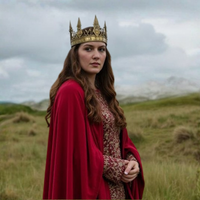 Maeve — Medb in Old Irish, sometimes rendered Méabh in Modern Irish — is one of the most significant and most complex figures in early Irish mythology: simultaneously a historical or pseudo-historical queen of Connacht, a sovereignty goddess whose favour determines the legitimacy of kingship, and a fully realised literary character whose combination of fierce ambition, sexual autonomy, political intelligence, and destructive pride makes her one of the most compelling female figures in early medieval literature anywhere in the world.
She appears primarily in the Ulster Cycle — the body of early Irish prose literature centred on the kingdom of Ulster and its heroes, particularly Cú Chulainn — where she is the primary antagonist of the great epic Táin Bó Cúailnge (The Cattle Raid of Cooley). The Táin is the longest and most important text in the Ulster Cycle, an epic that Irish scholars have sometimes compared to Homer's Iliad in its scope and cultural centrality, and Maeve drives its entire action. The war she initiates, the army she assembles, the determination she maintains across the course of the conflict, and the single-minded pursuit of what she wants regardless of the cost — all of these make her a figure of extraordinary force, whether or not one approves of what she does with it.
Her name, Medb, is cognate with the Old English medu (mead) and is related to the Proto-Celtic root for intoxication — a connection that is not coincidental. In Irish sovereignty theology, the goddess of sovereignty was understood to offer the sacred mead (the drink of the feast) to the rightful king, and this ritual drinking was what conferred kingship. Maeve embodies this function in her person: she is simultaneously the mead that confers sovereignty and the queen whose sexual favour ratifies the king's legitimacy.
 The sovereignty goddess is one of the most important and most distinctively Irish theological concepts in the Celtic tradition. In the Irish understanding, the land itself was feminine — personified as a goddess whose willing union with a king legitimised his rule and ensured the fertility and prosperity of his territory. Without the sovereignty goddess's favour, a king ruled without divine sanction; with it, he was the rightful lord of his land, and the land would flourish under him.
Maeve is the sovereignty goddess in her most fully developed and most politically explicit form. She states this directly in the Táin: she has never been without one man in the shadow of another, meaning she has always had a lover standing by while she was with her current husband. This is not casual promiscuity; it is a theological statement about the nature of sovereignty. The land cannot be monogamously bound to a single king; it gives its favour to whoever is currently worthy of ruling it, and withdraws it when the king fails to meet the standard sovereignty requires.
Her famous list of requirements for a husband reflects the same sovereignty theology: her husband must be without fear, without meanness, and without jealousy. Fear would make him unfit to rule; meanness would dishonour the generosity that kingship requires; jealousy would be an attempt to possess what sovereignty specifically does not allow to be possessed. She chooses Ailill as her husband because he meets these criteria — and the Táin begins precisely when Ailill fails the last criterion, engaging in a competitive comparison of their respective wealth that Maeve will not accept as placing her in a position of inferiority.
The cattle raid itself — the Táin Bó Cúailnge — begins because Maeve and Ailill compare their possessions and discover that Ailill has one more white-horned bull than Maeve has. This comparison is not trivial or comic; in early Irish society, cattle were the primary measure of wealth, and the relative wealth of husband and wife determined the balance of power in their marriage. Maeve will not accept a position of subordination — and rather than receiving the comparison as establishing Ailill's superiority, she immediately sets out to acquire a bull that will make them equal. The bull she wants is the Donn Cúailnge, the great Brown Bull of Ulster, and its owner's refusal to give it to her is the proximate cause of the war.
 The Táin Bó Cúailnge — preserved in manuscripts from the 12th century but drawing on material considerably older, with linguistic features suggesting composition as early as the 7th or 8th century CE — is one of the most remarkable literary achievements of early medieval Europe. Its central action is simple: Maeve of Connacht invades Ulster to seize the Brown Bull of Cooley. Its execution is anything but simple: the text is a complex weave of heroic combat, supernatural intervention, political manoeuvring, tragic friendship, and the most sustained portrayal of a female military commander in early Irish literature.
Maeve assembles a vast army from across Ireland — she negotiates with multiple kingdoms, makes alliances, and promises the hand of her daughter Findabair to several heroes simultaneously (a deception that, when discovered, results in a mass suicide among the deceived heroes). She leads the army personally, directing strategy and tactics throughout the campaign. She is not a figure who sends others to fight while she waits at home; she is present, commanding, and personally courageous.
The Ulster warriors are under a curse — the Debility of the Ulstermen, placed upon them by the goddess Macha — that causes them to fall into the weakness of a woman in labour during their hour of greatest need. The sole exception is Cú Chulainn, who as a child of the gods (his father is Lugh) is immune to the curse. The bulk of the Táin is therefore a series of single combats between Cú Chulainn and the successive champions Maeve sends against him — which he wins — while the main Ulster army is incapacitated.
Maeve's relationship with Cú Chulainn is one of the most interesting in the text. She respects his prowess, attempts to buy him off with the offer of her daughter and her own friendship (a sovereignty offer — the goddess's favour), and when he refuses, continues to press the war by other means. She is not diminished by his individual superiority in combat; she responds with strategy, persistence, and the recognition that a single hero, however great, cannot hold an army indefinitely.
The Táin ends with Maeve's army in retreat, the Brown Bull won and then lost (the two great bulls, once united, fight each other to mutual destruction), and Cú Chulainn victorious but gravely wounded. Neither side has truly won, and the thing that started the war — the bull — no longer exists. The epic's ending is characteristically Irish in its refusal of simple triumph.
 Knocknarea — Cnoc na Ré, the Hill of the Moon or possibly the Hill of the Executions — is a prominent mountain in County Sligo in the west of Ireland, visible for miles across the surrounding landscape. On its summit sits a massive cairn known as Miosgán Méabha — Maeve's Cairn — a Neolithic passage tomb of enormous size, approximately 55 metres in diameter and 10 metres high, that tradition associates with Maeve's burial place. She is said to be buried standing upright, facing Ulster, still in a battle posture.
The cairn has never been excavated, partly because of its cultural significance and partly because its sheer size makes excavation a major undertaking. What lies inside is unknown. What is known is that the summit of Knocknarea commands a view of extraordinary breadth — Sligo Bay, the Ox Mountains, Benbulben, the Atlantic — and that the landscape of Connacht visible from it is precisely the territory that Maeve personifies as sovereignty goddess. To stand at her cairn is to stand at the centre of her domain.
W.B. Yeats, who spent much of his childhood and many of his adult years in County Sligo, was deeply influenced by the local mythology surrounding Maeve and Knocknarea. His poem "The Hosting of the Sidhe" places Maeve — in her supernatural, Otherworld dimension — riding across the landscape with the fairy host. Yeats's engagement with Maeve as a figure of fierce, supernatural feminine power influenced his larger mythological and political poetry in ways that are worth tracing.
Maeve's Enduring Significance:
Maeve endures as a significant figure in Irish cultural and feminist thought because she represents something genuinely unusual in the literary tradition of any culture: a female protagonist who is powerful, politically active, sexually autonomous, and unapologetic about all three. She is not a victim; she is not subordinate to any man; she does not achieve her ends through the kind of indirect, manipulative cunning that literary traditions typically allow women while denying them direct power. She is simply powerful — and the consequences of her power, both for herself and for others, are explored with the complexity they deserve.
Working with Maeve's archetype means engaging with this specific quality of power: the willingness to act from one's own values and desires regardless of whether they are socially approved, the refusal to accept subordination, the territorial and political intelligence that creates and maintains sovereignty. Her story does not present her as wholly admirable — she manipulates, deceives, and causes enormous suffering in the pursuit of her goals — but it takes her seriously as a person of genuine power and genuine consequence, which is itself unusual enough to be worth attending to.
Explore The Morrígan — War, Fate & Prophecy →
The Táin Bó Cúailnge — The Cattle Raid of Cooley — is the longest text in the Ulster Cycle and the central epic of early Irish literature.
Maeve initiates the war to obtain the Brown Bull of Ulster and restore equality with her husband Ailill.
Cú Chulainn defends Ulster alone while its warriors are under the Debility curse.
Neither side wins. The bull is destroyed. The war resolves nothing.
In Irish theology, the land is feminine — a goddess whose willing favour legitimises the king's rule.
Maeve embodies this explicitly: she cannot be possessed; she gives her favour to the worthy king and withdraws it when he fails.
Her list of husband requirements — no fear, no meanness, no jealousy — describes the qualities sovereignty demands.
A mountain summit in County Sligo, Ireland. On it sits Maeve's Cairn — a Neolithic passage tomb 55 metres across, never excavated.
Tradition holds that Maeve is buried standing upright inside it, still facing Ulster.
From the summit, the entirety of Connacht — her domain — is visible to the horizon.