Notifications (Click to mark read)
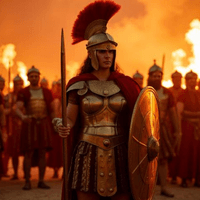 Bellona is one of the most distinct war deities in the Roman pantheon. While Mars governs the force and glory of armed conflict, Bellona embodies its strategic intelligence — the planning, discipline, and ordered resolve that separates purposeful warfare from chaos. Her name derives from the Latin bellum, meaning war, and she was venerated as a divine companion to Roman legions, a presence on the field who sharpened focus, steadied nerves, and confirmed the righteousness of a cause.
In Roman tradition, Bellona was regarded variously as the sister, wife, or companion of Mars. Her temple stood on the Campus Martius outside the sacred boundary of Rome, the pomerium, because war business was conducted beyond the city walls. Ambassadors from foreign powers were received in her temple precinct, and declarations of war were ritually performed by casting a spear across the columna bellica, the war column, into territory symbolising enemy ground.
Bellona's identity also absorbed elements of Cappadocian and Anatolian war goddess traditions through the cult of Ma-Bellona, which spread through the Roman world during the Republic. This eastern connection gave her a wilder, more ecstatic quality that coexisted with her Roman discipline — a combination of strategic clarity and fierce, uncompromising energy that refused to be suppressed.
Sacred Qualities of Bellona:
• Strategic Warfare: Calculated action, planning, and organised effort
• Righteous Courage: The strength to fight for what is genuinely just
• Disciplined Force: Power that is directed, not scattered
• Protection: Defence of the vulnerable, the community, and the sacred
• Righteous Anger: Fury that serves justice rather than ego
• War Ritual: The ceremonial weight of conflict, declaration, and consequence
• Victory Through Resolve: Endurance, commitment, and refusal to abandon just causes
Bellona energy is relevant for anyone who must fight — in the metaphorical sense — against injustice, institutional harm, manipulation, or the slow erosion of what matters. She teaches that effective action requires both passion and structure, and that courage without strategy is just noise.
Bellona in Roman Religion: Temple, Ritual and the Columna Bellica
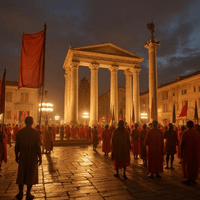
Bellona's place in Roman civic and religious life was highly specific. She was not merely an abstract deity of conflict but a goddess embedded in the actual machinery of Roman statecraft and military ritual. Her temple, the Aedes Bellonae, stood on the Campus Martius near the Circus Flaminius and was reportedly vowed during a battle against the Samnites in 296 BCE by the consul Appius Claudius Caecus.
The Columna Bellica:
Near her temple stood the war column, a short pillar that served as the ritual boundary of symbolic enemy territory. When Rome declared war on a foreign power, the Fetiales, Rome's priestly envoys, would cast a spear over this column into the ground beyond it as a formal declaration of hostilities. The act transformed war from an act of aggression into a sacred and legally sanctioned undertaking. Bellona presided over this threshold moment.
Foreign Diplomacy and War Business:
Because her temple lay outside the pomerium, it was the appropriate location for receiving foreign ambassadors and enemy envoys. War and the negotiations surrounding it were conducted in Bellona's precinct. She was not kept at a comfortable distance from political reality. She was built into it.
The Bellonarii:
With the absorption of the eastern Ma-Bellona cult, Bellona gained a priesthood known as the Bellonarii. These priests performed ecstatic rites that included drawing their own blood with small axes or knives and offering it to the goddess. This practice, striking in the context of Roman religious restraint, suggests that Bellona's eastern aspect carried a quality of radical self-sacrifice — the willingness to bleed for what one serves.
The Festival of 3 June:
Bellona's festival was observed on 3 June, a dies natalis marking the dedication of her temple. It was a day associated with military preparation, cleansing, and the acknowledgement of war's cost alongside its necessity.
Companion to Mars:
In artistic and literary representations, Bellona often appears alongside Mars, her chariot drawn by war horses, her helmet plumed, her expression fiercely purposeful. Where Mars represents the energy of conflict, Bellona represents its direction. Together they form the complete picture of war as both force and intelligence.
Sacred Symbols and Attributes of Bellona

Bellona's symbols are those of organised, purposeful warfare. They speak to readiness, protection, direction of force, and the ceremonial gravity of conflict undertaken for legitimate reasons.
Sword and Shield:
The sword represents the capacity for decisive action and the willingness to cut through what must be severed. The shield represents protection, boundaries, and the defence of what is sacred. Together they express Bellona's core balance: the readiness to both protect and act.
The Spear:
The spear, especially in the context of the columna bellica, represents intention made physical — the formal declaration that a conflict has been acknowledged, named, and committed to. Bellona's spear is not thrown in anger; it is cast with purpose and legal weight.
The War Chariot:
Bellona's chariot represents swift, organised movement — the capacity to act decisively once strategy is clear. Unlike chaotic battle, the chariot moves with direction, maintaining formation even at speed.
The Helmet:
The plumed helmet is a consistent element of Bellona's iconography. It represents readiness and the visible commitment to a protective role. The helmet is worn before the battle begins; it represents prepared resolve rather than reactive panic.
The Torch:
In some representations, Bellona carries a torch, connecting her to the element of fire as a force that both illuminates and destroys. The torch can represent the light of righteous cause burning through the darkness of injustice, or the fire of disciplined fury that refuses to be extinguished.
The War Trumpet:
The tuba or war trumpet announces the beginning of action, calls soldiers to formation, and signals the moment when deliberation ends and commitment begins. It is the sound of transition from planning to execution.
Colors and Elements:
• Deep Red: Blood, courage, sacrifice, and righteous conflict
• Bronze and Steel: Readiness, endurance, military craft
• Gold: Victory, divine favour, the glory of just causes
• Black: The gravity of war, the weight of consequences
• Fire: Righteous fury, illumination, the burning away of what is false
Working with Bellona: Practices for Courage and Strategic Action

Bellona's energy is most useful when you are facing a situation that requires organised, sustained effort — not just a moment of bravery, but the long-form commitment of strategic action. She rewards preparation, clear objectives, and the disciplined channelling of anger into effective movement.
The Declaration Ritual:
Before beginning a major effort — a difficult conversation, a legal challenge, an advocacy campaign, a significant life change — write a single clear statement of what you are fighting for and why it is just. Speak it aloud before a red candle. This mirrors the Roman ritual of formal declaration: naming the conflict gives it weight and direction.
Strategic Mapping:
Bellona does not respond to vague intention. Draw out the situation in full: who is involved, what the objective is, what resources you have, what obstacles exist, and what the first three concrete steps are. War planning is not cynical — it is a form of respect for the difficulty of what you are undertaking.
Anger as Information:
When righteous anger arises, do not suppress it or perform it. Sit with it long enough to ask: what value is being violated? What protection is being demanded? What would disciplined action in service of that value look like? Bellona's fire is most powerful when it is channelled, not discharged.
The Shield Visualisation:
Before entering a hostile environment or difficult confrontation, close your eyes and visualise Bellona's shield in front of you — not to make you invulnerable, but to remind you that you are prepared and that your cause has weight. Enter the space grounded, not reactive.
Honouring the Cost:
Bellona's Bellonarii acknowledged the price of what they served. Before major action, take time to acknowledge honestly what this fight will cost: time, energy, relationship, peace of mind. Acknowledgement is not deterrence; it is the warrior's honesty about what service requires.
Bellona and Ma: The Eastern Dimension

One of the most distinctive aspects of Bellona's history is her syncretism with Ma, the great mother and war goddess of Cappadocia in Anatolia. This merging happened as Rome's sphere expanded eastward and Roman soldiers and merchants encountered the fierce, ecstatic worship of Ma at her great sanctuary at Comana in modern Turkey.
Ma of Comana:
Ma was a goddess of absolute sovereignty and terrible power. Her sanctuary at Comana was one of the wealthiest and most influential religious centres in Asia Minor. Thousands of temple servants, priestesses, and devotees served her in a tradition of intense, embodied worship. She was not an intellectual deity; she was a force.
The Merger:
Roman soldiers returning from eastern campaigns brought the cult of Ma back with them, and over time she was identified with Bellona. The combined figure, sometimes referred to as Ma-Bellona, carried both the civic, strategic weight of the Roman goddess and the wild, sacrificial intensity of the Anatolian one. This made Bellona a more complex figure than many Roman deities — she contained both order and ecstasy.
The Bellonarii in Rome:
The ecstatic priesthood that emerged from this merged tradition was startling by Roman standards. Their practices of ritual self-wounding, their prophetic states, and their visible intensity were tolerated precisely because Bellona's war function gave them legitimacy. They were fierce servants of a fierce goddess.
What This Means Spiritually:
The Ma-Bellona merger teaches that strategic discipline and deep, embodied passion are not opposites. The most effective action often comes from those who feel the cause completely and think about it clearly at the same time. Bellona holds both.
Bellona for Modern Life: Strategy, Justice and the Long Fight

Bellona speaks clearly to anyone engaged in sustained effort against injustice, institutional harm, or forces that erode what is sacred. She is the goddess of the long campaign rather than the single outburst — the archetype for those who have chosen a fight they know will require endurance.
The Organised Fight:
Bellona does not celebrate reactive rage. She supports the kind of anger that has been turned into a plan: the advocacy campaign, the legal challenge, the community organising effort, the sustained refusal to accept what is wrong. She is relevant for activists, lawyers, union organisers, whistleblowers, and anyone building collective resistance to harm.
Leadership Under Pressure:
For those in leadership roles facing sustained opposition, Bellona provides the archetype of the commander who does not break under pressure. She teaches that leaders must be both visible and strategic — willing to stand at the front while also thinking clearly about what comes next.
The Personal Battle:
Not all battles are political. Bellona also supports those fighting personal battles that require sustained effort: recovery, rebuilding after harm, standing firm against repeated pressure to abandon what matters, or protecting someone who cannot protect themselves. The principles are the same — clear purpose, disciplined action, acknowledgement of cost.
When to Declare and When to Wait:
The columna bellica ritual was not impulsive. War was declared formally, after deliberation, with ritual weight. Bellona teaches discernment about timing: when the cause is just and the moment right, act with full commitment. When neither condition is met, preparation is not delay — it is strategy.
After the Fight:
Bellona was also present in the aftermath. Victory required acknowledgement, cleansing, and the restoration of civil order. When a fight ends — won or lost — Bellona asks what must now be rebuilt, what must be grieved, and how the community returns to sustainable life.
Explore More Goddess Archetypes →
Select your warrior intention:
Declaration Prayer:
"Bellona, I name what I am fighting for. My cause is just. My preparation is complete. Grant me the discipline to act with strategy and the courage to hold my ground."
Before Hard Action:
"Let my anger serve clarity, not chaos. Let my strength serve protection, not pride. Let this effort end with order restored."
After the Fight:
"The field is held. May what was broken now be repaired. May what was defended now be honoured."
Bellona's teachings:
Useful times for Bellona's energy:
Best focus: clear purpose, disciplined action, and restoration after conflict.