Notifications (Click to mark read)
 Hera is one of the central figures of Greek mythology: daughter of Cronus and Rhea, sister and wife of Zeus, and queen of Olympus. Ancient traditions associate her particularly with marriage, legitimate union and the status of women within family and society. Her myths are often difficult, especially those shaped by Zeus's repeated infidelities and Hera's anger towards his lovers and their children. Read carefully, they reveal a goddess of immense authority whose stories explore power, status, loyalty and the unequal conditions of divine marriage.
Qualities associated with Hera:
• Sovereignty and authority: A theme for reflection and understanding
\n • Commitment and the obligations of marriage: A theme for reflection and understanding
\n • Dignity and self-respect: A theme for reflection and understanding
\n • The complexity of loyalty: A theme for reflection and understanding
\n • Protection of legitimate union: A theme for reflection and understanding
\n • The consequences of unequal power: A theme for reflection and understanding
\n
Hera is relevant to reflection on partnership, commitment, personal dignity, boundaries and the social expectations placed upon women. Her myths should not be reduced to a simple ideal of the perfect wife: they contain conflict, pain, political power and contradictions.
Hera's Place Among the Olympians

Hera is the daughter of Cronus and Rhea and, in the dominant Olympian tradition, the wife of Zeus. As queen of the gods she possesses rank and authority in her own right. Her worship was important at major sanctuaries including Argos and Samos, and her significance reaches beyond the familiar stories of her marriage. She was honoured as a powerful goddess whose sphere touched marriage, women and the ordering of society.
The Marriage of Hera and Zeus

The marriage of Hera and Zeus is presented in myth as a divine union, but it is far from an uncomplicated romance. Zeus's affairs repeatedly provoke Hera's anger, and many stories describe her pursuing or punishing those connected with his infidelity. These narratives reflect ancient ideas about marriage and divine power; they should not be treated as a model for healthy relationships. They also invite questions about what loyalty means when respect and equality are absent.
The Peacock, Sceptre and Pomegranate
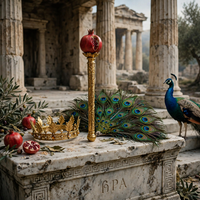
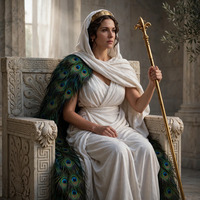
Hera is commonly represented with a diadem or crown and a sceptre, signs of royal authority. The peacock became one of her most recognisable sacred animals, while the cow and cuckoo also appear in ancient associations. The pomegranate is linked with marriage and fertility in later and broader symbolic traditions. Images of Hera enthroned emphasise her sovereignty, not merely her relationship to Zeus.
Reflecting with Hera: Commitment and Self-Respect
A Hera-inspired reflection asks what makes a commitment meaningful. Consider the promises you have made, the expectations placed upon you, and whether respect is mutual. Where a relationship or responsibility has become unequal, ask what boundaries would restore dignity. Commitment is not the same as tolerating harm, and loyalty does not require abandoning self-respect.
Hera in Modern Life
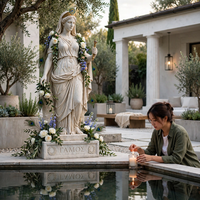
Hera's mythology can illuminate the pressures surrounding marriage, public identity, partnership and women's authority. She can be approached as a figure through whom to examine the difference between status and genuine respect, or between the appearance of a successful union and the reality within it. Her stories are most useful when their difficult elements are acknowledged rather than softened.
Symbols and Attributes
Diadem or crown and sceptre as signs of sovereignty; peacock, cow and cuckoo in ancient traditions; pomegranate in marriage and fertility symbolism. The precise importance of individual symbols varies across periods and local cults.
A Simple Reflective Practice
Write down what commitment means to you in practice, not simply in principle. Identify three qualities that must be mutual in any lasting partnership, and one boundary that protects your dignity. Consider whether your actions and expectations reflect those values.
Offerings and Contemporary Observance
Ancient Hera worship varied by place and festival. A modern reflective gesture might be a written promise to act with integrity, a flower arrangement, or a moment recognising a relationship built on mutual respect. These should be understood as contemporary personal practices, not a reconstruction of one universal ancient rite.
Explore More Goddess Archetypes →
Select a theme for reflection:
What does this goddess's story bring into focus for you?
Read the myths in their historical and cultural context. Different ancient authors and communities sometimes tell different versions of the same story.