Notifications (Click to mark read)
 Selene is the Greek goddess who personifies the Moon itself. In ancient poetry she travels across the night sky in a chariot, bringing her light to the darkened world. Hesiod names her as a daughter of the Titans Hyperion and Theia, and sister of Helios, the Sun, and Eos, the Dawn. She is sometimes confused with Artemis or Hecate, who also acquired lunar associations, but Selene has a distinct identity in early Greek poetry: she is the Moon made divine.
Qualities associated with Selene:
• Rhythm and recurring cycles: A theme for reflection and understanding
\n • Reflection and quiet observation: A theme for reflection and understanding
\n • The passage of time: A theme for reflection and understanding
\n • Light within darkness: A theme for reflection and understanding
\n • Change and renewal: A theme for reflection and understanding
\n • The relationship between distance and longing: A theme for reflection and understanding
\n
Selene is a natural focus for reflection on changing rhythms, night-time quiet, the passage of time and the way perspective shifts when viewed from a distance. Lunar symbolism can be used poetically without assuming that moon phases determine personality or events.
Selene's Origins and Celestial Journey
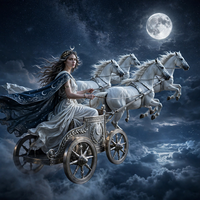
In Hesiod's Theogony, Selene is born to Hyperion and Theia, alongside Helios and Eos. Ancient images show her riding a horse or driving a chariot across the heavens. Her light marks the passage of the lunar month and gives the night a visible rhythm. Unlike Artemis, who became strongly associated with the Moon in later traditions, Selene is directly identified with the lunar body in early poetic sources.
Selene and Endymion
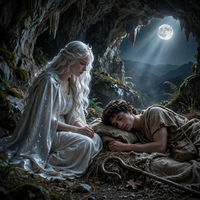
Selene's best-known love story concerns Endymion, a beautiful young man placed in eternal sleep. The versions differ: some say Zeus granted him his choice of fate, while others emphasise Selene's visits to him as he sleeps. The story has been read as an image of longing, beauty held outside ordinary time, and the distance between a divine being and a mortal life. It is also an unsettling myth when considered through the question of consent and the power imbalance between immortal and mortal.
The Moon's Chariot and Lunar Symbols
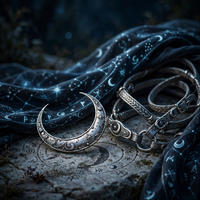
Selene is commonly shown with a crescent or lunar crown and a flowing cloak that catches the light. Her chariot is drawn by horses in many depictions, though oxen also appear in some traditions. The changing phases of the Moon gave ancient communities a way to mark months and organise festivals. Her symbolism therefore connects celestial observation with timekeeping and the rhythms of human life.
Reflecting with Selene: Cycles and Perspective

Observe the Moon over several evenings, noting its changing appearance without assigning a fixed meaning to each phase. Alongside each observation, write what is changing in your own life. Look for patterns over time rather than forcing a conclusion from one night. The practice is an exercise in attention and perspective, not prediction.
Selene in Modern Life

Selene offers a way to think about cycles without treating change as failure. A project, relationship or period of life may wax, reach fullness, wane and begin again. The Moon's visible changes also remind us that what appears incomplete from one viewpoint may be part of a larger pattern. Her myth encourages patient observation rather than hurried judgement.
Symbols and Attributes
The lunar crescent or crown; the shining cloak; a horse or chariot; the full Moon. The Moon is her defining attribute, and ancient sources connect her with the measurement of lunar months.
A Simple Reflective Practice
For one lunar month, observe the Moon when it is visible and record its shape, position and brightness. Add one sentence about something in your life that is developing, changing or coming to an end. At the end of the month, read the entries together and look for patterns.
Offerings and Contemporary Observance
Ancient practices connected with Selene varied, and she was not worshipped in exactly the same way everywhere. A modern reflective gesture might be quiet observation of the Moon, a written record of its phases, or a poem. Avoid presenting contemporary lunar rituals as established ancient Greek practice.
Explore More Goddess Archetypes →
Select a theme for reflection:
What does this goddess's story bring into focus for you?
Read the myths in their historical and cultural context. Different ancient authors and communities sometimes tell different versions of the same story.