Notifications (Click to mark read)
Hindu Goddess of Wealth, Beauty, and Spiritual Grace
Lakshmi is one of the most widely venerated goddesses in the Hindu tradition — present in temples, homes, and businesses across South and Southeast Asia, invoked daily in prayers for prosperity, wellbeing, and spiritual grace. She is the goddess of wealth, but the understanding of wealth in her tradition is considerably broader than the material sense the word carries in contemporary Western usage. Lakshmi presides over all eight forms of abundance: material wealth, knowledge, strength, victory, children, food, gold, and liberation itself. The last of these — moksha, spiritual liberation — is understood in Vaishnavism as the highest gift she can bestow.
She is the consort of Vishnu, the preserver of the universe, and her relationship with him is one of the most theologically significant partnerships in the Hindu pantheon. Where Vishnu maintains cosmic order, Lakshmi provides the abundance and grace that makes life within that order worth living. She is not subordinate in this relationship — she is its other half. The tradition holds that where Vishnu goes, Lakshmi follows; where Lakshmi is present, Vishnu is not far away.
Origins and the Churning of the Ocean
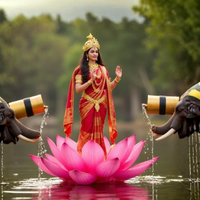
The most celebrated account of Lakshmi's origin is the myth of Samudra Manthan — the churning of the cosmic ocean. In this story, the gods and the demons cooperated to churn the ocean of milk using Mount Mandara as a churning rod and the great serpent Vasuki as a rope, in order to produce amrita, the nectar of immortality. As the churning proceeded, various treasures and beings emerged from the depths. Among them was Lakshmi herself, rising from the waters on a fully bloomed lotus, radiant and complete, holding lotus flowers in her hands while celestial elephants poured water over her from golden vessels.
She chose Vishnu as her consort in that moment, garlanding him with a lotus wreath, and the two have been inseparable in the tradition ever since. This origin story captures several essential qualities: her emergence from the depths is associated with the purification of what was previously churned and troubled; her appearance is spontaneous and complete, not formed by another's hand; and her first act is one of sovereign choice — she selects her partner rather than being assigned one.
In some traditions Lakshmi is said to be much older than this myth suggests, existing before the churning as Sri — the abstract principle of auspiciousness and abundance — who took form as Lakshmi in the Vaishnava tradition. The Rigveda contains early hymns to Sri, suggesting that the qualities Lakshmi embodies were recognised and venerated long before they were consolidated into her specific form.
The Eight Lakshmis: Ashtalakshmi
The tradition of Ashtalakshmi — the eight forms of Lakshmi — is one of the most theologically rich aspects of her worship. Each form represents a distinct dimension of abundance, and together they constitute a complete picture of what genuine prosperity means within the Hindu framework.
Adi Lakshmi is the primordial form, the original manifestation of the goddess as the consort of Vishnu and the source of all other forms. Dhana Lakshmi governs material wealth and coins — the abundance that comes from honest work and right action. Dhanya Lakshmi presides over agricultural abundance, the fertility of the earth and the sufficiency of food. Gaja Lakshmi is associated with power and royal dignity, represented with elephants and the kind of strength that sustains kingdoms.
Santana Lakshmi governs the abundance of children and lineage — the continuation of life. Veera Lakshmi or Dhairya Lakshmi is the form associated with courage and strength in adversity, the inner resource that sustains a person through difficulty. Vijaya Lakshmi governs victory — not merely in battle but in all endeavours undertaken with righteous purpose. And Vidya Lakshmi presides over knowledge and wisdom, reminding the tradition that education and understanding are forms of wealth as real and as valuable as any material resource.
Lakshmi and Diwali
The festival of Diwali — the festival of lights — is the most significant occasion of Lakshmi worship in the Hindu calendar. Celebrated in autumn at the new moon of the month of Kartik, it is the night when Lakshmi is believed to move through the world, entering homes that are clean, bright, and welcoming. Households light lamps and diyas (small oil lamps) to guide her, clean and decorate their homes, and leave their doors open as an invitation.
The association of Lakshmi with light, cleanliness, and welcome is significant. She does not enter places of neglect, stagnation, or darkness — not as a moral judgment but as a reflection of her nature. Abundance, in this understanding, flows where there is active care, attention, and gratitude. The Diwali practice of cleaning the home before lighting the lamps is a physical enactment of the inner preparation that invites grace: clearing what is heavy and stagnant, creating space for what is luminous to enter.
The Owl: Lakshmi's Vehicle
Lakshmi's vahana — her vehicle or mount — is the owl, which is an unusual and often misunderstood aspect of her iconography. In many traditions the owl is associated with ill omen, but in Lakshmi's case it carries a specific meaning. The owl sees clearly in the dark. It is associated with the wisdom to perceive what others cannot, with the capacity to find abundance and opportunity even in conditions of apparent scarcity or obscurity.
There is also a cautionary dimension to the owl association. An owl that faces away from Lakshmi — that looks away from the light she embodies toward only the darkness — represents the misuse of wealth: the blind accumulation that loses sight of abundance's spiritual dimension and becomes mere hoarding. The owl facing toward Lakshmi represents the right relationship with prosperity: using the capacity for clear sight in the service of genuine abundance rather than mere possession.
Lakshmi as an Archetype
As an archetype, Lakshmi represents the quality of graceful abundance — the capacity to attract, receive, and circulate prosperity without grasping or hoarding. Her energy is associated with the understanding that abundance is a natural state, not a scarce resource to be competed for. She embodies the principle that what we genuinely care for and tend to flourishes, and that the orientation of gratitude and welcome is itself a form of preparation for what we hope to receive.
She is also an archetype of beauty as a spiritual quality — not mere appearance but the radiance that comes from genuine alignment between inner and outer. Her iconography always shows her as luminous, adorned, complete — not performing beauty but embodying it as a natural expression of her nature. This is a useful distinction for those working with her energy: the invitation is not toward surface decoration but toward the kind of inner ordering and care that naturally expresses itself outward.
The energy she carries is particularly relevant for anyone navigating a relationship with material abundance — either working to invite more into their life, or working to hold what they have with appropriate gratitude and generosity rather than anxiety and attachment.
Working with Lakshmi
Lakshmi is an active and living presence in the Hindu tradition, worshipped daily by many millions of people. Approaching her with genuine respect for the depth and continuity of that tradition — rather than as a generic prosperity symbol — is the appropriate starting point for anyone outside of Hinduism who feels drawn to her energy.
Her day is Friday, and Friday evening is a traditional time for Lakshmi puja — a devotional practice involving light, flowers, incense, and the chanting of her names or the Lakshmi Ashtakam, a devotional hymn in her honour. The lotus is her primary symbol, and keeping fresh flowers, particularly pink or red ones, in the home or on an altar is a simple and appropriate gesture of welcome.
Keeping a home clean and well-ordered, ensuring there is always some food available to share, and practising genuine gratitude for what is already present are the foundational attitudes that the tradition associates with inviting her energy. She is not summoned by elaborate ritual from a position of lack — she is welcomed from a position of genuine care for what already exists.
Citrine, green aventurine, and pyrite are appropriate crystals for an altar in her honour. A gold or yellow candle, lit on a Friday evening with a clear and genuine intention, is a simple starting point. What she responds to, above all, is sincerity and gratitude — the recognition that abundance is already present in some form, and the genuine desire to use it well.
Her mantra, widely used in devotional practice: Om Shri Maha Lakshmyai Namah — a salutation to the great Lakshmi, offered with respect and an open hand.