Notifications (Click to mark read)
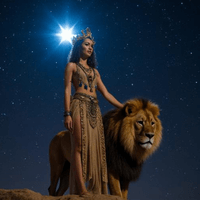 Inanna is the oldest extensively documented goddess in human history. Her hymns, myths, and liturgical texts are preserved in cuneiform on clay tablets from ancient Sumer (modern southern Iraq), some dating to approximately 2300 BCE — meaning she has a written record stretching back more than four thousand years. The hymns composed in her honour by Enheduanna, the high priestess of Ur and daughter of Sargon of Akkad, are the earliest signed literary works by a named author in the historical record. Inanna's mythology is not a recently reconstructed or speculative tradition; it is among the best-documented religious traditions of the ancient world.
She is the Queen of Heaven — Nin-anna in Sumerian, the lady of the sky — and her domain is comprehensive and paradoxical in ways that distinguish her from the more narrowly defined goddesses of later traditions. She governs love and war simultaneously; she is the goddess of the morning star and the evening star (both identified with the planet Venus in Mesopotamian astronomy); she controls the me — the divine laws and sacred powers that govern civilised life — which she famously steals from Enki, the god of wisdom, and brings to her city of Uruk. She is simultaneously the most powerful and the most vulnerable figure in her mythology: the goddess who descends to the underworld and is killed, who is restored to life through the intervention of her servants, and who sends her own beloved husband Dumuzi to the underworld in her place.
Her Akkadian name and counterpart is Ishtar — the same goddess known by a different name in the Akkadian and Babylonian traditions that absorbed and continued Sumerian religious culture after the fall of the Sumerian city-states. The two are sufficiently identified that they are treated as one figure across much of the scholarship, though there are subtle differences in emphasis between the Sumerian Inanna and the Akkadian Ishtar.
 The most remarkable fact about Inanna's literary tradition is not simply its antiquity but the identity of its primary author. Enheduanna — whose name means "ornament of the heavens" — was the daughter of Sargon of Akkad, the first empire-builder in recorded history, and served as high priestess of the moon god Nanna at Ur in the 23rd century BCE. She composed two long hymns to Inanna — the Hymn to Inanna and the Exaltation of Inanna (also known as Inninsagurra) — that survive on clay tablets and represent the earliest known literary compositions attributed to a named individual.
What makes Enheduanna's hymns theologically significant is not only their age but their content. The Exaltation of Inanna is in part autobiographical — Enheduanna describes being driven from her position by a political usurper, appealing to Inanna for intervention, and being restored. The hymn moves between cosmic description of Inanna's powers and intimate personal supplication in ways that feel remarkably direct across four millennia. Enheduanna addresses Inanna as someone she knows, whose power she has witnessed, and whose help she genuinely needs.
Enheduanna's hymns establish Inanna's theological position with great clarity: she is supreme among all the gods, feared even by An (the sky god) and Enlil (the lord of earth and air), capable of overriding all other divine decisions. She is described in terms that emphasise her absolute, terrifying power alongside her capacity for love and protection of those she favours. The famous opening of the Hymn to Inanna — "Lady of all the divine powers, resplendent light, righteous woman clothed in radiance, beloved of heaven and earth" — sets a tone that the rest of the text sustains with remarkable consistency.
The existence of Enheduanna as a real historical figure who composed texts about Inanna from a position of personal devotion and political engagement gives Inanna's tradition a quality that most ancient goddess mythologies lack: a documented human voice speaking about her experience of the goddess, from inside the tradition, from more than four thousand years ago.
 The Descent of Inanna to the Underworld is the most theologically complex and most psychologically rich text in the Sumerian literary corpus. It is the direct antecedent of the Akkadian Descent of Ishtar, the Greek Persephone myth, and multiple other ancient descent narratives — arguably the single most influential myth in the development of Western religious and philosophical thought about death, rebirth, and transformation.
The text opens with Inanna — at the height of her power, queen of heaven and earth — making a decision to descend to the Great Below, the underworld ruled by her sister Ereshkigal. The text is specific that this is Inanna's choice: she "set her ear to the Great Below," meaning she turned her attention and intention toward it. Why she chooses to descend is not entirely clear in the text — various interpretations have been offered — but the fact of her choosing is emphasised. This is not a forced descent; it is a deliberate entry into the realm of death.
Before descending, Inanna arms herself with all seven of her divine powers (the me) worn as adornments: a crown, lapis lazuli beads, a breastplate, a golden ring, a measuring rod, a lapis lazuli rod, and a royal robe. She instructs her servant Ninshubur to wait for her and, if she does not return in three days, to petition the great gods for her rescue.
At each of the seven gates of the underworld, Inanna is stopped by the gatekeeper Neti, and at each gate she is required to remove one of her divine powers. By the time she reaches the throne of Ereshkigal in the deepest realm of the dead, she has been stripped of everything — naked and "bowed low" before her sister. Ereshkigal kills her. Inanna is hung on a hook in the underworld, dead.
Three days and three nights pass. Ninshubur follows her instructions, petitioning the gods. Enki — the god of wisdom and compassion — alone agrees to help. He creates two small beings from the dirt under his fingernail, gives them the food of life and the water of life, and sends them to the underworld. They gain entry by empathising with Ereshkigal's pain — the queen of the dead, it turns out, is in agony, mourning, suffering. The small beings simply witness her pain, saying "Woe" in sympathy each time she cries out. Touched, Ereshkigal offers them a gift; they ask for Inanna's corpse. They revive her with the food and water of life.
But no one ascends from the underworld without providing a substitute. Inanna must name someone to take her place. She returns to the upper world escorted by demons, and everywhere she passes, the people and gods are mourning and humbled in her absence — everywhere except where her husband Dumuzi, the shepherd king, is sitting on his throne in full regalia, not mourning at all. Inanna, who had loved him passionately, turns her death-gaze on him. The demons take him to the underworld in her place.
The myth does not end there. Dumuzi's sister Geshtinanna, in grief, negotiates with Inanna: she will take her brother's place for half the year. Inanna accepts. Dumuzi spends half the year in the underworld (the dry, barren season) and half the year above ground (the fertile season). This seasonal alternation — rooted in the relationship between Inanna, Dumuzi, and the underworld — is the Sumerian explanation of the agricultural cycle.
 One of the most culturally revealing texts in the Inanna cycle is the story of Inanna and Enki — the tale of how Inanna acquired the me, the divine powers and sacred laws that govern civilised life, from the god of wisdom.
The me are an extraordinary list — more than a hundred attributes of civilised existence, ranging from kingship, godship, and truth to descent to the underworld, the scribal arts, musical instruments, the craft of the smith, the art of the fuller, the standard and the quiver, the flood, weapons, sexual intercourse, prostitution, law, and libel. Together they constitute everything that distinguishes human civilisation from the chaos that preceded it.
In the text, Inanna travels to visit Enki, the god of wisdom, at his dwelling in Eridu. Enki, enchanted by her and perhaps rather drunk on sacred beer, gives her the me as gifts. She loads them onto her Boat of Heaven and sails back toward her city Uruk. Enki, sober and alarmed at what he has given away, sends his servants to recover the me. Inanna refuses to return them, and eventually arrives in Uruk where she distributes the me to her city.
The theological significance of this story is considerable: the powers of civilisation do not simply reside with male wisdom but are actively sought and secured by the Queen of Heaven, who brings them to the human world. Inanna's city Uruk — the largest and most important city of the Sumerian world, the city of Gilgamesh — is civilised by her agency. The story is not a critique of Enki but a strong statement about Inanna's role as the active, acquisitive force that makes human flourishing possible.
 Inanna's mythology offers one of the richest and most psychologically precise bodies of material for working with the archetype of the full-spectrum feminine — the divine force that encompasses love and war, descent and return, complete power and complete vulnerability, the capacity to love passionately and to send the beloved into death without mercy.
The Descent as Framework:
The Descent of Inanna is the oldest and in many ways the most psychologically sophisticated framework available for understanding periods of profound crisis, loss, or transformation. The myth is precise about several things that modern psychological frameworks also recognise: that some descents are chosen (Inanna sets her ear to the Great Below), that the descent requires giving up everything you have relied on (the seven garments stripped at the seven gates), that in the deepest place there is nothing left but the naked self confronting its own mortality, and that restoration requires something that is not your own power — the small compassionate beings sent by Enki, who restore Inanna not by fighting Ereshkigal but by witnessing her pain.
The element of compassionate witness is particularly striking. Ereshkigal — the dark sister, the queen of death, the one who kills Inanna — is not overcome by force or out-argued or tricked. She is heard. Her pain, which has not been witnessed because she rules in darkness where no one voluntarily goes, is acknowledged. And this acknowledgement is what makes Inanna's restoration possible. The teaching encoded here about the relationship between the light and dark aspects of the feminine — and about what the dark aspect actually needs — is more sophisticated than most modern psychological frameworks for shadow integration.
Full-Spectrum Power:
Inanna does not specialise. She is simultaneously the goddess of erotic love and the goddess of war; she governs both the most tender and the most destructive dimensions of human experience without apology. Working with her archetype means developing the capacity to hold a full range without reducing oneself to a partial version — to be capable of both love and fierceness, both vulnerability and power, without requiring that only the comfortable aspects be expressed.
Sacred Symbols:
The eight-pointed star — her symbol as the planet Venus, the morning and evening star. The lion — her sacred animal, the creature that embodies the combination of power and beauty she represents. The reed bundle — symbol of her role as patron of the sacred marriage. Lapis lazuli — the blue stone of the Mesopotamian world, associated with heaven, royalty, and divine power. The date palm — the most important food plant of Mesopotamia, whose cultivation she governs.
Explore Ishtar — Inanna's Akkadian Form →
At each gate of the underworld, Inanna surrenders one divine power:
Naked and bowed low before her sister. Everything stripped. The descent is complete.
High priestess of Ur, daughter of Sargon of Akkad. Approximately 2300 BCE.
Author of the Hymn to Inanna and the Exaltation of Inanna — the oldest signed literary works by a named individual in the historical record.
"Lady of all the divine powers, resplendent light, righteous woman clothed in radiance..."
Ereshkigal — the dark sister, queen of the dead — is not defeated by Inanna's restoration. She is heard.
The small beings sent by Enki restore Inanna by witnessing Ereshkigal's pain. Not by overpowering her. Not by arguing with her. By saying "Woe" when she cries out.
The dark aspect does not need to be conquered. It needs to be witnessed.