Notifications (Click to mark read)
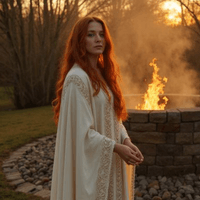 Brigid is one of the most beloved and enduring figures in Irish and Celtic tradition. She is a goddess of fire in its three sacred forms — the flame of the forge, the flame of the hearth, and the flame of inspiration — and her presence spans the worlds of creativity, healing, craftsmanship, and poetry. As a member of the Tuatha Dé Danann, she is the daughter of the Dagda and one of the most culturally persistent divine figures in the Irish tradition.
What makes Brigid unusual among mythological figures is the continuity between her ancient form and her later Christian expression as Saint Brigid of Kildare. The two figures share the same name, the same festival date of 1 February, the same eternal flame tended by women, the same associations with healing, wells, craft, and poetry. Whether this represents conscious adaptation or genuine spiritual continuity, the effect is that Brigid has never truly left the cultural memory of Ireland and the Celtic world.
Brigid's flame was tended at Kildare for centuries, first by priestesses and later by the nuns of the Abbey of Kildare. The flame was extinguished during the Reformation but relit in 1993 by the Brigidine Sisters and continues to burn today. This unbroken quality — the flame that returns, the goddess who persists, the inspiration that will not be extinguished — is central to understanding what Brigid represents.
Sacred Qualities of Brigid:
• Poetic Inspiration: The fire that illuminates creative and artistic work
• Healing: Compassionate restoration of body, mind, and spirit
• Smithcraft: The transformative fire of skilled craft and making
• Sacred Wells: The healing waters that accompany her flame
• Protection: The Brigid's cross as a ward for home and threshold
• Imbolc: The turning of winter toward spring, the first signs of return
• Persistence: The flame that is relit, the creative drive that survives difficulty
Brigid energy is particularly relevant for those engaged in any form of creative work, healing practice, or skilled making. She does not demand grand gestures. She responds to the kept flame — the daily return to the work, the persistent tending of what matters.
Brigid in Irish Mythology: The Dagda's Daughter

In the early Irish texts, Brigid appears as a goddess of considerable standing within the Tuatha Dé Danann, the divine people of Ireland. She is named in Cath Maige Tuired and other mythological cycle material, and the tenth-century Cath Maige Tuired account describes her lamenting her son Ruadán — the first keening heard in Ireland — after he is killed in battle. This moment is mythologically significant. It connects Brigid directly with the origins of the Irish mourning tradition, and it gives her a dimension of grief and love that grounds her fire in deep human emotion.
Daughter of the Dagda:
Brigid's father is the Dagda, the great god of abundance, skill, and wisdom. This parentage places her among the most powerful figures of the Tuatha Dé Danann and aligns her creative and healing capacities with the broader theme of divine craft and nourishment that the Dagda embodies. Her gifts are not ornamental; they are functional and vital.
The Triple Brigid:
Cormac's Glossary, a ninth-century Irish text, describes Brigid as a triple figure: three sisters sharing the name, each governing one of her three sacred domains — poetry, healing, and smithcraft. This tripling is a common device in Celtic mythology, suggesting a divine function so essential that it requires more than a single form to express it fully.
Brigid and Ruadán:
The story of Brigid's son Ruadán, forged by his father Bres to act against the Tuatha Dé Danann, and killed in the attempt, contains grief, betrayal, divided loyalty, and the impossible position of loving across the line of conflict. Brigid's keening — her cry of mourning — became the origin of that practice in Ireland. She is not untouched by loss. Her fire has survived grief.
Wells and Water:
Brigid is also associated with sacred wells throughout Ireland, the most famous being Tobar Bhríde near Kildare. The pairing of fire and water in her mythology is not a contradiction; it represents the two fundamental elements of healing. Fire cleanses, purifies, and transforms. Water soothes, nourishes, and restores. Brigid holds both.
The Eternal Flame: Kildare and the Fire That Persists
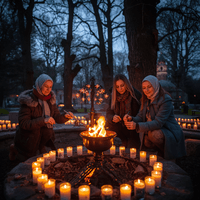
The sacred flame at Kildare is one of the most remarkable pieces of living continuity in European religious history. Before Christianity, Kildare — Cill Dara, the Church of the Oak — was a sacred site associated with Brigid. When Saint Brigid founded her monastery there in the fifth century, the flame continued. It was tended by nineteen women, each keeping it for a day before it passed to the next, with the twentieth day given to Brigid herself, after which it miraculously remained alight without tending.
The Fire Keepers:
The tradition of women tending a sacred flame pre-dates Christianity in Ireland and connects Brigid to the broader Indo-European tradition of the vestal fire — the maintained hearth that represents the living continuity of a community's spirit. To tend the flame was not merely a ritual act; it was a statement that inspiration, healing, and creative power had not been extinguished.
Extinguishing and Return:
The flame was put out during the dissolution of the monasteries under Henry VIII and was not relit for centuries. Its return in 1993 by the Brigidine Sisters is itself a mythologically resonant act — the relit flame after a long darkness, echoing the pattern of Imbolc itself: winter's end, the return of light, the fire that could not be permanently lost.
Imbolc and the Turning of the Year:
Brigid's primary festival is Imbolc, observed on or around 1 February. It marks the midpoint between the winter solstice and the spring equinox — the first signs that the year is turning. Snowdrops appear. Ewes begin lactating. The light is measurably returning. Imbolc is not dramatic; it is subtle. It asks for attention, not spectacle. Brigid's fire is appropriate for this moment: steady, tended, persistent rather than explosive.
The Brigid's Cross:
Made from rushes, the Brigid's cross is traditionally woven at Imbolc and hung at the threshold of the home for protection. Its four-armed form connects it to both the sun's movement and the four directions. The making of the cross is itself a ritual act, the hands working with natural materials in a pattern inherited across generations.
Sacred Symbols and Attributes of Brigid
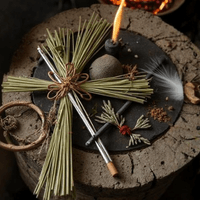
Brigid's symbols are connected with fire, water, making, and the threshold between seasons and states. They are practical as well as sacred — many of them arise from the actual materials of Irish daily and ritual life.
The Sacred Flame:
Fire is Brigid's central symbol in all three of its forms: the forge fire of transformation, the hearth fire of nourishment, and the poetic fire of inspiration. In practice, a candle or small flame kept during creative or healing work can serve as a point of connection with her energy.
The Brigid's Cross:
The woven rush cross is both protective symbol and seasonal marker. Making one is itself an act of honouring Brigid — the hands working with the land's materials at the threshold of the new year.
Sacred Wells:
Water and healing are deeply paired in Brigid's mythology. Sacred wells associated with her are found across Ireland and the Celtic world, and water from these sites has traditionally been used for blessing and healing. The well represents the depth beneath the surface, where healing work actually happens.
The Anvil and Hammer:
Brigid's smithcraft aspect is represented by the tools of the forge. These symbols speak to the willingness to subject raw material — including the self — to intense transformation through skilled effort. The anvil receives; the hammer shapes. Together they produce what could not exist without both.
The Swan:
Swans appear throughout Celtic mythology as creatures of grace, beauty, and liminal power, comfortable in both water and air. Associated with Brigid's poetic aspect, the swan represents the voice that carries across boundaries — the song that can be heard in more than one world.
The Mantle:
Saint Brigid's cloak appears in several protective legends. The mantle of Brigid represents hospitality, shelter, and the generous extension of warmth to those who need it. In practice it can represent the creative space that a person builds to protect their work and their vision.
Colors and Elements:
• Flame Red and Orange: Inspiration, transformation, creative fire
• Gold: The sun's return, sacred radiance, poetic clarity
• White: Healing, purity, the clean beginning at Imbolc
• Green: The first growth, the healing herbs, spring's return
• Fire and Water: Transformation and restoration working together
Working with Brigid: Practices for Creativity, Healing and Craft
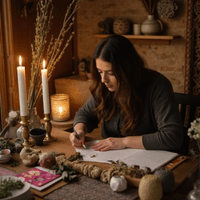
Connecting with Brigid does not require elaborate ceremony. She is a goddess of daily tending — the kept flame, the returned-to work, the consistent small practice rather than the occasional grand gesture. Her energy responds to sincerity, persistence, and honest craft.
The Daily Creative Flame:
Light a candle before beginning creative work and let it burn for the duration. This small act establishes intention and marks the time as sacred. No invocation is required beyond the acknowledgement that this work is being done with care and offered to something larger than productivity.
Imbolc Practice:
On or around 1 February, clear a creative space, light a white candle, and name the creative or healing work you are committing to for the year ahead. Weave a Brigid's cross from rushes or paper if you can. The act of making is itself the practice.
Blessing Your Tools:
Hold the tools of your craft — pens, brushes, instruments, medical equipment, cooking implements, whatever your hands use to create or heal — and ask Brigid to bless them. This is not superstition; it is the conscious alignment of your intention with the purpose of the object.
The Healing Well Practice:
Fill a bowl with clean water. Hold your hands over it and ask that it carry Brigid's healing quality. Use it to wash your hands before healing work, or simply to mark the beginning of a session of compassionate attention. The ritual acknowledges that healing is not performed from above; it flows through.
Poetic Tending:
Read poetry aloud regularly — not to analyse it, but to let language move through the body as sound. This is an ancient practice, and Brigid's poetic fire is fed by it. If you write, commit to writing even a single sentence daily. The flame must be tended to keep burning.
Brigid for Modern Life: The Kept Flame in a Distracted World

Brigid's mythology speaks with particular force to the conditions of modern creative and healing life. In a world structured around distraction, speed, and output, Brigid represents the counter-principle: the tended flame, the patient craft, the work that requires return and repetition before it becomes excellent.
The Creative Long Game:
Brigid does not represent the viral moment or the sudden breakthrough. She represents the years of practice that make the breakthrough possible. Her fire at Kildare burned for centuries. She teaches that meaningful creative work is cumulative — built through daily tending rather than occasional inspiration.
Healing as Vocation:
For those in healing professions — medicine, therapy, bodywork, counselling, pastoral care — Brigid offers a framework for understanding the work as sacred service rather than a service transaction. She also speaks to the importance of the healer's own restoration: you cannot tend a flame indefinitely without being renewed yourself.
The Craft Ethic:
Brigid's smithcraft aspect supports anyone engaged in skilled making — coding, carpentry, cooking, music, design, or any discipline that requires the patient development of technical skill alongside creative vision. She distinguishes between work that is merely produced and work that is genuinely crafted.
Creative Blocks:
When the creative fire goes out, Brigid's mythology offers the most honest response: the flame was extinguished for centuries and was relit. Blocks are not failures. They are the dark period before the relighting. The question is not why the fire went out but what is needed to bring it back.
Threshold Moments:
Imbolc is a threshold festival — not the full arrival of spring but its first signal. Brigid presides over those moments when change is not yet visible but has already begun beneath the surface. She is the right presence for the early stages of a project, a healing, or a life change: when the commitment is real but the outcome is not yet apparent.
Explore More Goddess Archetypes →
Select your sacred flame:
Before Creative Work:
"Brigid, keeper of the sacred flame, kindle the fire of inspiration within me. May this work be honest, careful, and worthy of the craft."
For Healing:
"May the healing that flows through my hands carry warmth without burning, depth without overwhelming, and restoration without demand."
At Imbolc:
"The flame returns. The year turns. I name what I am tending this season and commit to its care."
Brigid's principles:
Best times for Brigid's energy:
Best focus: daily tending, patient craft, and persistent creative return.