Notifications (Click to mark read)
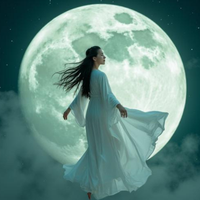 Chang'e is one of the most beloved figures in Chinese mythology and one of the few major moon deities in world religion who is a woman presiding alone over the celestial body. Her story is ancient, emotionally complex, and resistant to simple moral interpretation. It involves heroism, loss, sacrifice, ambiguity, and a form of transcendence that is not entirely chosen — yet becomes, over centuries of cultural reflection, associated with luminous beauty, longing, and the particular kind of wisdom that comes from separation and solitude.
She is venerated during the Mid-Autumn Festival, Zhongqiu Jie, one of China's most important traditional celebrations, held on the fifteenth day of the eighth lunar month when the moon is at its fullest and brightest. On this night, families gather to share mooncakes, light lanterns, and gaze at the moon — and Chang'e is at the centre of the ritual imagination. She looks down from the lunar palace, the Guanghan Palace, accompanied by the Jade Rabbit, and the sight of the full moon becomes an occasion for reflection on reunion, separation, and what endures across distance.
Chang'e is not a simple figure of comfort. Her mythology carries genuine ambiguity about choice, consequence, and the relationship between personal action and larger fate. Different versions of her story assign different motivations and different emotional tones to her ascent. This complexity is part of what makes her a rich archetype for modern spiritual practice — she does not offer easy answers but holds the tension between love and transcendence, duty and desire, the human and the celestial.
Sacred Qualities of Chang'e:
• Lunar Wisdom: The reflective, cyclical intelligence of the moon
• Transformation: The irreversible change that comes from a defining choice
• Immortality: The transcendence of ordinary limitation through spiritual depth
• Sacred Solitude: The wisdom that can only be found in separation and stillness
• Sacrifice: The giving up of something precious for a purpose larger than comfort
• Longing: The emotional intelligence of yearning, loss, and continued love across distance
• Luminous Presence: Beauty that shines steadily without requiring an audience
Chang'e energy is relevant for those navigating major transitions, grief, enforced solitude, spiritual transformation, or the aftermath of an irreversible choice. She does not promise resolution. She offers companionship in the long, luminous distance.
The Myth of Chang'e: Flight to the Moon
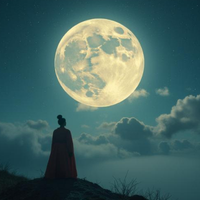
The myth of Chang'e exists in multiple versions, each preserving a different emotional tone and assigning different weight to her agency and her guilt. This plurality is important: it means the tradition itself has never settled on a single interpretation of what she did and why, leaving the story open to continued reflection.
The Ten Suns:
The story begins with the archer Hou Yi, Chang'e's husband, who was a divine hero celebrated for shooting down nine of the ten suns that once scorched the earth simultaneously. This act saved humanity but angered the Jade Emperor, who stripped Hou Yi and Chang'e of their immortality and sent them to live as mortals. In this version, their earthly life begins as a consequence of Hou Yi's heroism — they have already sacrificed their divine nature for the world's sake.
The Elixir of Immortality:
Hou Yi eventually obtained an elixir of immortality from the Queen Mother of the West, Xiwangmu. The elixir could restore immortality to one person, or if shared, grant both of them a lesser form of continued life. Hou Yi intended to share it with Chang'e when the time was right. He stored it in their home.
The Moment of Choice:
The accounts diverge here. In some versions, a villainous apprentice named Fengmeng broke into the house while Hou Yi was away and threatened Chang'e to hand over the elixir. Rather than allow it to fall into dangerous hands, she swallowed it herself. In other versions, Chang'e took the elixir of her own deliberate choice — from ambition, from longing to return to her divine nature, or from a decision that has never been fully explained. The ambiguity is preserved across the tradition.
The Ascent:
After swallowing the elixir, Chang'e began to rise. She ascended through the sky and came to rest on the moon, the celestial body nearest to earth. She could not return. In the Guanghan Palace — cold, silent, and radiant — she remained, accompanied only by the Jade Rabbit, who grinds the herbs of immortality with a mortar and pestle.
Hou Yi's Response:
Hou Yi, on learning what had happened, looked up at the moon and saw Chang'e there. He set out offerings of the foods she loved. His grief became the origin of the lunar offerings made on the Mid-Autumn Festival. The separation was permanent, but the love was not extinguished — it became the moon itself, bright and present and unreachable.
The Mid-Autumn Festival and Chang'e's Living Tradition
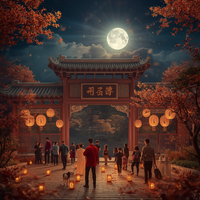
Chang'e is not only a mythological figure preserved in ancient texts. She is a living presence in Chinese culture through the Mid-Autumn Festival, one of the most widely observed traditional celebrations in the Chinese-speaking world. The festival falls on the fifteenth day of the eighth lunar month, when the full moon is at its largest and most luminous.
Zhongqiu Jie:
The Mid-Autumn Festival has been celebrated in China for over a thousand years, with roots extending even further into harvest traditions connected with lunar observation. In its current form it is an occasion for family reunion, lantern lighting, mooncake sharing, and moon-gazing. The full moon on this night is understood as a symbol of completeness and reunion — and the longing for Chang'e, alone on the moon, gives the celebration an undertone of bittersweet reflection alongside its warmth.
Mooncakes:
The round mooncakes exchanged at Mid-Autumn Festival symbolise the full moon and, by extension, wholeness, family unity, and the hope of reunion. They are dense, richly filled pastries that come in many regional varieties. The offering of mooncakes to Chang'e at lunar altars is a traditional act of acknowledgement and connection.
Lanterns:
Children carry lanterns on the night of the festival, lighting paths and filling gardens with soft colour. The lanterns mirror the moon's light, bringing celestial brightness down to the human level. In some traditions, paper lanterns are floated on water or released into the sky.
Chang'e and Modern China:
The cultural resonance of Chang'e extends into contemporary China. China's lunar exploration programme is named the Chang'e Programme, and each successive lunar probe carries her name into space. The tradition of the moon goddess has become the name of the country's actual lunar missions — a striking continuity between ancient myth and modern science.
Respectful Approach:
Because Chang'e belongs to a living religious and cultural tradition in China and among Chinese communities worldwide, spiritual engagement with her should be approached with genuine respect. Learning her mythological context, her festival, and her cultural meaning provides a grounded foundation for working with her as an archetype.
Sacred Symbols and Attributes of Chang'e
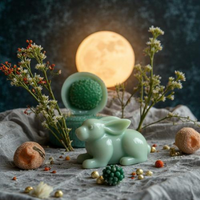
Chang'e's symbols are lunar, celestial, and rooted in Chinese artistic and spiritual tradition. They speak to transformation, longevity, beauty, and the particular quality of light that the moon offers — reflected, steady, and present even in darkness.
The Full Moon:
The full moon is Chang'e's primary symbol. It represents completeness, illumination, the visible face of what is hidden, and the cyclical nature of all things. In practice, the full moon — and particularly the full moon of the Mid-Autumn Festival — is the most powerful time to work with her energy.
The Jade Rabbit:
The Jade Rabbit, Yutu, is Chang'e's constant companion on the moon, grinding the elixir of immortality in a mortar and pestle. The rabbit is associated with the moon across many Asian traditions and represents patience, gentle endurance, and the quiet alchemical work of transformation. It also gives the moon a quality of companionship — Chang'e is alone but not entirely without presence.
The Elixir of Immortality:
The pill or elixir that Chang'e swallowed represents the decisive act that cannot be undone — the choice, deliberate or forced, that permanently transforms. In spiritual practice it can symbolise any irreversible threshold: a commitment, a loss, a transformation that has already happened.
Osmanthus Flowers:
The osmanthus tree is said to grow in the lunar palace, and its delicate fragrance is associated with autumn and with the moon. Osmanthus flowers represent beauty that persists in cool, remote conditions and the refinement of sensory experience in solitude.
Flowing White Robes:
Chang'e is traditionally depicted in long, flowing white or silver robes that suggest movement between worlds, the graceful acceptance of transformation, and the aesthetic of the celestial rather than the earthly. White in Chinese tradition is associated with mourning and with transcendence.
Jade:
Jade is deeply embedded in Chinese spiritual and cultural life as a stone of virtue, immortality, and connection between the human and divine. The Jade Rabbit, the jade palace, and Chang'e's own association with jade all speak to the quality of enduring refinement.
Colors and Elements:
• Silver and Pearl White: Lunar radiance, purity, celestial distance
• Soft Blue: The night sky, cool stillness, the space between worlds
• Gold: The moon at its fullest, warmth within the cold
• Jade Green: Immortality, virtue, enduring beauty
• Water and Moon: Reflection, cyclical renewal, the visible and the hidden
Working with Chang'e: Practices for Transformation and Lunar Wisdom
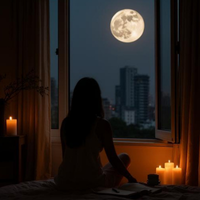
Chang'e is best approached during the full moon, with simplicity, sincerity, and a willingness to sit with complexity rather than resolve it. Her energy is not about quick transformation; it is about the slow, luminous process of integrating a decisive change.
Full Moon Offering:
On the full moon, place offerings of fruit, flowers, or mooncakes on a windowsill or outdoor surface where moonlight can reach them. Sit quietly and acknowledge what you are in the process of transforming. You do not need elaborate ritual — the attention itself is the practice.
Moonlight Reflection Practice:
On a clear night, sit in moonlight or near a window where the moon is visible. Bring to mind something you have left behind — a relationship, a version of yourself, a path not taken. Hold it with the same quality the moon holds the earth: present, luminous, not grasping.
The Irreversible Threshold:
When facing or having passed through a major, irreversible change, write about it without trying to resolve it into a lesson or a silver lining. What was lost? What was transformed? What is the quality of the distance now? Chang'e's myth does not end with reconciliation; it ends with luminous presence at a remove.
Sacred Solitude Practice:
Choose one period of deliberate solitude each lunar cycle — an evening, a morning, a few hours. Use this time not for productivity but for the kind of reflection that only happens in stillness. Ask what the solitude is clarifying.
Mid-Autumn Festival Observance:
On the fifteenth day of the eighth lunar month, however you mark it, acknowledge Chang'e. Share food with others if possible. Look at the moon. Let the festival's combination of reunion and longing be a meditation on what endures across distance.
Chang'e for Modern Life: Transformation, Solitude and What Endures
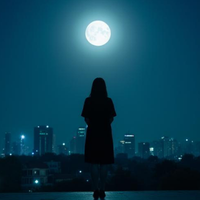
Chang'e's mythology speaks to experiences that are genuinely difficult to talk about: the aftermath of irreversible choices, the particular loneliness of having changed in ways others have not, and the strange beauty that can develop in sustained solitude. She is an archetype for transformation that does not resolve neatly.
After the Irreversible Choice:
Many people carry the weight of choices they cannot undo — relationships ended, paths abandoned, words said or unsaid. Chang'e does not offer a path back. She offers a model for inhabiting the consequences with luminosity: present, steady, and continuing to shine despite the distance.
The Loneliness of Transformation:
When a person changes significantly — through grief, spiritual development, illness, recovery, or major life transition — they can find themselves at a remove from the people they love. The closeness that existed before is not always recoverable in exactly the same form. Chang'e holds this experience without false comfort.
Solitude as Practice:
Chang'e's palace is cold and still. Her solitude is real. But within it she has the Jade Rabbit, the grinding of the elixir, the quality of moonlight itself. In modern terms, sustained solitude — whether chosen or circumstantial — can be inhabited as a space of genuine depth rather than merely endured as absence.
Sacrifice for a Larger Purpose:
In the version of her myth where she takes the elixir to prevent it falling into harmful hands, Chang'e acts from a form of protective courage. She accepts personal loss to prevent a larger harm. This dimension of her mythology speaks to those who have made costly choices in service of something they believed mattered.
Lunar Rhythm as Anchor:
The moon's phases provide a consistent, reliable rhythm for those navigating difficult transitions. Chang'e's association with the lunar cycle suggests working with the moon's rhythm as a framework for reflection: new moon for new intentions, full moon for acknowledgement and release, waning moon for integration.
Explore More Goddess Archetypes →
Select your lunar intention:
Full Moon Offering:
"Chang'e, I see you in the moon's light. I place this offering with gratitude and acknowledge the distance between where I stand and where I long to be."
For Transformation:
"What has changed in me cannot be undone. Help me inhabit it with grace and let what has been lost become light."
For Solitude:
"In this stillness I am not empty. I am preparing. Let the quiet deepen into wisdom."
What Chang'e teaches:
Best times for Chang'e's energy:
Best focus: transformation, solitude, lunar reflection, and the beauty of what endures.