Notifications (Click to mark read)
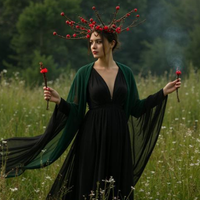 Persephone is one of the most psychologically rich and theologically significant figures in Greek mythology — the goddess who is simultaneously the bringer of spring and the Queen of the Dead, the daughter whose annual absence produces winter and whose annual return produces flowering. Her myth is the central narrative of the Eleusinian Mysteries, the most important initiation rites of the ancient Greek world, attended by hundreds of thousands of initiates over a period of nearly two thousand years.
Her name may derive from the Greek meaning "she who brings destruction" or "she who is struck" — but in practice she is most consistently referred to as Kore (the Maiden) before her descent and as Persephone (the Queen) after it. This naming distinction is itself significant: the myth encodes the understanding that the descent into the underworld produces a genuine change of identity, not merely a change of location. The one who returns is not the same as the one who descended.
The myth's basic structure is ancient and appears in related forms across the ancient Near East — in the descent of Inanna/Ishtar, in the story of Osiris. But the Greek version, elaborated most fully in the Homeric Hymn to Demeter (approximately 7th century BCE), has particular qualities worth attending to carefully, because many contemporary goddess spirituality presentations of it significantly alter or romanticise what the text actually says.
The Homeric Hymn describes Persephone as a young woman picking flowers in a meadow when the earth opens and Hades takes her below against her will. Her mother Demeter — the goddess of grain and earth's fertility — searches for her in grief, and while she searches, nothing grows. The world faces famine. Zeus eventually intervenes and orders Hades to return Persephone, but because she has eaten pomegranate seeds in the underworld, she must return there for a portion of each year. During her months below, Demeter withdraws her gifts and winter comes.
 The Persephone myth has been interpreted in multiple ways across two and a half millennia, and it is worth knowing the range of these interpretations rather than settling on any single reading as definitively correct.
The Eleusinian Reading:
The Eleusinian Mysteries — the initiation rites held at Eleusis near Athens — were centred on the Demeter-Persephone myth and promised their initiates an altered relationship to death. We know very little about the specific content of the Mysteries (initiates were bound by a strict oath of secrecy), but ancient sources consistently suggest that what was revealed there changed the initiate's understanding of what death means and what lies beyond it. In this reading, Persephone's descent and return is a model for the soul's own journey: the willingness to go into darkness and the understanding that return is possible.
The Seasonal Reading:
The most obvious reading of the myth is as an explanation of the seasons: Persephone's presence above ground produces spring and summer; her absence produces autumn and winter. This is a fertility myth encoded in narrative form. What makes it more interesting than a simple nature allegory is the emotional complexity of the story — the grief of the mother, the apparent arbitrariness of the abduction, the irrevocability of the pomegranate seeds — which suggest that the ancients understood the natural cycle not as a simple and comfortable rhythm but as something that involves genuine loss and genuine return.
The Feminist Rereading:
Contemporary feminist mythology has often reinterpreted the abduction as a shamanic initiation undertaken by choice, presenting Persephone as actively choosing her descent rather than being taken against her will. This rereading has genuine psychological value — it transforms the myth from a story of victimisation into a story of initiation — but it does require acknowledging that it departs from what the ancient text actually says. The Homeric Hymn is explicit that Persephone did not choose to go. The rereading can coexist with this knowledge; it simply needs to be honest about being a contemporary interpretation rather than the ancient original.
The Pomegranate:
Perhaps the most psychologically interesting element of the myth is the pomegranate. Persephone eats the seeds — in some versions willingly, in others unknowingly — and this eating binds her to the underworld. The pomegranate is a fruit of the dead, and eating it makes her one of them in a particular way. Many commentators have read this as representing the irrevocability of genuine experience: once you have known something, you cannot un-know it. The initiate who has descended cannot return as though the descent never happened.
 The Pomegranate:
The pomegranate — its seeds red as blood within white pith, enclosed in a tough, structured rind — is Persephone's primary symbol and one of the most ancient symbols of the underworld in Mediterranean cultures. Its seeds bind her to the underworld; they also represent the seeds of new life contained within apparent death, and the specific wisdom that can only be gained through the underworld experience.
Narcissus and Spring Flowers:
It is picking narcissus that Persephone is doing when Hades takes her — the flower opens the earth beneath her. Narcissus is a flower of both spring and death in ancient symbolism, appearing in both this myth and in the myth of Narcissus himself. As a spring flower, it represents the first emergence after winter; as a death flower, it represents the thinness of the boundary between the worlds at the liminal moments of seasonal transition.
Wheat and Grain:
Through her mother Demeter, Persephone is connected to grain and to the agricultural cycle. Her return produces the growth of grain; her absence produces its withdrawal. Wheat sheaves represent the abundance that her presence above ground enables.
The Crown of the Underworld:
As Queen of the Dead, Persephone bears the crown and authority of the underworld. This symbol of hard-won sovereignty — earned through the experience of descent, not inherited from birth — represents the specific quality of power that comes from having survived what seemed unsurvivable.
Colours:
Deep purple and black (the underworld, the darkness that precedes return), spring green and white (the return, the flowering), pomegranate red (the binding knowledge, the seeds of new life within apparent death).
 Persephone's archetype is most directly relevant for those in the specific experience her mythology describes: the descent — whether chosen or unchosen — into a period of darkness, difficulty, or loss, and the question of how to navigate it and what to bring back.
The myth makes a particular claim that is worth holding clearly: the descent changes you irrevocably. The pomegranate seeds are not undone. The person who returns is not the same as the person who descended, and pretending otherwise — rushing back to the surface self as quickly as possible, performing a return to normality before the integration has happened — is a form of spiritual dishonesty that the myth does not support. Persephone becomes Queen of the Dead; she does not return to being Kore.
The Descent as Metaphor:
Grief, depression, major loss, trauma, serious illness, the dark night of the soul — all of these share the phenomenological quality of descent: the world above continues while one is absent from it in some essential way, withdrawn into an inner territory that others cannot fully access. Persephone's archetype does not promise that this experience is comfortable or quick. It does suggest that it is navigable, that it has a quality of meaningful structure rather than being simply random suffering, and that what is gained in the underworld is worth having.
Shadow Work:
Persephone's sovereignty is specifically sovereignty over the underworld — over the territory of what is hidden, what has died but not been released, what lies beneath ordinary consciousness. Working with her archetype in shadow work means developing willingness to look at these territories with genuine curiosity rather than either voyeuristic intensity or defensive avoidance. The Queen of the Dead is not afraid of what she governs; she knows it intimately.
Seasonal Alignment:
Working with Persephone across the seasonal cycle — acknowledging autumn as descent time, winter as underworld time, spring as return — connects individual cycles of withdrawal and renewal with the larger natural pattern she embodies. This does not require dramatic ceremony; it requires honest attention to what each season actually calls for.
The Return:
Persephone's return to the world above is not a return to innocence but a return with knowledge — with what the underworld taught, with the pomegranate's wisdom, with the authority of one who has ruled the dead. Working with her archetype in periods of emergence means asking what was learned in the descent and how it changes what is possible above ground.
Explore More Goddess Archetypes →
🌸 Spring — Return: Emergence with the wisdom gained below. Not the same as before.
☀️ Summer — Above ground: Full presence, the abundance that return enables.
🍂 Autumn — Descent begins: The turning inward, the preparation for darkness.
❄️ Winter — Underworld: The territory of shadow, of what lies beneath. The work done in darkness.
The pomegranate seeds cannot be un-eaten. Genuine experience is irrevocable.
The one who returns from the underworld is not the same as the one who descended. Persephone becomes Queen; she does not return to being Kore.
What is gained in descent is worth having — but it changes what is possible above ground.
In the Homeric Hymn to Demeter, Persephone does not choose her descent — she is taken. Contemporary interpretations often present this as a chosen initiation.
Both readings have value. The ancient version acknowledges that some descents are not chosen. The modern reading offers agency in how they are navigated. Both deserve to be known.