Notifications (Click to mark read)
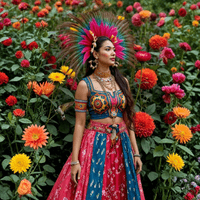 Xochiquetzal (pronounced show-chee-KET-zal) is one of the most distinctively characterised goddesses in the Aztec pantheon — unusual among Mesoamerican deities in being consistently depicted as young, beautiful, and associated with pleasure rather than with the cosmic forces of destruction and warfare that dominate so much of Aztec theology. Her name in Nahuatl combines xochitl (flower) and quetzal (the iridescent green bird whose feathers were among the most prized luxury materials in Mesoamerica), giving her name a meaning something like "Precious Feather Flower" or "Flower Quetzal" — a name that encodes both natural beauty and high value.
She governs the domain of beauty in a comprehensive sense: the beauty of flowers, of human physical attractiveness, of skilled artistic work, of erotic love, of the domestic arts — weaving, embroidery, the crafting of beautiful objects. She is patron of artisans working in beautiful materials: weavers, silversmiths, painters, sculptors. In the Aztec understanding, the capacity to create beauty was itself a divine gift, and Xochiquetzal was the source and patron of that gift.
Her domain also includes sexuality and fertility — and the Aztec treatment of these is notably less shame-laden than the European Christian tradition that eventually colonised Mesoamerica. Xochiquetzal was patron of both committed partnerships and of sex workers, without moral distinction between them; she governed the domain of erotic love as a legitimate and important aspect of human and divine life. Her iconography in the codices reflects this openly: she is depicted as alluring, richly dressed, associated with flowers whose symbolic relationship to sexuality was explicit in Nahuatl culture.
It is worth noting at the outset that our knowledge of Xochiquetzal comes primarily through sources that were either created or transcribed after the Spanish conquest — the Florentine Codex compiled by Bernardino de Sahagún in the 16th century, the Codex Borgia, the Codex Ríos, and other post-conquest manuscripts. Some pre-conquest pictorial manuscripts survive, but the textual elaboration of Aztec mythology was largely filtered through the colonial encounter. This shapes what we know and how we know it.
 Xochiquetzal's mythological biography is complex and somewhat contradictory across different sources — a characteristic of Aztec deity traditions generally, where the same god could have multiple, sometimes inconsistent stories across different regional and ceremonial contexts.
Origins in Tamoanchan:
Xochiquetzal is said to have been born in and to have dwelled in Tamoanchan — the paradise of the west, described in the sources as a place of lush vegetation, flowering trees, and divine abundance. Tamoanchan is linguistically Mayan rather than Nahuatl (the Aztec language), reflecting the Aztec tradition's incorporation of older Mesoamerican religious elements. It is one of thirteen heavens in the Aztec cosmological structure and is associated with creation, fertility, and the origins of humanity.
The Abduction by Tezcatlipoca:
One of the most significant mythological narratives involving Xochiquetzal concerns her abduction by Tezcatlipoca — the lord of the night sky, of dark magic, of the smoking obsidian mirror through which he could see all things. In versions of this story recorded in post-conquest sources, Xochiquetzal was originally the wife of Tlaloc, the rain god; Tezcatlipoca, attracted by her beauty, abducted her and made her his companion, installing her as goddess of love. The story encodes a shift in cosmological order — a disruption of established relationships — and is one of several Aztec narratives that explain the current state of the world through a history of divine conflict and rearrangement.
The Xochitlicacan — The Flowering Tree:
A significant mythological act attributed to Xochiquetzal is her role in cutting the Xochitlicacan — the Flowering Tree, the tree of paradise — which in Aztec cosmology effectively ended the immortality of the other gods. This act parallels the transgressive garden narratives found in several religious traditions: the action that disrupts a prior state of perfection and introduces the condition of mortal, temporal existence. Interestingly, rather than demonising Xochiquetzal for this act, the Aztec tradition treats it as simply part of the cosmological sequence.
Twin Relationship with Xochipilli:
Xochiquetzal is paired with a male counterpart — Xochipilli, the Flower Prince — who shares her domain of beauty, flowers, love, and the arts. Their twinning reflects the Aztec theological tendency toward male-female complementarity in divine pairs, and Xochipilli's specific associations (with male erotic love, with ecstatic states, with the intoxicating plants used in ceremony) complement Xochiquetzal's domain without duplicating it.
Mother of Cintéotl:
In some sources, Xochiquetzal is the mother of Cintéotl, the corn god — a connection that places her beauty and fertility in direct relationship with the agricultural sustenance of life. The corn god's birth from a goddess of flowers and erotic love reflects the Aztec understanding of these forces as continuous rather than separate: the same generative principle that produces beauty and desire also produces the corn that sustains life.
 Xochiquetzal's iconography in the surviving codices is distinctive and consistent — she is identifiable across multiple manuscripts by a recognisable set of attributes.
Flowers:
Flowers are Xochiquetzal's primary symbol, appearing throughout her iconographic representations — in her headdress, in her hands, surrounding her figure. In Nahuatl culture, the symbolic connection between flowers and sexuality was explicit: flowers were understood as evoking the vulva and the clitoris, making Xochiquetzal's floral association a direct statement about her domain rather than a genteel euphemism. The same symbolic logic extends to the quetzal bird's feathers — iridescent, luxurious, precious — which are also part of her name and imagery.
The Weaving Spindle:
Xochiquetzal is frequently depicted with weaving tools — the spindle and loom that are the instruments of textile production. Weaving in Mesoamerican culture was far more than a domestic craft; it was a skilled art whose products were among the most valued luxury goods in Aztec society, and it carried strong associations with feminine creative power. The spindle's shape also carried a symbolic connection to fertility and pregnancy — the spindle growing more rounded as work progressed paralleled the swelling of the pregnant belly.
Rich Garments and Adornment:
Unlike most Aztec goddesses, who are often depicted in austere or terrifying forms, Xochiquetzal consistently appears richly dressed, adorned with jewellery, wearing elaborate headdresses. This visual distinction marks her as specifically associated with luxury, beauty, and the pleasures of material life — a deliberate contrast with the more severe aspects of the Aztec pantheon.
Butterflies and Hummingbirds:
Both of these creatures appear in Xochiquetzal's iconographic context. Butterflies — xochitl in Nahuatl also signifies butterfly — were associated with the souls of warriors who had died in battle, now dwelling in the paradise of Tamoanchan. Their presence in Xochiquetzal's imagery connects her beauty to the sacrificial dimension of Aztec religious life. Hummingbirds, with their extraordinary speed and their intimate relationship with flowers, are natural symbols for the erotic and the beautiful.
Colours:
Red, yellow, and gold — the colours of flowers and sunlight. The iridescent green of quetzal feathers. The rich colour palette of luxury textile production.
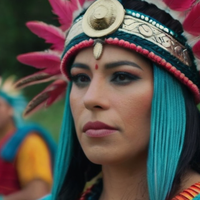 Xochiquetzal was honoured in several ceremonial contexts in the Aztec calendar, the most significant of which was the Atamalqualiztli — a festival held once every eight years, dedicated to the renewal of agricultural fertility. The eight-year cycle corresponds to the Venus cycle, the planet associated with beauty and erotic love across multiple Mesoamerican traditions.
During Atamalqualiztli, participants consumed only plain tamales (atamalii — water tamales, without flavouring) as a form of ritual fasting and purification, giving the festival its name. Xochiquetzal was said to have knelt at the Xochitlicacan tree, weaving at her loom, while participants danced in elaborate costumes representing birds and other creatures. The dance, described by 16th-century sources as the most elaborate and important of its kind, symbolised the sexual union between flowers and the insects and birds that pollinate them — the generative encounter between beauty and desire that produces the next generation of life.
The Hueypachtli festival (also known as Tepeílhuitl) — the thirteenth festival month — also honoured Xochiquetzal, with flower offerings, communal drinking, and the erotic dimensions of her domain openly celebrated alongside Tlaloc's rain-bringing power. The Codex Borgia depicts Xochiquetzal and Tlaloc together at this festival, reflecting the connection between agricultural fertility, water, beauty, and sexuality in the Aztec religious imagination.
The Aztec practice of ixiptlatli — the impersonation of a deity by a human representative who took on the god's identity for a period of time — was central to many Xochiquetzal ceremonies. Women chosen as her representatives dressed in her garments, wore her adornments, and temporarily became her embodied presence. The sacrificial dimension of some of these ceremonies — which involved the death of the ixiptlatli — reflects the Aztec understanding that the meeting point between the human and the divine required the full offering of life.
It is important to engage with this sacrificial dimension honestly rather than selectively. Xochiquetzal is a beautiful goddess associated with pleasure and art, and also one in whose honour human beings were killed in specific ceremonial contexts. These two facts coexist in the historical record and both belong to an honest understanding of the tradition.
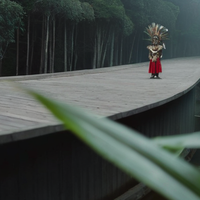 The qualities that Xochiquetzal's mythology concentrates — the sacredness of beauty, the dignity of skilled creative work, the legitimacy of pleasure and erotic love as dimensions of a full human life, the connection between aesthetic attention and the divine — are accessible through contemplative and practical engagement with her domain.
Beauty as Devotional Practice:
Xochiquetzal's domain is not beauty as an instrument for gaining approval but beauty as an end in itself — as a value worth cultivating and attending to for its own sake. Working with her archetype means developing genuine attention to beauty in daily life: the quality of what you make, the care given to your physical environment, the attention brought to flowers and natural beauty. This is not vanity in the pejorative sense but the cultivation of aesthetic sensitivity as a spiritual practice.
Skilled Artistry:
Xochiquetzal is specifically patron of skilled artisans — people who have developed genuine mastery of a craft that produces beautiful objects. Her domain is not amateur dabbling (though that has its own value) but the serious, sustained development of a creative skill. Working with her energy means taking one's creative work seriously enough to develop genuine skill rather than settling for mere expression.
The Sacredness of Pleasure:
Xochiquetzal's tradition treats pleasure — including erotic pleasure — as a legitimate and important dimension of human experience rather than as a problem to be managed or a temptation to be overcome. Working with her archetype means examining where inherited shame or guilt around pleasure is limiting full engagement with life, and developing the capacity to receive beauty and pleasure as genuine gifts rather than as sources of anxiety.
Flowers as Daily Practice:
The most immediate and accessible practice connected to Xochiquetzal is simply attending to flowers — growing them, bringing them into your home, visiting gardens, genuinely observing their specific qualities of colour, form, and scent rather than treating them as generic background. In the Nahuatl tradition, flowers were not decorative accessories but sacred symbols of the generative, erotic, beautiful life force. Bringing that quality of attention to flowers is a small but genuine form of honouring Xochiquetzal's domain.
Explore More Goddess Archetypes →
Xochitl — flower (Nahuatl)
Quetzal — the iridescent green bird whose feathers were among the most prized luxury materials in Mesoamerica
Together: Precious Feather Flower — a name encoding both natural beauty and the highest material value
Pronunciation: show-chee-KET-zal
Also known as: Ichpochtli ("maiden")
Beauty, flowers, and natural luxury. Erotic love and sexual pleasure. Weaving, embroidery, and the textile arts. Painting, sculpture, and crafts in precious materials. Pregnancy and the protection of young mothers. The pleasure of music, dance, and song.
Patron of artisans, lovers, and those whose work produces beauty in the world.
Xochiquetzal appears in several surviving manuscripts: the Codex Borgia, the Codex Borbonicus, and the Codex Ríos among others. She is identifiable by her rich dress, floral headdress, and weaving tools — consistently depicted as young and alluring, unlike most Aztec goddesses who appear as elder women.
These manuscripts were mostly created after the Spanish conquest, filtering pre-Columbian tradition through the colonial encounter.