Notifications (Click to mark read)
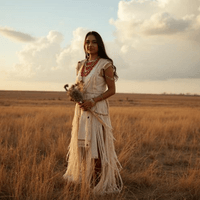 White Buffalo Calf Woman — Ptesan-Wi or Ptehíŋčala Sáŋ Wiŋ in the Lakota language — is one of the most sacred figures in Lakota spirituality, the being who brought the Čhaŋnúŋpa (the Sacred Pipe) to the Lakota people along with the seven sacred rites that form the foundation of Lakota ceremonial life. She is not a mythological figure from an ancient and closed tradition; she belongs to the living religious life of the Lakota people, who are a living nation whose ceremonies, language, and spiritual practices are actively maintained today.
This page offers substantive informational context about White Buffalo Calf Woman and the Lakota people drawn from publicly available sources, including accounts shared by Lakota elders and scholars who have chosen to make aspects of their tradition accessible. It does not provide practices, invocations, or rituals for non-Lakota people to adopt. The reasons for this — which are worth understanding rather than simply accepting — are explained in a later section.
 The Lakota are one of the three main divisions of the Great Sioux Nation — the others being the Dakota and the Nakota — a confederacy of nations whose traditional homeland covers much of the northern Great Plains, centred on what is now South Dakota, North Dakota, Nebraska, Montana, and Wyoming. The Lakota are divided into seven bands (Očhéthi Šakówiŋ, the Seven Council Fires): Sičháŋǧu, Oglála, Húŋkpapȟa, Mnikȟówožu, Sihásapa, Itázipčho, and Oóhenuŋpa.
Understanding who the Lakota are and what they have survived is not separable from understanding the significance of White Buffalo Calf Woman. The sacred traditions she embodies are not separate from the people who carry them; they are expressions of Lakota identity, sustained across an extraordinary history of survival.
The Fort Laramie Treaties and Their Violation:
The Treaty of Fort Laramie (1851) and the Fort Laramie Treaty of 1868 established the Great Sioux Reservation — including the Black Hills (Pahá Sápa), which are sacred to the Lakota — and recognised Lakota sovereignty over this territory. The 1868 treaty explicitly stated that the Black Hills would belong to the Lakota "as long as grass shall grow and water flow." Within six years, gold was discovered in the Black Hills. The United States government, rather than upholding the treaty, pressured the Lakota to sell. When they refused, the army moved against them. The Great Sioux War of 1876–77 resulted, including the Battle of the Little Bighorn (where Sitting Bull and Crazy Horse defeated Custer) and ultimately the military defeat and confinement of the Lakota people.
Wounded Knee:
On December 29, 1890, US Army troops massacred approximately 250–300 Lakota men, women, and children at Wounded Knee Creek on the Pine Ridge reservation in South Dakota. The massacre came in the context of the Ghost Dance movement — a religious revival that US authorities interpreted as a threat — and followed the killing of Sitting Bull two weeks earlier. Wounded Knee is among the most significant atrocities in the history of US-Indigenous relations and remains a site of profound significance for the Lakota people.
The 20th Century:
The 20th century brought the boarding school system — in which Lakota children were forcibly removed from their families and communities, forbidden to speak their language or practise their culture — the Indian Reorganisation Act, the American Indian Movement (AIM) and the 1973 Wounded Knee occupation, the ongoing legal battle over the Black Hills (the US Supreme Court ruled in 1980 that the seizure of the Black Hills was illegal and awarded $102 million in compensation; the Lakota refused the money and continue to seek return of the land), and the persistent socioeconomic impacts of reservation life, including among the highest rates of poverty, unemployment, suicide, and addiction of any group in the United States.
This history is not background information. It is the context within which the preservation of Lakota spiritual traditions — including the traditions associated with White Buffalo Calf Woman — represents an act of cultural survival and resistance, not merely heritage maintenance.
 The account of White Buffalo Calf Woman that has been most widely shared publicly comes primarily from Black Elk — the Oglála Lakota holy man whose visions and teachings were recorded by John G. Neihardt in Black Elk Speaks (1932) and by Joseph Epes Brown in The Sacred Pipe (1953). Black Elk chose to share this knowledge, and his accounts are therefore the most authoritative publicly available source. What follows is drawn from those accounts.
Long ago, when the Lakota people were suffering and could not find buffalo to feed themselves, two scouts were sent out to search for game. As they were travelling, they saw a figure approaching from a great distance — and as she came nearer, they saw she was a woman of extraordinary beauty, dressed in white buckskin that shone, carrying a bundle on her back.
One of the scouts looked at her with desire and inappropriate intent. The other recognised her immediately as something sacred and warned his companion. The first scout would not listen. When he approached her, a white cloud descended around them both; when it lifted, he was nothing but bones being devoured by snakes. The second scout stood humbly.
The woman spoke to the remaining scout, instructing him to return to his people and tell the chief to prepare a large tipi. She would come in four days with something of great importance. The scout returned and did as he was told. The people prepared.
On the fourth day, White Buffalo Calf Woman arrived. She entered the tipi singing. She carried the bundle she had been carrying when first seen — and from it she unwrapped the Čhaŋnúŋpa, the Sacred Pipe. She taught the people how to use it, explaining its every part and what it represented. The bowl of the pipe was the earth; the wooden stem was all that grows upon the earth; the smoke was the breath of Tunkáŋšila (the Grandfather, the Great Spirit). When the people prayed with the pipe, their breath and prayers would rise to Tunkáŋšila with the smoke.
She taught them the seven sacred rites: the keeping of the soul, the rite of purification (Inipi, the sweat lodge), crying for a vision (Haŋbléčheyapi), the sun dance (Wiwáŋyag Wačhípi), the making of relatives (Hunkápi), the girl's coming of age ceremony (Išnáthi Awíčhalowaŋpi), and the throwing of the ball (Tȟápa Waŋk'ÁŋyapI). Each of these ceremonies carries specific teachings and specific protocols that belong to the Lakota tradition and are transmitted through proper ceremonial channels.
As she left, she stopped and rolled over four times. The first time she became a black buffalo; the second time, a brown buffalo; the third time, a red one; and finally, a white female buffalo calf — the most sacred of all animals to the Lakota. She disappeared over the hill. Shortly after, great herds of buffalo appeared to feed the people.
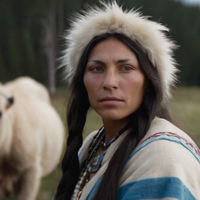 The Čhaŋnúŋpa — the Sacred Pipe — is the central sacred object of Lakota spirituality and the physical embodiment of White Buffalo Calf Woman's gift to the people. The Pipe is not simply a ceremonial implement; in the Lakota understanding it is a living sacred being whose use connects the human world to the world of Wakan Tanka (the Great Mystery) and the Grandfathers.
The original pipe brought by White Buffalo Calf Woman is understood to still exist and to be in the keeping of the Lakota people. Its current keeper — the role of Pipe Keeper has passed through generations of the Looking Horse family — is the recognised custodian of this most sacred object. Arvol Looking Horse, the 19th-generation Pipe Keeper, has been one of the most important voices calling for the protection of Lakota spiritual traditions from misappropriation.
The Seven Sacred Rites:
The seven rites brought by White Buffalo Calf Woman form the complete ceremonial life of the Lakota tradition. Each has specific protocols, specific songs, specific knowledge requirements, and specific ceremonial leaders whose authority to conduct them comes through proper transmission within the tradition — not through reading about them, not through attending a workshop, and not through the kind of self-authorisation that is common in contemporary New Age contexts.
The Inipi (sweat lodge purification ceremony) has been among the most frequently appropriated of the Lakota rites. Numerous non-Native individuals have charged money to lead "sweat lodge ceremonies" drawing on Lakota protocols. This practice has caused deaths — most notoriously the 2009 deaths of three people at a "sweat lodge" run by self-help entrepreneur James Arthur Ray in Arizona. Arvol Looking Horse and other Lakota leaders have specifically and repeatedly called out this appropriation as spiritually dangerous as well as culturally harmful.
The vision quest (Haŋbléčheyapi) has similarly been commercialised and offered by non-Native practitioners who lack the ceremonial knowledge and community relationships that make the practice safe and meaningful within its original context.
 Lakota spiritual leaders — including Arvol Looking Horse, the Pipe Keeper, and the Lakota Summit on Sovereignty — have explicitly and publicly stated that Lakota ceremonies are not available for adoption by non-Lakota people without proper authorisation from within the tradition. This is not an abstract policy position; it is a position held by the living religious authority of a living people, stated clearly and repeatedly over several decades.
Understanding why requires holding several things simultaneously. The Lakota tradition is not simply a collection of practices that happen to belong to one group rather than another; it is a complete, integrated religious and cultural system in which each practice is meaningful because of its relationship to the whole — the language, the kinship system, the land, the ceremonial cycle, the transmission of knowledge through proper relationships. A sweat lodge ceremony conducted by someone without Lakota ceremonial knowledge and community relationship is not a Lakota ceremony; it is a simulation that may use the physical form while missing everything that makes the form meaningful.
There is also the specific history: a people who have had their land taken, their language suppressed, their children forcibly removed, their ceremonies outlawed (the practice of Indigenous ceremonies was illegal in the United States from 1883 to 1978 under the Code of Indian Offenses) are entitled to draw a clear line around what remains of what is theirs. The appropriation of Lakota ceremonies by non-Native people — often for commercial gain — is not a neutral act of cultural appreciation. It continues a pattern of extraction from a community that has had much taken.
What respectful engagement looks like:
Learn Lakota history thoroughly — including the treaties, the wars, Wounded Knee, the boarding schools, and the current situation of Lakota communities. Read work by Lakota authors and scholars. Support Lakota-led organisations working for land rights, language preservation, and community wellbeing. If you are genuinely called to Indigenous spiritual practice, approach specific communities with humility and patience, understanding that any invitation to learn comes from the community and on the community's terms, not from your own sense of spiritual entitlement.
The themes that White Buffalo Calf Woman embodies — the sacred gift freely given, the test of those who receive it, the connection between right relationship with the sacred and the survival of the community — are genuinely profound and genuinely available for contemplation. What is not available is the ceremonies themselves, separated from the people and the tradition that give them meaning.
Explore More Goddess Archetypes →
White Buffalo Calf Woman is a sacred figure of the living Lakota people. Lakota spiritual leaders have explicitly stated their ceremonies are not available for adoption by non-Lakota people.
This page offers substantive context — Lakota history, the story, the Pipe's significance — without providing practices for adoption.
Čhaŋnúŋpa — the Sacred Pipe, brought by White Buffalo Calf Woman
Wakan Tanka — the Great Mystery, Great Spirit
Tunkáŋšila — Grandfather; the Great Spirit
Mitákuye Oyásʼiŋ — "All my relations" — the foundational Lakota phrase acknowledging relationship with all life
Očhéthi Šakówiŋ — the Seven Council Fires; the Great Sioux Nation
Pahá Sápa — the Black Hills; sacred to the Lakota and still legally theirs under the 1868 Treaty
Arvol Looking Horse is the 19th-generation keeper of the original Čhaŋnúŋpa brought by White Buffalo Calf Woman.
He has been one of the most prominent Lakota voices calling for the protection of Lakota sacred traditions from misappropriation, and has specifically addressed the commercialisation of sweat lodges and vision quests by non-Native practitioners.
If you are drawn to the themes of sacred gift, right relationship with the natural world, and ceremony as the foundation of community survival, many traditions have specifically invited wider engagement: