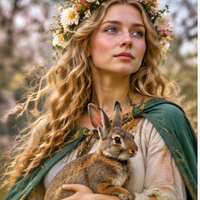
 Eostre is known to us through a brief but important passage written by the eighth-century monk Bede. In his account of the English months, he records that Eosturmonath, the month later associated with Easter, had once been named for a goddess called Eostre, in whose honour feasts were held. Beyond that statement, the surviving historical evidence is very limited. Her precise character, appearance and rites are not recorded.
Later writers and modern Pagan traditions have associated Eostre with dawn, spring, returning light and renewed life. These are meaningful interpretations of her name and seasonal setting, but they should be distinguished from what the early source actually tells us. Eostre offers an opportunity to explore how a fragment of history can inspire reflection while leaving room for uncertainty.
Ideas often associated with Eostre today:
• Spring: the turning of the season and renewed growth
• Dawn: the return of light and the beginning of a new day
• Renewal: the possibility of beginning again
• Seasonal awareness: noticing changes in the natural world
• Historical curiosity: separating early evidence from later interpretation
Eostre in Bede’s Account: What the Source Actually Says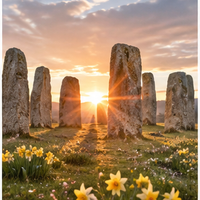 The principal written reference to Eostre appears in Bede’s De temporum ratione (The Reckoning of Time), written in the early eighth century. Bede explains that the Anglo-Saxon month Eosturmonath had once been named after a goddess called Eostre and that feasts were celebrated in her honour during that month. He also notes that Christians had come to use the old month-name for the Paschal season.
Bede does not describe Eostre’s appearance, myths, sacred animals, temples or ceremonies. Nor does he explain the form of the feasts. Modern scholarship has debated whether she was a historical local goddess and how her name should be understood. Some researchers accept Bede’s testimony; others question how much can safely be inferred from this single passage.
The responsible approach is to preserve that distinction. Eostre is named in an early medieval source, but many familiar details about her are modern interpretations rather than documented ancient tradition.
Spring Symbols and Later Associations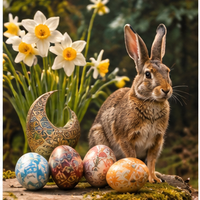 There is no surviving early Anglo-Saxon description that assigns particular objects or animals to Eostre. Hares, eggs, flowers and sunrise imagery are widely used in contemporary celebrations of spring and in modern devotional representations of Eostre, but a direct historical connection between these symbols and an ancient Eostre cult has not been demonstrated.
Dawn and the eastern horizon:
Modern interpretations often connect Eostre’s name with the east and the arrival of morning light. This is an interpretation, not a description supplied by Bede.
Flowers and new growth:
Spring flowers offer a natural way to represent the season in which Eosturmonath fell.
Hares and eggs:
These are familiar symbols in later European spring and Easter customs. They can be used in contemporary Eostre imagery, but should not be presented as proven attributes of the early medieval goddess.
Light:
The lengthening days provide a powerful modern symbol of seasonal change and renewed energy.
Reflecting with Eostre: Noticing Renewal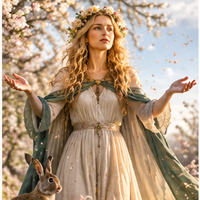 A contemporary practice inspired by Eostre can begin with observation rather than an elaborate ritual. Take a short walk and notice what has changed in the natural world: the first flowers, longer daylight, new leaves or the sound of birds. The purpose is to pay attention to renewal as it actually appears, rather than expecting transformation to happen all at once.
A seasonal observation:
Write down three changes you have noticed outdoors. Return to the same place a week later and see what has altered.
A beginning:
Choose one small thing you would like to restart or bring into your life. Make the first step modest enough to complete.
Light and attention:
Spend a few quiet minutes in the morning without a screen. Notice the quality of the light and how your attention feels before the day gathers pace.
These are modern reflective exercises, not reconstructions of ancient Anglo-Saxon rites.
Eostre and the Modern Meaning of Renewal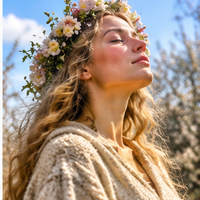 The value of Eostre for a modern reader need not depend on certainty about every detail of her ancient identity. Her place in Bede’s account connects her name with a point in the seasonal calendar when the natural world begins to change visibly. That connection can prompt useful questions about renewal, patience and the conditions that allow new growth.
Spring does not arrive everywhere at once, and personal change rarely follows a neat calendar. A new beginning may first appear as a small sign: a thought reconsidered, a habit resumed, or the willingness to approach something differently. Eostre can serve as a focus for noticing those beginnings while remaining honest about the limits of the historical record.