Notifications (Click to mark read)
 Sekhmet is one of the most ancient and theologically significant goddesses in the Egyptian pantheon — a figure whose apparent paradox is central to her meaning. She is simultaneously a goddess of destruction and a goddess of healing, a deity of war and a patron of medicine, a force that brings plague and a force that cures it. This is not contradiction; it is the Egyptian theological understanding that the same force that can harm can also heal, that the physician's knowledge of how disease works is the same knowledge that makes disease.
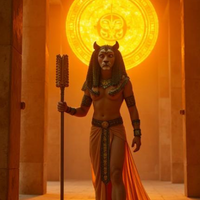
Her name derives from the Egyptian word sekhem — power, might — and she is among the oldest divine figures in Egyptian religious history, her worship attested from the earliest periods. She is depicted as a woman with a lioness head, wearing the solar disk and the uraeus (the sacred cobra of divine authority). The lioness — apex predator of the Egyptian world, simultaneously terrifying and sovereign — is her primary animal form, and the solar disk connects her to the fierce, uncompromising, life-giving and life-taking power of the sun in the desert.
In the Egyptian religious system, Sekhmet is understood as the fierce eye of Ra — the solar power that can bring destruction when released against the enemies of divine order, and that can heal when properly directed. The same burning solar energy that causes heatstroke and fever also purifies and cauterises. The same power that makes the desert deadly makes the sun the source of all life in the Nile Valley. Sekhmet embodies this double nature without trying to resolve it into something more comfortable.
 The most famous Sekhmet myth — the Destruction of Mankind — is one of the oldest texts in the Egyptian corpus and one of the most psychologically rich in Egyptian religion. Ra, the sun god, learns that humanity is plotting against him in his old age. He sends Sekhmet — his eye — to punish them. She descends to earth and begins slaughtering humanity with such ferocity that she cannot stop; having tasted blood, she continues killing even those who have done nothing wrong, and Ra himself becomes alarmed that she will destroy all human life.
The gods devise a plan: they flood the fields with beer dyed red to resemble blood. Sekhmet drinks the beer thinking it is blood, becomes intoxicated, and falls into a stupor. When she wakes, her frenzy has passed and the slaughter ends. This myth is unusual in Egyptian religion for its psychological candour about the nature of violence — the recognition that destructive force, once fully released, is very difficult to stop through opposing it directly, and that the solution lies in something other than brute confrontation.
The myth also encodes the understanding that Sekhmet's destructive power is not malicious — it is justice that has exceeded its mandate. She was sent to punish genuine wrongdoers; she got carried away. This distinguishes her from chaotic or evil forces: she operates within the framework of divine order (Ma'at) but requires containment to prevent excess.
In her healing dimension, Sekhmet's priests were among the most sophisticated medical practitioners of the ancient world. The temple of Sekhmet at Memphis served as a medical centre, and Sekhmet's priests — the "priests of Sekhmet" — were physicians, combining religious knowledge with genuine medical practice. This is historically accurate and archaeologically documented. The association between Sekhmet and medicine reflects the Egyptian understanding that the same forces that cause disease — particularly epidemic disease — are the forces that, properly understood and directed, can cure it.
 The Lioness:
The lioness in ancient Egypt was the apex predator — faster than the lion, primarily responsible for the pride's hunting, simultaneously terrifying and majestic. The lioness head identifies Sekhmet as combining the qualities of supreme predatory power with royal authority. In Egyptian iconography, lionesses were also associated with protection: they guarded the thresholds of temples and sacred spaces, their fierceness in service of what they protected.
The Solar Disk:
The solar disk that Sekhmet wears identifies her with the Eye of Ra — the fierce, solar aspect of divine power that can be sent against the enemies of cosmic order. The sun in Egypt was not simply benevolent; it was the source of the desert's killing heat as well as of the light that made agriculture possible. Sekhmet embodies this double quality of solar power.
The Uraeus:
The cobra that rises from the solar disk represents divine authority and protective power — the capacity to strike at what threatens the sacred order. The uraeus was worn by pharaohs and gods as a symbol of their divine mandate to protect and to judge.
Red Linen:
Sekhmet was associated with the colour red — the colour of blood, of the desert, of the fierce solar noon. Her priests wore red linen in her ceremonies, and red was the colour of her sacred nature.
The Ankh:
Despite her fierce associations, Sekhmet holds the ankh — the key of life — confirming that her ultimate purpose is the preservation and renewal of life, not its destruction. The destruction she brings serves the restoration of life, not its elimination.
Stones and Colours:
Carnelian (courage and the warrior's heart), red jasper (grounding fierce energy in practical action), citrine (solar power and healing clarity). Deep red, gold, orange, and solar yellow.
 Sekhmet's archetype is most directly relevant for situations that require the specific combination of fierce clarity and healing intention — situations where something genuinely harmful must be addressed directly rather than accommodated, but where the purpose of addressing it is restoration rather than punishment.
The Dual Nature as Practice:
The core teaching of Sekhmet's mythology is that the same force that destroys can heal, and that the practitioner who understands this can direct fierce energy toward healing rather than harm. This is not the comfortable image of healing as only gentle and compassionate — sometimes healing requires the courage to name what is causing harm, to stop accommodating it, to cut it out rather than hoping it will resolve itself. Sekhmet's energy is appropriate for these moments.
Righteous Anger as Information:
Sekhmet's mythology is explicit that her anger arises in response to genuine wrongdoing — Ra sends her against those who are actually plotting against divine order. The anger she represents is not reactive or capricious; it is information about what has genuinely violated the order that sustains life. Working with her archetype means developing the capacity to distinguish between righteous anger that is pointing to something real and reactive anger that is about something else. The distinction matters because the first kind of anger, when properly directed, serves healing.
The Limit of Force:
The Destruction of Mankind myth is also a warning: even righteous, justified force requires limit and direction. Sekhmet in the myth cannot stop once she has started; she requires external intervention to prevent her from destroying what she was sent to protect. This encodes the practical understanding that fierce energy, once fully engaged, needs containment — that the practitioner who works with this kind of force needs structures and relationships that can provide that containment when necessary.
Healing Work:
For healers, Sekhmet's energy supports the specific courage required to address what is actually causing harm rather than only managing its symptoms. The Sekhmet practitioner is not primarily the gentle companion to suffering but the one who diagnoses what is causing the suffering and addresses it directly. This is not gentle work, but it is genuine healing.
Explore More Goddess Archetypes →
Sekhmet causes plague and cures it. She destroys and heals. Her priests were physicians.
This is not contradiction — it is the Egyptian understanding that to know how harm works is to know how to stop it. The same force directed differently produces opposite results.
The Destruction of Mankind myth adds a warning: even righteous force requires limit. Sekhmet could not stop herself. External intervention was required.