Notifications (Click to mark read)
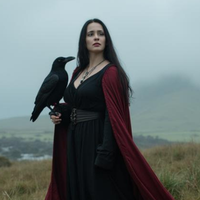 The Morrigan is one of the most significant and most demanding figures in Irish mythology — a triple goddess who presides over war, fate, sovereignty, and the liminal territory between life and death. She is not a comfortable figure and she was never meant to be. Her appearances in the Ulster Cycle and the Mythological Cycle of Irish mythology are consistently associated with conflict, with testing, and with the hard truths that those who hold power or seek it must eventually face.
The name "Morrigan" is typically translated as "Phantom Queen" or "Great Queen" — the Old Irish "Mór" (great, phantom) combined with "Rígan" (queen). She appears in the Irish texts both as a single figure and as a collective of three goddesses: most commonly Badb (the Battle Crow, who cries before battles and washes the armour of those about to die), Macha (associated with sovereignty, horses, and the land's fertile power), and either Nemain (frenzy and panic in battle) or Anand/Anu (abundance and prosperity). The triple structure reflects the comprehensive scope of her authority — she governs not one dimension of conflict and transformation but all of them.
Her most extended mythology appears in the Ulster Cycle — particularly in the Táin Bó Cúailnge (The Cattle Raid of Cooley) and in her complex relationship with the hero Cú Chulainn. She approaches him three times in disguise; he fails to recognise her on each occasion and rebuffs or injures her; and she responds by fighting against him in his most crucial battles — not from personal vindictiveness but as the consequence of his having refused the sovereignty she offered. When he is finally dying, she perches on his shoulder in the form of a crow, and it is only then that his enemies believe he is truly dead.
In the Mythological Cycle, she appears at the Second Battle of Mag Tuired, fighting on the side of the Tuatha Dé Danann against the Fomorians, prophecying victory and then delivering a prophetic poem about the state of the world at the end of times — a poem that moves from abundance and flourishing to desolation and moral collapse. She sees both what is and what will be, and she speaks what she sees without softening it.
 The Morrigan's triple nature is not simply a theological convention; it reflects a genuine understanding of conflict and transformation as multi-dimensional processes that require different qualities at different moments. No single quality suffices for the full range of what sovereignty and just action require.
Badb — the Battle Crow:
Badb is the prophetic aspect — the one who sees what is coming and announces it, however unwelcome the announcement. In Irish mythology she appears washing the armour or weapons of those who are about to die in battle — the "washing at the ford" — which serves as a premonitory vision for those who witness it. She is not causing the death; she is seeing it clearly and acknowledging it. This is the quality of prophetic vision that does not flinch from what it sees and does not soften what it says. Her corvid form — the crow on the battlefield — represents perception that operates at the boundary between life and death, seeing both clearly.
Macha — Sovereignty and the Land:
Macha appears in several distinct mythological narratives that share a common theme: the proper relationship between a ruler and the land, and the consequences of violating that relationship. In one narrative she is a supernatural woman who settles with a farmer and, heavily pregnant, is forced by the king to race his horses or her husband will die; she wins the race but dies in childbirth, cursing the men of Ulster with the weakness of a woman in labour during their hour of greatest need. This curse — the Debility of the Ulstermen — drives much of the Ulster Cycle. Macha's sovereignty is not abstract; it is embodied in the land's fertility and the health of those who govern it justly.
Nemain — Frenzy and Transformation:
Nemain represents the dimension of conflict that goes beyond strategic calculation — the quality of full commitment to action that does not hold back, does not hedge, does not preserve itself for a more convenient moment. Her name is associated with "frenzy" and "panic," but the panic she induces in her enemies is not irrational; it is the appropriate response to encountering a force that will not be stopped by ordinary means. In the context of personal development, her energy is relevant when the situation calls for complete rather than partial commitment — when the half-measure will accomplish nothing.
 Crows and Ravens:
The crow is the Morrigan's primary animal form and her most consistent symbol across all her mythological appearances. Corvids — crows, ravens, rooks — are among the most intelligent birds: they use tools, recognise individual human faces, hold grudges across years, and conduct rituals around their dead. Their association with battlefields (where they gathered to feed on the fallen) made them natural symbols of the death-wisdom that the Morrigan embodies. To encounter a crow at a significant moment is one of the traditional signs of the Morrigan's attention.
The Washing at the Ford:
Badb's appearance at a river ford, washing the armour and weapons of those about to die, is one of the most distinctive and most haunting images in Irish mythology. The ford — the crossing point of a river — is itself a liminal space, a threshold between territories. Her presence there connects the Morrigan specifically to the threshold between life and death and to the quality of clear sight that threshold locations enable.
Red Clothing:
The Morrigan is frequently described wearing red — the colour of blood, of the life force, of the warrior energy that her domain encompasses. Red in Celtic iconography is associated with the Otherworld as well as with warfare; her red clothing marks her as a figure who moves between worlds.
The Cauldron:
The cauldron — a central symbol in Celtic tradition — appears in the Morrigan's mythology in connection with renewal and rebirth. The cauldron from which warriors can be restored to life after death is one of the great treasures of the Tuatha Dé Danann, and the Morrigan's connection to both death and renewal places her in relationship with its regenerative power.
Colours and Stones:
Black (the crow, the darkness of Otherworld knowledge), red (warrior energy, life force), silver (prophetic clarity, the liminal). Obsidian for cutting through illusion; garnet for warrior courage; hematite for grounding visions in practical action.
 Working with the Morrigan requires honesty about what she actually offers — and what she does not. She is not a comfort goddess. She does not reassure or soothe. She does not offer the kind of support that tells you what you want to hear. What she offers is clarity — the capacity to see situations as they actually are rather than as you hope or fear they are — and the specific courage to act from that clarity even when the action is difficult or costly.
The mythology's consistent pattern is instructive: when Cú Chulainn fails to recognise her, fails to accept the sovereignty she offers, he loses her support in precisely the situations where he most needs it. The Morrigan's assistance is not unconditional; it requires the willingness to see clearly, to acknowledge what is being offered, and to accept the full weight of sovereignty — responsibility for one's choices and their consequences — rather than only its privileges.
Prophetic Development:
The Morrigan's prophetic dimension is accessible through divination practices — tarot, runes, scrying, dreamwork — approached with genuine willingness to receive what arrives rather than seeking confirmation of what one already believes. The practice is not about developing a mystical skill; it is about developing the honest attention that genuine perception requires.
Sovereignty Work:
Sovereignty in the Morrigan's tradition is not dominance over others but full authority over oneself — the capacity to make decisions from one's own genuine values rather than from fear, social pressure, or the desire for approval. Working with her archetype means honestly identifying where this authority is being ceded and recovering it. This is not dramatic; it is the daily practice of choosing from genuine conviction.
Justice and Protection:
The Morrigan fights on the side of the Tuatha Dé Danann — not arbitrarily but because they represent a legitimate order against the chaos of the Fomorians. Her warrior energy is not available for every conflict; it is specifically available for those where something genuine is at stake. Working with her archetype in activism or protective work means being honest about whether the conflict you are engaged in is genuinely in service of what you claim, or partly in service of your own need for righteousness.
Crow Medicine:
Pay attention to corvids. Not as superstition — not as proof that the Morrigan is personally messaging you — but as a practice of attention. Crows are genuinely present in most environments, genuinely intelligent, and genuinely observant of human behaviour. Developing the habit of noticing them develops the habit of noticing what is actually present rather than what you expect to find.
Explore More Goddess Archetypes →
Badb — the Battle Crow; prophetic vision; the washing at the ford
Macha — sovereignty; the land's fertile power; the costs of violating just rule
Nemain — frenzy; complete commitment; the panic that signals an unstoppable force