Notifications (Click to mark read)
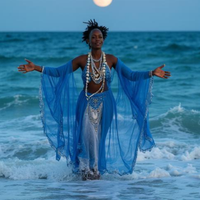 Yemoja (also spelled Yemaya or Iemanjá) is one of the most beloved and widely venerated Orisha in the Yoruba religious tradition and its diaspora — a living divine being, not a historical figure or mythological archetype. Like Oshun and Oya, she belongs to a living religious tradition that has survived colonisation, slavery, and sustained cultural suppression, and that continues in vibrant practice in West Africa, Brazil, Cuba, and throughout the African diaspora.
Yemoja governs the ocean — literally and theologically. She is both the sea itself and the divine force of the ocean's qualities: its vast, generative depth, its capacity to sustain life, its fierce protectiveness when her children are threatened, its capacity to receive and cleanse what is offered to it. Her name in Yoruba — Yèyé Omo Eja — means "Mother whose children are like fish," encapsulating both her maternal identity and her oceanic domain.
As the Mother of All Orisha in many Yoruba tellings, Yemoja occupies a foundational position in the Yoruba cosmological understanding: the primordial waters from which all things emerged. This makes her, in a sense, the origin point — the source before sources — and her maternal quality is not simply one attribute but the expression of a genuinely generative, all-encompassing presence.
The transatlantic slave trade and Yemoja's relationship to it deserves direct acknowledgement. The ocean that is Yemoja's domain was also the site of one of history's greatest atrocities — the Middle Passage, in which millions of Africans were transported across the Atlantic in conditions designed to dehumanise and destroy. For the enslaved Yoruba and Yoruba-influenced peoples who survived that crossing and maintained their religious traditions in the Americas, Yemoja's ocean was both the site of their trauma and the divine presence that had watched over them in it. This dual nature — the ocean as terror and the ocean as mother — is inseparable from who Yemoja is in the diaspora context, and honouring her without acknowledging this history is a form of disrespect to both her and to the communities that preserved her.
Yemoja in Yoruba Tradition and the Diaspora

In the original Yoruba tradition of south-western Nigeria, Yemoja is associated with the Ogun River (not the ocean — in the original tradition she is a river deity whose domain was later expanded to encompass the sea as the tradition moved with enslaved Africans to coastal and island environments). This distinction matters: the original Yemoja is a river goddess, deeply local and specific to the Ogun River's ecology and the peoples who live along it. The ocean-mother figure known primarily in the diaspora is a development of that original tradition in new geographical and cultural contexts.
In the diaspora traditions — Candomblé in Brazil (where she is known as Iemanjá), Santería/Lucumi in Cuba (where she is syncretised with Our Lady of Regla), Trinidad Orisha, and contemporary pan-African spiritual practice — Yemoja has become the great ocean mother, patron of fishermen and sailors, protector of those who cross water, and the divine mother whose love encompasses all her children regardless of how far they have been scattered.
The Festa de Iemanjá in Salvador, Brazil — held each February 2nd — is one of the most significant religious and cultural celebrations in Brazil, in which offerings are floated out to sea on boats and the ocean herself is honoured as a divine presence. This is not a reconstruction or revival; it is a continuous living tradition maintained by communities who have kept it alive across centuries of suppression.
Sacred Symbols (publicly shared):
Blue and white — the colours of ocean and foam, of sky and sea. Cowrie shells — ancient currency and symbol of feminine creative power. The number seven — associated with spiritual completeness in Yoruba cosmology. Silver, pearls, and ocean materials — treasures from her domain. Fish and sea creatures — her children in her element. Saltwater — purifying, cleansing, oceanic.
Working with Yemoja's Energy

The same distinction that applies to Oshun and Oya applies here: the publicly shared dimensions of Yemoja's mythology and associations are available for respectful engagement; the specific initiated practices of the Yoruba and diaspora traditions belong to those communities and require genuine relationship with them rather than self-directed adoption.
The qualities that Yemoja's mythology concentrates — the comprehensive, generous quality of maternal love that receives all her children regardless of their condition; the ocean's capacity to both hold and cleanse; the fierce protectiveness that arises from genuine maternal devotion; the understanding that healing sometimes happens through simply being held — these are accessible through contemplation and honest engagement with what they offer.
The Ocean as Contemplative Resource:
If you have access to the sea, spending genuine time with it — not as a backdrop but as a presence — provides direct encounter with what Yemoja governs. The ocean is genuinely vast, genuinely old, genuinely indifferent to individual human concerns, and genuinely sustaining of life. Sitting with these qualities honestly is different from bringing expectations about what you will feel or receive.
Maternal Love as Practice:
Yemoja's primary domain is maternal love — the love that receives without condition, that protects fiercely, that nourishes regardless of whether the child has earned it. Working with her archetype means developing this quality in whatever relationships you inhabit — not performing nurturing but genuinely extending the kind of care that does not require performance in return.
Emotional Healing:
The ocean receives everything — it doesn't distinguish between what is worthy and what is not. Saltwater baths used with genuine intention to release emotional weight are a simple practice that engages with Yemoja's domain without requiring adoption of religious ritual. What matters is genuine release, not elaborate ceremony.
Acknowledgement of History:
For those outside the Yoruba and African diaspora communities who are drawn to Yemoja, the most meaningful engagement is learning the actual history — the Middle Passage, the survival of the tradition, the living communities that maintain it — and allowing that learning to inform how one relates to her. Supporting those communities directly is more genuinely honouring of Yemoja than spiritual borrowing disconnected from the human beings who have carried her across centuries.
Explore More Goddess Archetypes →
Select your Yemoja work:
Yemoja belongs to a living religious tradition carried across centuries of trauma by specific communities.
The most meaningful engagement is learning that history and supporting those communities — not adopting their religious practices without initiation and relationship.