Notifications (Click to mark read)
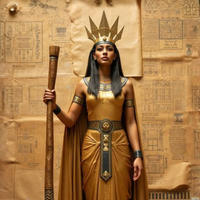 Seshat is one of the most ancient and most specifically functional goddesses in the Egyptian pantheon — the divine scribe, the keeper of records, the measurer of time, and the mistress of the House of Life. Where many Egyptian deities govern cosmic forces or natural phenomena, Seshat governs something more precisely human: the act of writing itself, the power of recorded knowledge, and the precision of measurement that makes large-scale building and administration possible.
Her name simply means "female scribe" — Sšȝt in ancient Egyptian — reflecting the directness with which the Egyptians named her domain. She is depicted consistently in a distinctive iconography: a woman wearing a leopard-skin robe and a headdress of a seven-pointed star or flower above two horns (or a bow), holding a palm rib notched to record the passage of years. The notched palm rib is her primary attribute — the instrument of record-keeping, marking the years of a pharaoh's reign, the dimensions of a new temple, the harvests of the Nile flood.
Seshat is attested from some of the earliest periods of Egyptian history — she appears in reliefs from the reign of Djer, one of the earliest pharaohs of the First Dynasty (approximately 3000 BCE). Her longevity in the Egyptian religious tradition reflects the fundamental importance of writing and record-keeping to Egyptian civilisation, which was among the first in human history to develop a sophisticated bureaucratic state apparatus dependent on written records.
She is often described as the wife or female counterpart of Thoth — the ibis-headed god of wisdom, writing, and the moon — though in some traditions she is his daughter. The pairing reflects the Egyptian understanding that the divine basis of writing and knowledge had both male and female dimensions, and that Seshat's role as the recorder and measurer of earthly reality complemented Thoth's role as the keeper of cosmic wisdom.
 Seshat's most distinctive and most theologically significant ritual role was in the ceremony known as "stretching of the cord" — the foundation ritual performed before the construction of every important Egyptian building. This ceremony established the precise orientation and dimensions of the new structure, aligning it with specific stars or celestial directions and marking its sacred boundaries in the earth. Seshat participated alongside the pharaoh in this ceremony, and her presence was essential: without the divine scribe's participation, the building's sacred geometry could not be properly established.
The ceremony involved driving stakes into the ground and stretching a measuring cord between them, establishing the primary axis of the building. The alignment was astronomical — Egyptian temples were typically oriented toward specific stars or toward the rising or setting sun at specific moments in the calendar. Seshat and the pharaoh each held a mallet for driving the stakes; the pharaoh represented the human authority that commanded the building, and Seshat represented the divine precision that made it correctly placed in the cosmos.
This ritual role makes Seshat the divine patron of architecture and construction as well as of writing and record-keeping — her domain is the precision of measurement in all its forms, whether measuring words or measuring space. The two are connected in Egyptian thought: both require the capacity to render reality accurately in a permanent form, whether in ink on papyrus or in stone aligned with the stars.
The stretching of the cord ceremony is attested from the earliest dynastic period and continued throughout Egyptian history. Inscriptions from multiple pharaohs describe their participation in the ceremony with Seshat, and images of the ritual appear on the walls of several major temples. The goddess who appears beside the pharaoh in these images — holding the mallet, gripping the cord — is one of the most directly functional divine presences in Egyptian religious iconography: not a cosmic force but a practical participant in the physical making of sacred space.
 Seshat was the keeper of the Per-Ankh — the House of Life — the institution attached to major Egyptian temples that served as scriptorium, library, school, and centre of sacred knowledge. The House of Life was where religious texts were copied and maintained, where medical knowledge was preserved, where astronomical observations were recorded, and where the training of scribes and priests took place. It was, in the most literal sense, the place where Egyptian knowledge lived — and Seshat was its divine mistress.
The records Seshat maintained were understood as having a cosmic as well as a practical dimension. She recorded not only the earthly achievements of the pharaoh — the length of their reign, the buildings constructed, the battles won, the tribute received — but the pharaoh's fate after death. In some texts she is described as recording the years allotted to each pharaoh on the leaves of the sacred tree at Heliopolis, determining how long they would live and what they would accomplish. This role as recorder of fate connects her to the broader Egyptian theological understanding of writing as having power over reality: to write something is, in a sense, to make it real.
The palm rib she carries — notched with a series of marks — is the instrument of this record-keeping. Each notch represents a year; the palm rib accumulates the years of a pharaoh's reign in a form that is both practical record and sacred tally. Images of Seshat recording the years appear frequently in royal contexts — particularly in jubilee festival (Heb-Sed) inscriptions, where the pharaoh's achievements and the renewal of their divine kingship are recorded by the goddess whose records are permanent.
Her relationship with writing went beyond record-keeping to encompass the sacred power of texts themselves. Spells, rituals, and magical texts were under her protection. The accurate transmission of sacred texts — the precise copying of spells that must be exactly right to work — was her domain, and errors in sacred texts were understood as violations of her authority.
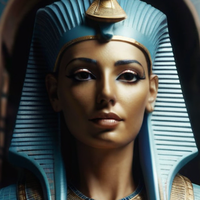 Seshat's archetype speaks directly to anyone whose work involves writing, record-keeping, research, teaching, architecture, or any form of precision in the rendering of reality. She represents the sacred dimension of these activities — the understanding that accurate, careful, disciplined work with words and measurements is not merely technical but genuinely significant.
Writing as Sacred Practice:
Seshat's domain includes not only functional writing but the sacred texts of the House of Life — texts that had to be copied with absolute precision because errors could render them powerless. Working with her archetype means approaching one's own writing with this quality of care: not the anxiety of perfectionism but the genuine respect for precision that comes from understanding that words, once written, have a power that careless words lack. The act of writing carefully, of choosing words that say exactly what one means, is a form of honouring Seshat's domain.
Record-Keeping and Memory:
Seshat records what happens so that it is not lost — the years of a reign, the dimensions of a building, the words of sacred texts. Working with her energy means taking seriously the value of maintaining accurate records: journals, notes, documentation of what has been learned and experienced. Memory without record is vulnerable to distortion; the discipline of writing things down accurately is Seshat's specific gift.
Measurement and Precision:
The stretching of the cord ceremony reflects Seshat's domain of precise measurement — the capacity to render space accurately, to align things correctly with the cosmos, to do the patient, exact work that makes large structures possible. Working with her archetype means developing respect for precision in whatever domain one works — the willingness to measure carefully rather than approximate, to get things right rather than merely acceptable.
Sacred Symbols:
The seven-pointed star headdress. The notched palm rib — recorder of years. The leopard skin robe — associated with priestly authority. The writing palette and reed pen. The measuring cord. Stars — her celestial alignment work.
Explore Isis — Egyptian Magic & Wisdom →
Before every major Egyptian building was constructed, Seshat and the pharaoh performed the foundation ceremony together — driving stakes, stretching the measuring cord, aligning the building with specific stars.
No sacred building could be correctly placed in the cosmos without the divine scribe's participation.
Seshat's domain is precision in all its forms — measuring space as well as recording time.
Thoth — ibis-headed god of wisdom, writing, and the moon — is Seshat's counterpart, variously described as her husband or father.
Where Thoth governs cosmic wisdom and the deep principles of knowledge, Seshat governs the practical, earthy work of recording reality accurately.
He keeps the knowledge of heaven; she records the history of earth.
Seshat's domain speaks directly to anyone whose work is with words, records, and precision:
The sacred dimension of accurate, careful work is Seshat's specific gift.