Notifications (Click to mark read)
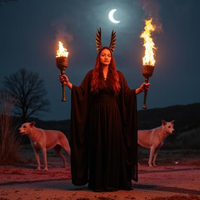 Hecate stands as one of the most mysterious and powerful goddesses of the ancient world, ruling over crossroads, magic, and the liminal spaces between states — between night and day, between life and death, between the known world and the unknown. Known as the "Distant One," "Key Holder," and "Torch Bearer," she guides souls through transitions, guards the thresholds between worlds, and offers profound wisdom to those prepared to walk paths of genuine transformation.
Originally a Titan goddess who retained her power even after Zeus's rise, Hecate was granted dominion over earth, sea, and sky — making her one of the few deities with such comprehensive authority in the Greek pantheon. The Homeric Hymn to Demeter places her as the only other deity who witnesses Persephone's abduction, and it is Hecate who leads Demeter to Helios when Demeter seeks the truth. She is a witness to hidden things, a holder of knowledge that others either cannot access or prefer not to see.
Sacred Qualities of Hecate:
• Crossroads Wisdom: Guidance through major life decisions and transitions
• Magical Knowledge: Mastery of spells, divination, and hidden wisdom
• Psychopomp Power: Safe passage between worlds and states of being
• Crone Wisdom: Deep understanding gained through experience of the full range of life
• Shadow Work: Illumination of rejected aspects of self for integration
• Protective Magic: Fierce guardian of boundaries and sacred spaces
• Lunar Mysteries: Connection to the dark moon and what it holds
Hecate is not a goddess for casual invocation. Her energy demands honesty, respect, and genuine willingness to face difficult truths. She serves those committed to authentic spiritual development, offering wisdom to those who approach her with appropriate seriousness while having little patience for those seeking power for trivial or selfish purposes.
The Triple Form of Hecate: Past, Present, Future

Hecate frequently appears in triple form — three bodies or faces looking in different directions simultaneously — which makes her the definitive goddess of the crossroads, where multiple paths converge. This triple nature reflects her capacity to hold time in a comprehensive field of awareness rather than seeing only the present moment, and it is this capacity that makes her particularly valuable at decision points.
Hecate of the Past:
This aspect illuminates how history has shaped current circumstances. She reveals patterns — generational, personal, karmic — that are operating beneath the surface of a present situation, making it possible to understand not just what is happening but why, and not just why now but why this person, this situation, this moment. Working with this aspect brings the kind of understanding that dissolves unconscious repetition.
Hecate of the Present:
This aspect cuts through the confusion and wishful thinking that so often cloud the perception of current situations. She is associated with discernment — the capacity to see what is actually present rather than what one hopes or fears is present. Her torch illuminates the crossroads not to make the choice easier but to make it visible.
Hecate of the Future:
This aspect offers prophetic insight into the likely consequences of different choices. This is not deterministic prediction — Hecate does not deal in fixed fates — but in the honest assessment of trajectories. Different paths lead to genuinely different places, and the willingness to look clearly at where different choices lead is essential to genuine decision-making.
The Crossroads Moment:
When all three aspects converge, Hecate provides the comprehensive wisdom needed for major life transitions: understanding how the past has created this moment, seeing the present situation as it actually is, and following the likely trajectories of different choices forward. This is the understanding that makes conscious, empowered decision-making possible rather than simply reactive.
The Dark Moon Connection:
Hecate's power is most intensely felt during the dark moon — the three-day period when the moon is not visible in the sky. This is not because darkness is evil but because it is the condition in which what is ordinarily hidden by the light of ordinary attention becomes accessible. The fertile darkness from which she draws her knowledge is not empty; it is full of what has not yet come to light.
Sacred Symbols and Attributes of Hecate

Hecate's symbols reflect her dominion over transitions, hidden knowledge, and the mysteries that govern life and death. Each symbol carries specific meaning and can be used to invoke different aspects of her wisdom and protection.
Keys:
Hecate is the key-holder — the one who holds the keys to all mysteries and hidden knowledge. In ancient Greece, keys were among the most significant offerings at her shrines. Her keys unlock doors between states and between levels of awareness, and they also lock: she is the guardian of thresholds in both directions, controlling not only what enters but what exits the sacred space.
Torches:
As torch-bearer, Hecate illuminates the dark paths of transformation. Her torches do not dispel darkness — they make it navigable. They represent the light of discernment that makes it possible to move through difficult territory without losing one's way, and the fire of the will that sustains movement through difficulty.
Daggers and Knives:
Hecate's blade represents the power to cut through illusion, sever unhealthy attachments, and make clean endings. The knife symbolises discernment — the capacity to distinguish between what serves genuine development and what merely feels comfortable or familiar.
The Crossroads (Triodos):
The three-way crossroads is Hecate's most sacred space. Greek towns maintained crossroads shrines (Hecataia) at intersections, and monthly offerings (the Deipna) were left there for her. The crossroads represents simultaneously the convergence of possibilities and the necessity of choice — the moment at which multiple paths are still open and one must be committed to.
Serpents:
Serpents represent wisdom, transformation, and the capacity to move between worlds. They symbolise the shedding of old identities and the renewal that genuine change requires, and they carry the specific kind of wisdom that comes from having navigated dangerous territory and survived it.
Yew Trees:
Sacred to Hecate for their longevity and their presence in both life and death — yews are among the oldest living things in the world, and they grow in churchyards because they were already considered sacred to death and rebirth before Christianity. Their berries are poisonous; their timber is among the hardest. They represent the knowledge that must be handled with respect.
Colors and Elements:
• Black: Mystery, protection, the fertile darkness of the unknown
• Deep Red: Life force, magical power, transformation
• Silver: Moon wisdom, psychic clarity, reflection
• Dark Purple: Spiritual authority, magical mastery
• Earth Element: Grounding, practical wisdom, what endures
Working with Hecate: Practices for Magical Development

Hecate demands serious commitment and respect from those who would work with her energy. She responds to sincere seekers of wisdom but has little patience for casual dabblers or those seeking power for selfish purposes. Approach her with reverence, honesty, and genuine dedication to growth.
Creating a Hecate Shrine:
Establish a dedicated sacred space for Hecate work, preferably in a quiet, private area. Include her image, black and red candles, a bowl for offerings, keys (old skeleton keys work well), and a small knife. Keep this space clean and approach it only with serious intent. The shrine is a point of contact, not decoration.
Dark Moon Practice:
During the dark moon, light black candles and sit quietly in near-darkness. Speak honestly to Hecate about what you are navigating — not what you want her to know but what is actually true. Ask for clarity about hidden factors. Then sit in silence and pay attention to what arises. Record it without interpretation; interpretation can come later.
Crossroads Divination:
When facing important decisions, visit a physical crossroads during twilight or night. Leave an offering — bread, honey, eggs, or wine — with genuine acknowledgement of Hecate's presence. Ask for guidance, then walk away without looking back. Pay attention to signs, synchronicities, and dreams over the following three to seven days. The guidance rarely arrives as a direct answer; it arrives as clarification.
Shadow Work with Hecate:
Ask Hecate to illuminate aspects of yourself you have been avoiding. Sit in near-darkness with a single candle and write without self-censorship about what arises. Be prepared for uncomfortable material. Hecate's purpose in showing what is hidden is always integration rather than condemnation — but the showing is not always gentle.
Protection and Boundary Work:
When you need to establish firm psychic or energetic boundaries, invoke Hecate as guardian of thresholds. Visualise her standing at your boundary with her torches and keys, controlling what enters and what exits. This is most effective when combined with practical boundary-setting in the physical world; Hecate supports but does not substitute for action.
Hecate for Modern Practitioners

In contemporary practice, Hecate serves as teacher, protector, and guide for those engaged in serious spiritual and magical development. Her wisdom is particularly relevant for the specific challenges of our time: the navigation of major life transitions without the community structures that once supported them, the development of genuine discernment in an era of information overload, and the integration of shadow material that is individually and collectively unacknowledged.
Life Transition Navigation:
Modern life presents multiple crossroads — career changes, relationship transitions, relocation, spiritual evolution, the transitions of the life cycle. Hecate's archetype offers guidance for navigating these transitions consciously rather than reactively, understanding their deeper meaning, and making choices from a position of as much clarity as is available.
Psychic and Magical Development:
For those seriously developing psychic abilities or magical practice, Hecate provides both protection and discernment — protection from the influences that ungrounded practice attracts, and the critical discernment to distinguish genuine perception from wishful thinking, genuine contact from projection. These are not minor concerns in magical development; they are central to it.
Death, Grief, and Loss:
As a psychopomp — one who guides souls through death — Hecate is among the most directly useful archetypes for working with grief. She does not offer false comfort or premature resolution; she offers the kind of honest presence in difficulty that genuine grief requires, and the understanding that the underworld journey of mourning is a genuine spiritual initiation rather than a malfunction.
Menopause and Crone Wisdom:
For women navigating menopause, Hecate's archetype offers a genuine counter-narrative to the cultural story of loss. She represents the specific authority and freedom that the elder years bring — the freedom from the social performance of earlier life stages, the clarity that comes from having genuinely survived difficulty, and the permission to speak directly without the social lubrication that younger people are expected to provide.
Shadow Integration:
Hecate's most demanding and most valuable role in modern practice is in shadow work — the sustained, honest engagement with rejected aspects of self. This is not dramatic or easy work; it is slow, patient, and often uncomfortable. Her archetype provides the torchlight that makes this territory navigable and the key that opens doors that have been deliberately kept locked.
The Deipna: Monthly Offerings
The Deipna was the traditional monthly offering made to Hecate at the new moon — left at crossroads for the goddess and her attendants. This practice honoured Hecate as protector of the household and community while acknowledging her role as guardian of the marginalised and the liminal: those who do not fit neatly into the categories that ordinary social life requires.
Traditional Deipna Offerings:
The ancient Greeks offered bread, eggs, fish, honey cakes, and garlic at three-way crossroads on the last day of each month. These were left on plates that were then not looked back upon — representing the irreversible nature of genuine offering. The food was understood to be consumed by Hecate's sacred hounds and by the hungry poor, and both consumptions were considered honourable.
Modern Deipna Practice:
Contemporary practitioners can honour this tradition by leaving offerings at crossroads on the dark moon. Choose foods with genuine association: bread, eggs, honey, wine. Leave the offering with sincere acknowledgement and walk away without looking back. Where leaving food at crossroads is not practical, donating to food banks or actively helping those in need in Hecate's name carries the same spirit.
The Deeper Meaning:
The Deipna is not merely a ritual exchange of offerings for favour. It acknowledges Hecate's specific domain — the margins, the thresholds, the people and situations that do not fit comfortable categories — and it enacts the practitioner's relationship with that domain. Hecate governs what is liminal and what is overlooked; honouring her means honourng both.
Personal Deipna:
In addition to physical offerings, offer Hecate your commitment to honest self-examination, your willingness to face what you have been avoiding, and your dedication to using whatever wisdom you develop in service of genuine good rather than personal aggrandisement. These are the offerings she values most from those who work with her seriously.
Explore More Goddess Archetypes →
Select your current crossroads:
Hecate work requires:
She teaches through direct experience, not gentle lessons.
Best times for Hecate work:
Hecate's Crossroads Questions: