Notifications (Click to mark read)
 A preliminary note that must come before everything else: the Rainbow Serpent belongs to living Aboriginal Australian peoples — peoples who maintain the world's oldest continuous cultural traditions, documented at more than 65,000 years. This is not a mythology from a vanished culture available for general spiritual adoption. It is the sacred knowledge of more than 500 distinct Aboriginal language groups, each with their own specific traditions, relationships to their country, and custodianship of their stories.
Some Rainbow Serpent stories and the general significance of the figure have been shared publicly by Aboriginal people who have chosen to make certain aspects of their traditions accessible to wider audiences. These shared materials exist, and engaging with them respectfully is appropriate. The sacred, secret, or ceremonially restricted dimensions of Rainbow Serpent traditions — which are extensive and which vary significantly between different Aboriginal nations — are not available for outside adoption and have not been shared for that purpose.
The most important thing a non-Aboriginal person can do in relation to this tradition is not to engage with it as a spiritual resource but to understand Aboriginal history, to support Aboriginal sovereignty and land rights, and to learn about the ongoing situation of Aboriginal peoples in Australia — who have survived colonisation, forced removal from their countries, the Stolen Generations, the systematic suppression of their languages and ceremonies, and who continue to fight for recognition of their rights to their own lands and cultural heritage.
With this context established: the Rainbow Serpent as a publicly discussed creation figure offers genuine teachings about the living nature of the land, the sacred significance of water, the relationship between human beings and the earth that sustains them, and what it means to understand oneself as a custodian rather than an owner of place. These teachings are significant and valuable for a world that urgently needs them.
The Rainbow Serpent in Aboriginal Tradition
The Rainbow Serpent — known by many names across Australia's 500+ Aboriginal language groups, including Wanambi, Yurlunggur, Ungud, Goorialla, and many others — is one of the most widespread and significant creation beings in Australian Aboriginal traditions. Different nations understand this figure differently, and it is important not to homogenise what is in fact a diverse range of distinct but related traditions.
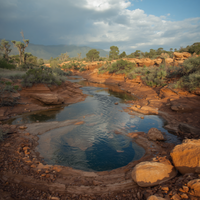
In many of the Dreamtime narratives that have been publicly shared, the Rainbow Serpent is understood as a creation being who moved across the landscape during the creative period — her movements shaping rivers, valleys, rock formations, and waterholes, bringing water to sustain all life. The landscape of Australia, in this understanding, is not simply geological terrain; it is the record of creation, a text written in country by the beings who made it.
The Rainbow Serpent is often described as feminine, or as encompassing feminine creative principle, though understandings vary between nations. She is associated with water — particularly with the waterholes and rivers that sustain life in a continent of extremes — and with the rainbow that appears after rain, bridging the sky and earth. Her colours, carried in the rainbow, reflect the full spectrum of what she contains.
She is also associated with law — the sacred law that governs right relationships between people, between people and country, between the human and non-human worlds. Her stories are not simply accounts of origins; they encode the principles by which life must be lived if the balance that sustains all things is to be maintained.
Sacred Symbols (publicly shared):
Water and waterholes — places where the Serpent dwells or emerged, understood as sacred sites deserving of respect. The rainbow — the bridge between earth and sky, the sign of her presence and blessing. The serpent form itself — associated with earth wisdom, regeneration, and the movement of creative force through landscape. Rock formations and rivers — the physical record of creation, alive with sacred meaning. The seasonal cycle of wet and dry — reflecting her governance of the rains that sustain all life.
Engaging Respectfully: What Non-Aboriginal People Can Do

The most meaningful engagement with Rainbow Serpent traditions available to non-Aboriginal people is not spiritual practice but ethical action: learning the history, supporting the communities, and applying the core teachings — about living in right relationship with the earth, about water as sacred rather than commodity, about custodianship rather than ownership — in one's own life.
Learn Aboriginal History:
Understanding what Aboriginal peoples have survived — and continue to navigate — is the prerequisite for any meaningful engagement with their cultural traditions. This means learning about the invasion, the frontier wars, the Stolen Generations, the policies of forced assimilation, the ongoing dispossession from land, and the current situation of Aboriginal and Torres Strait Islander peoples. This history is not ancient; its effects are present and ongoing.
Acknowledge Country:
Land acknowledgement — acknowledging the traditional custodians of the land on which you live, work, and gather — is a minimum form of respect that should be accompanied by genuine understanding of what it means. It is not a formula to be recited and forgotten; it is an acknowledgement of ongoing relationship and ongoing responsibility.
Learn from Aboriginal Sources:
Aboriginal authors, scholars, artists, and educators have shared a great deal of publicly accessible knowledge about their traditions, histories, and contemporary lives. Engaging primarily with Aboriginal voices — rather than with outside interpretations of Aboriginal culture — is both more accurate and more respectful.
Support Practically:
Support Aboriginal-led organisations working for land rights, cultural preservation, language revitalisation, and community wellbeing. Purchase from Aboriginal artists and businesses. Advocate for Aboriginal recognition and rights.
Apply the Core Teachings in Your Own Life:
The understanding of the earth as alive, of water as sacred, of human beings as custodians rather than owners of the land — these are teachings that the world urgently needs and that can be applied to one's relationship with one's own place without requiring adoption of Aboriginal spiritual practice. Attend to the land where you live. Treat water with genuine reverence. Ask what it means to care for rather than to use the place you inhabit.
Rainbow Meditation:
After rain, watch for rainbows and sit quietly with what they represent: the bridge between earth and sky, the full spectrum of creative possibility, the light that holds all colours within its apparent whiteness. This is available to anyone as a contemplative practice without requiring appropriation of Rainbow Serpent tradition specifically.
Explore More Goddess Archetypes →
Select your earth connection:
Aboriginal traditions are living cultures belonging to living peoples.
Always acknowledge traditional custodians. Learn from Aboriginal sources. Support Aboriginal sovereignty. Understand what has been survived before engaging with what has been created.
The Rainbow Serpent tradition offers teachings that the world urgently needs: