🪔 Muhurat Checker — Today's Panchang
Check whether today, or any date, is astrologically favourable — a real Panchang calculation (the five traditional elements: Tithi, Vara, Nakshatra, Yoga, and Karana) plus the daily Rahu Kalam, Yamaganda, and Gulika Kalam windows, calculated from real sunrise/sunset times using Swiss Ephemeris and the Lahiri ayanamsa.
Check a Date
Calculating the Panchang...
Working out Tithi, Nakshatra, Yoga, and Karana for this date
⚠️ Calculation Error
The Five Limbs (Panchang)
Windows to Avoid for New Beginnings
Understanding Muhurat & the Panchang
Choosing an auspicious time, the traditional way
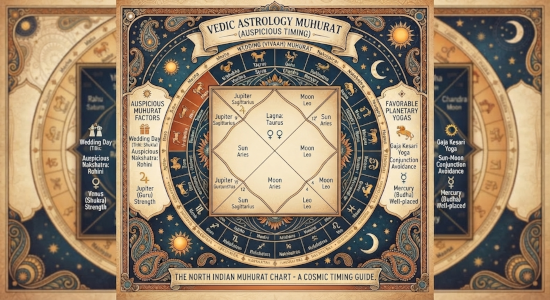
Muhurat is the branch of Jyotisha concerned with electing a favourable moment
for an activity — weddings, housewarmings, opening a business, starting a journey — rather
than reading a birth chart. It works in the opposite direction from a Kundli: instead of
taking a fixed past birth moment and describing a person permanently, Muhurat takes a
candidate date and checks whether the conditions on that day are favourable.
The Panchang — Five Limbs
Panchang literally means "five limbs" — the five elements calculated for every day: Tithi
(the lunar day, based on the angle between Sun and Moon), Vara (the weekday and
its ruling planet), Nakshatra (the Moon's lunar mansion for the day),
Yoga (a combined Sun-Moon angle with its own 27-fold cycle), and Karana
(a half-Tithi unit). Each carries its own traditional qualities, and together they form the
basis of whether a day is considered generally favourable.
Rahu Kalam, Yamaganda, and Gulika Kalam
Every day, regardless of how favourable the Panchang otherwise is, three specific windows are
traditionally avoided for starting anything new: Rahu Kalam (ruled by Rahu,
considered the most inauspicious of the three), Yamaganda (ruled by Yama, the
god of death — particularly avoided for travel and financial matters), and Gulika Kalam
(ruled by Gulika, son of Saturn — milder than the other two, but still generally avoided, and
traditionally believed to cause whatever is started then to repeat). Each is exactly one eighth
of the time between sunrise and sunset, with which eighth falls to each period determined by
the day of the week.
🪔 Muhurat Tips
Rahu Kalam: The most important window to avoid — traditionally takes priority over the other two if only one can be avoided.
Gulika Kalam: Milder than Rahu Kalam, but anything started during it is traditionally believed to repeat — useful to know for recurring purchases, unhelpful for one-off events.
Rikta Tithis: The 4th, 9th, and 14th of each lunar fortnight are traditionally considered "empty" and best avoided for new beginnings.