Ank Jyotish — Indian Numerology Calculator
Enter your name and date of birth to find your Mulank, Bhagyank and Lo Shu grid. A full guide to reading your numbers follows below the calculator.
Understanding Ank Jyotish
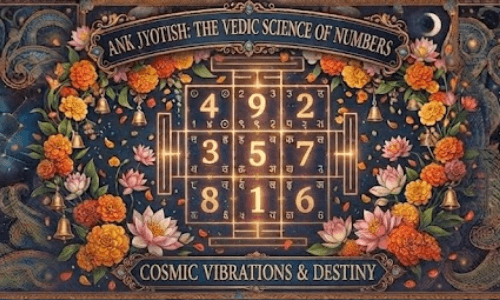
Ank Jyotish means "number astrology", the Indian tradition of numerology. Each number from 1 to 9 is linked with one of the nine planets (the Navagraha), and your birth date and name are read through those links. We treat the numbers as a lens for reflection rather than a fixed fate: a structured way of noticing your tendencies, the strengths you can rely on and the qualities that need more conscious work.
Mulank and Bhagyank
Mulank (root number) comes from the day of the month you were born, reduced to a single digit. It describes your temperament — how you think, react and approach other people. Its influence tends to show most clearly in everyday behaviour and in the earlier part of life.
Bhagyank (destiny number) comes from adding every digit of your full date of birth and reducing the total to a single digit. It describes the overall direction your life tends to take and where opportunities are most likely to come from. Its influence usually becomes more noticeable as you get older.
Most readings start with these two numbers together. When they support each other, your nature and your circumstances tend to pull the same way. When they clash, you may find that what you want and what life asks of you need more conscious balancing.
A Worked Example
Take someone born on 25 July 1966.
- Mulank: the birth day is 25, so 2 + 5 = 7. Mulank 7 is ruled by Ketu.
- Bhagyank: add every digit of 25-07-1966: 2 + 5 + 0 + 7 + 1 + 9 + 6 + 6 = 36, then 3 + 6 = 9. Bhagyank 9 is ruled by Mars.
- Harmony: Ketu treats Mars as a friend, so this Mulank and Bhagyank pairing is classed as friendly.
If you were born on the 1st to the 9th, your Mulank is simply your birth day. Anyone born on the 10th, 19th or 28th shares Mulank 1, because each reduces to 1.
Mulank 1 to 9 at a Glance
| Mulank | Born on | Planet | Core qualities |
|---|---|---|---|
| 1 | 1, 10, 19, 28 | Sun | Leadership, confidence, independence |
| 2 | 2, 11, 20, 29 | Moon | Sensitivity, imagination, care |
| 3 | 3, 12, 21, 30 | Jupiter | Learning, guidance, principle |
| 4 | 4, 13, 22, 31 | Rahu | Unconventional thinking, hard work, sudden change |
| 5 | 5, 14, 23 | Mercury | Communication, adaptability, business sense |
| 6 | 6, 15, 24 | Venus | Harmony, relationships, comfort, artistry |
| 7 | 7, 16, 25 | Ketu | Reflection, intuition, independence of mind |
| 8 | 8, 17, 26 | Saturn | Discipline, patience, slow but lasting results |
| 9 | 9, 18, 27 | Mars | Courage, energy, protectiveness |
The Lo Shu Grid
The Lo Shu square is the oldest known magic square: a 3×3 grid in which every row, column and diagonal adds up to 15. In Indian numerology it is used as a map of your birth date. Each digit of your date of birth is placed in its fixed cell, zeros are left out because zero has no planetary ruler, and your Bhagyank is added. Many practitioners also add the Mulank when the birth day has two digits, and our calculator follows that practice.
Using the same example, 25 July 1966 gives the digits 2, 5, 7, 1, 9, 6 and 6, plus the Bhagyank 9 and the Mulank 7:
| 99 | 2 | |
| 5 | 77 | |
| 1 | 66 |
Numbers that appear show qualities you have readily to hand. Repeated numbers show where that quality is especially strong, sometimes to the point of overdoing it. Here 3, 4 and 8 are missing, which points to planning, routine and practical management as areas that need deliberate effort.
Planes and Arrows
Each row, column and diagonal of the grid is read as a line. A complete line is a strength; an empty line is a quality to build on purpose.
- Mind Plane (4-9-2): thinking, planning and memory.
- Emotional Plane (3-5-7): feeling, intuition and emotional balance.
- Practical Plane (8-1-6): money, work and getting things done.
- Thought Plane (4-3-8): organising ideas and strategy.
- Will Plane (9-5-1): determination and follow-through.
- Action Plane (2-7-6): turning intentions into action.
- Diagonal 4-5-6: persistence and staying power.
- Diagonal 2-5-8: calm and steady judgement under pressure.
In the example grid, the Will Plane (9-5-1) and the Action Plane (2-7-6) are complete, while the Thought Plane (4-3-8) is empty — a person who acts decisively and finishes what they start, but who benefits from writing plans down before they begin.
Your Name Number
Indian numerology usually reads names with the Chaldean system, named after the ancient Chaldeans of Babylon and popularised in India by the numerologist Cheiro in the early twentieth century. Each letter is given a value from 1 to 8 based on its sound, and no letter is given 9. The letters of your full name are added to give a compound number, which is then reduced to a single digit. Because the name you use every day is the one you hear and answer to, it is the name usually read.
Your Personal Year
Alongside the fixed numbers, numerology tracks a nine-year cycle. Your Personal Year number is worked out from your birth day, birth month and the current year, and it describes the theme of the year you are in — beginnings in a 1 year, consolidation in a 4 year, completion in a 9 year. Personal Months break each year into smaller steps.
What Your Reading Includes
- Everyone: your Mulank and Bhagyank with their ruling planets, and today's personal number.
- Free members: fuller meanings, your Lo Shu grid and your Personal Year.
- Premium members: your planes and arrows, missing numbers explained, Chaldean name number, Mulank–Bhagyank harmony, your next 12 months, and favourable days, colours and dates.
Common Questions About Ank Jyotish
Which matters more, Mulank or Bhagyank?
What is my lucky number by date of birth?
How is Mulank and Bhagyank compatibility worked out?
Why are zeros left out of the Lo Shu grid?
What does it mean if a number is missing from my grid?
Should I use my birth name or the name I use now?
Should I change my name to get a better name number?
How is this different from Western numerology?
🔢 About Ank Jyotish
Mulank: your root number, from the day you were born.
Bhagyank: your destiny number, from your full date of birth.
Lo Shu grid: the numbers present and missing in your birth date.