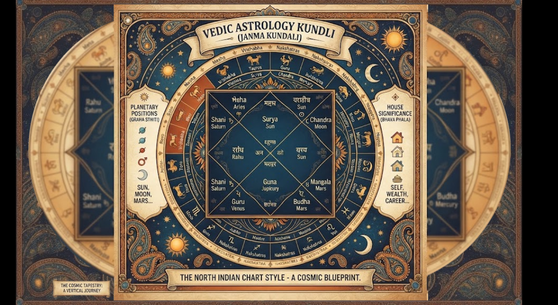
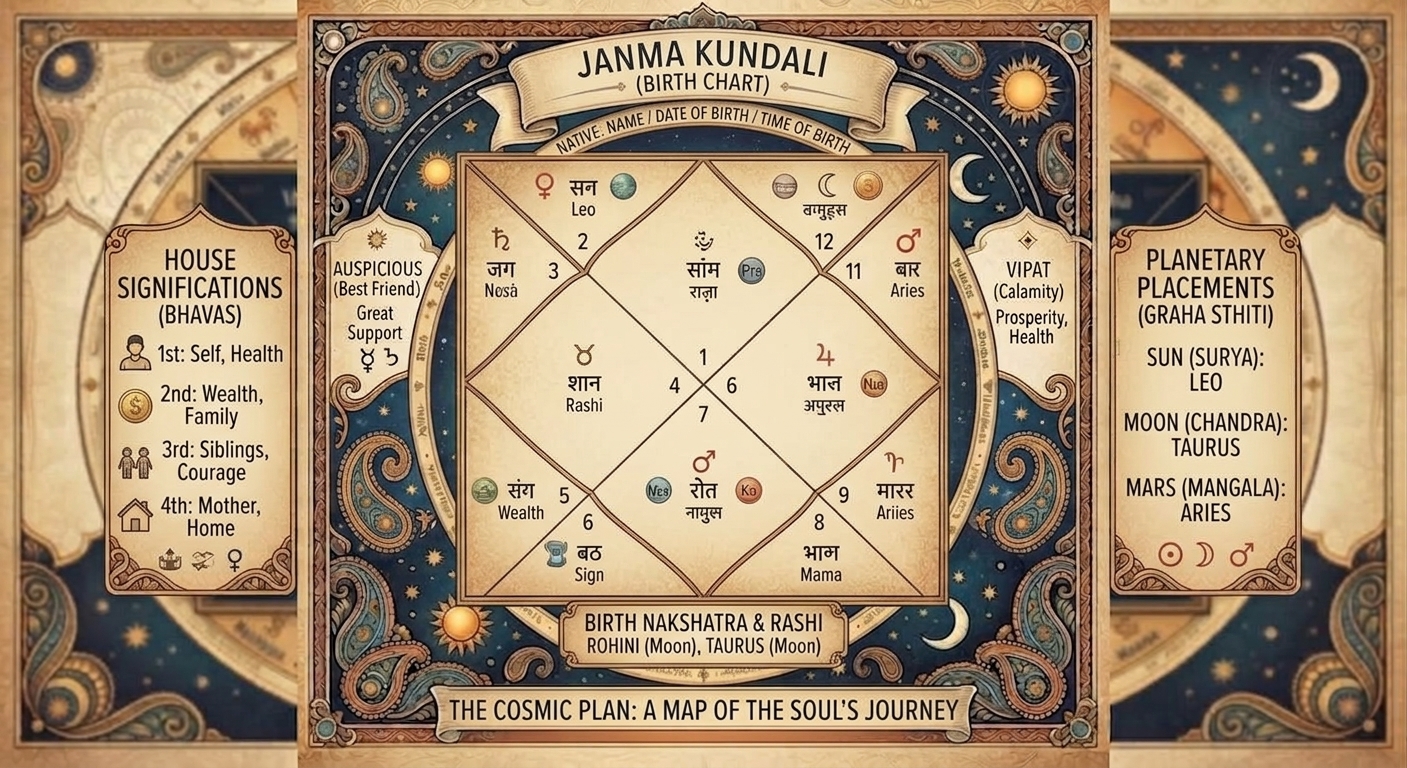
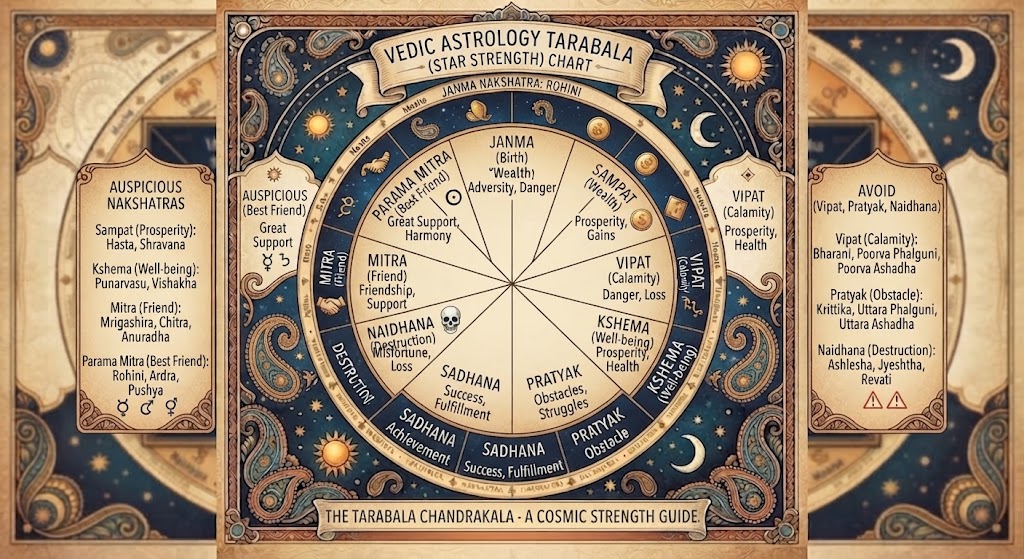
🕉️ Your Vedic Birth Chart (Kundli)
Generate your Jyotisha birth chart — the sidereal system of Vedic astrology, calculated using real astronomical positions (Swiss Ephemeris) and the Lahiri ayanamsa, the standard recognised by the Government of India's Calendar Reform Committee.
Generate Your Kundli
Calculating Your Kundli...
Consulting the sidereal positions of the Navagraha
⚠️ Calculation Error
Your Core Chart
Planetary Positions
Ayanamsa & Timezone
What Your Chart Means
Bhava — Houses (Whole Sign)
Vimshottari Dasha Timeline
Dosha Analysis
Understanding Your Jyotisha Chart
The Sidereal Zodiac, the Navagraha, and the Vimshottari Dasha
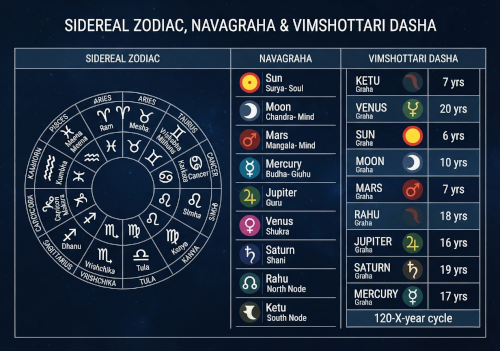
Jyotisha, meaning "science of light," is the traditional Vedic system of astrology. It differs
from Western astrology in one foundational respect: it uses the sidereal zodiac,
anchored to the actual positions of the constellations, rather than the tropical zodiac's
fixed relationship to the seasons. Because the Earth's axis slowly precesses, the two systems
have drifted apart by roughly 24 degrees over the centuries — the offset known as the
ayanamsa. This chart uses the Lahiri ayanamsa, the standard
adopted by India's Calendar Reform Committee and used in the Rashtriya Panchang, the country's
official calendar.
The Navagraha — Nine Planetary Influences
Jyotisha works with nine graha (planetary influences): the Sun (Surya), Moon (Chandra),
Mercury (Budha), Venus (Shukra), Mars (Mangal), Jupiter (Guru), Saturn (Shani), and the two
lunar nodes — Rahu and Ketu — the points where the Moon's
orbit crosses the ecliptic. Rahu and Ketu are not physical bodies but are treated as full
graha in their own right, associated respectively with worldly ambition and obsession, and
with detachment and spiritual insight.
Rashi, Bhava, and the Ascendant
Your Rashi is your Moon sign — in Jyotisha, the Moon's sidereal sign at birth
is considered at least as significant as the Sun sign, since it governs the mind and emotional
nature. The Lagna, or Ascendant, is the sidereal sign rising on the eastern
horizon at the moment of birth, and forms the basis of the twelve Bhava
(houses). This chart uses the Whole Sign house system — the classical and most
widely used method in Jyotisha — in which the entire sign containing the Ascendant becomes the
first house, the next sign the second house, and so on.
Nakshatra — The Lunar Mansions
The zodiac is also divided into 27 Nakshatra (lunar mansions) of 13°20' each,
a system unique to Vedic astrology. Each Nakshatra is further divided into four Pada
of 3°20'. Your Moon's Nakshatra and Pada at birth is traditionally the single most important
placement in the chart — it is the basis of naming conventions in many Indian families, of
compatibility matching (Kundli Milan), and of the Dasha timing system below.
Vimshottari Dasha — The Timing System
Where Western astrology uses transits to time events, Jyotisha's primary timing method is the
Vimshottari Dasha — a fixed 120-year cycle divided among the nine graha, each
ruling a Mahadasha (major period) of a set length, determined by the Moon's Nakshatra at birth.
Each Mahadasha further subdivides into nine Antardasha (sub-periods), giving a
detailed timeline of which planetary influences are most active at any point in life. Your
current running Mahadasha and Antardasha are highlighted in the results below.
Doshas
A Dosha is a specific planetary pattern traditionally associated with particular life
challenges. This tool checks for Mangal Dosha (also called Kuja Dosha or
Manglik) — Mars placed in a challenging house counted from the Ascendant, Moon, and Venus — and
Kaal Sarp Dosha — all seven classical graha hemmed between Rahu and Ketu.
Doshas are presented here in the traditional framing used across Jyotisha practice, including
the remedies traditionally prescribed for them.
How to Use This Tool
Enter your date, time, and place of birth. As with any birth chart, accuracy of birth time
matters most for the Ascendant and house placements — use your birth certificate time where
possible. Free members can access your core chart: Ascendant, Rashi, Nakshatra, and planetary
positions. Premium members also receive the full Vimshottari Dasha timeline and dosha analysis.
💫 Jyotisha Tips
Birth Time: The Ascendant shifts roughly every two hours — use your birth certificate time for accuracy.
Rashi vs Lagna: Your Moon sign (Rashi) governs mind and emotion; your Ascendant (Lagna) governs body and presentation. Both matter.
Dasha: Your running Mahadasha and Antardasha describe which planetary influence is most active right now.