Notifications (Click to mark read)
Sound has been a healing force in human history since ancient times. From Tibetan singing
bowls to Aboriginal didgeridoos, from Gregorian chant to Vedic mantra, cultures worldwide
have harnessed vibration to restore harmony to the body, mind, and spirit. These traditions
were not merely symbolic — they recognised something that contemporary research has begun
to examine seriously: sound affects the body in measurable ways, and certain kinds of
sound affect it differently from others.
The basic principle is resonance — the understanding that vibrations can influence other
vibrations. When a tuning fork is struck near another of the same frequency, the second
begins to vibrate in response without being touched. The body works similarly. Different
tissues, organs, and energy centres have their own natural frequencies, and sound that
corresponds to or complements those frequencies tends to support rather than disrupt
their functioning.
Research on sound and the nervous system has shown that certain acoustic environments
reliably shift physiological states — slowing heart rate, lowering cortisol, changing
brainwave activity. This is why some sounds calm us instantly and others create immediate
tension. The response is not merely psychological; it is physiological, and it operates
faster than conscious thought.
Sound healing practice draws from three broad sources, each with its own character
and applications.
Natural sound encompasses the original acoustic environment of our
planet — rain, wind, running water, birdsong, thunder, the sea. These sounds evolved
alongside human beings and speak directly to the nervous system in ways that artificial
sound rarely does. Spending time in natural acoustic environments — forests, coastlines,
open hillsides — tends to shift physiological state reliably and without effort. The
unpredictability of natural sound is part of its value: it invites presence and
surrender rather than control, which is itself a form of healing.
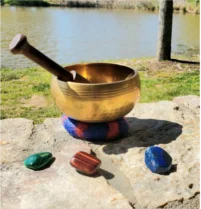
Created sound encompasses instruments and vocalisation specifically
used for therapeutic purposes. Tibetan singing bowls, crystal bowls, gongs, tuning
forks, drums, bells, and chimes all fall here. These instruments create complex
harmonic patterns — a fundamental tone plus multiple overtones — that move through
the body in ways a single pure tone cannot. The human voice is perhaps the most
powerful of all: when we chant, hum, or tone, our bones and tissues become resonant
chambers, and the body receives sound from the inside out as well as the outside in.
Recorded sound offers accessibility and consistency. Digital
recordings allow specific frequencies, binaural beats, and composed soundscapes
to be used as part of daily practice regardless of circumstances. Binaural beats —
slightly different frequencies played in each ear — create a perceived third frequency
in the brain that tends to entrain brainwave activity toward specific states: delta
frequencies support deep sleep and restoration, theta frequencies support meditation
and creative openness, alpha frequencies support relaxed attention, beta frequencies
support focus and cognition. While recordings lack the dimensional quality of live
sound, they are a practical and effective starting point.
Sound meditation brings the benefits of mindfulness together with vibrational
healing. Several approaches are worth exploring, from the simplest to the more
developed.
Toning uses sustained vowel sounds to create vibration from within.
Begin with a deep breath, then exhale with a long "Ahhh" and notice where in the
body you feel the resonance. Experiment with "Eee" for throat and head, "Ooo" for
face and sinuses, "Mmm" for the skull and upper palate, "Zzz" for teeth and jaw.
Five to ten minutes of toning consistently shifts state — it is one of the most
direct and underused sound practices available.
Mantra meditation uses specific syllables or phrases repeated with
intention. The repetition creates a sustained vibrational field that quiets mental
activity and focuses attention. Traditional mantras like "Om," "Ram," or the
Tibetan "Om Mani Padme Hum" have been refined over centuries for this purpose.
A common practice is 108 repetitions, counted on mala beads, which provides
both a vibrational and a contemplative anchor.
Sound bathing involves lying comfortably while instruments are
played around and above the body. Singing bowls, chimes, and gongs are most
commonly used. The intention is to allow sound to move through the body rather
than to analyse or respond to it — a practice of receptivity rather than activity.
Areas of the body that seem to respond particularly strongly to certain sounds
often indicate where energetic attention is most useful.
Binaural journeying uses headphones to deliver binaural recordings,
allowing the brain to entrain to specific frequency states. Theta frequencies
(4–8 Hz) support meditative depth and are commonly used for this kind of work.
A clear intention set before listening, followed by genuine surrender to the
sound rather than effort to direct the experience, tends to produce the
most productive sessions.
Nature immersion is the simplest and most accessible practice:
time spent in natural environments with distinctive soundscapes, with eyes closed
and attention expanded to receive the full spectrum of what is present. Noticing
how different sounds affect breathing, heartbeat, and the quality of thought is
itself a form of training in acoustic sensitivity.
In the framework of chakra work, each energy centre is associated with a specific
note and vowel sound. Toning through the chakras sequentially — spending three to
five minutes on each — provides a structured practice for balancing the entire
energy system. The correspondences most commonly used are:
Root Chakra — Note C, sound "Uh" as in "hut"
Sacral Chakra — Note D, sound "Ooo" as in "you"
Solar Plexus — Note E, sound "Oh" as in "go"
Heart Chakra — Note F, sound "Ah" as in "father"
Throat Chakra — Note G, sound "Eye" as in "high"
Third Eye — Note A, sound "Aye" as in "may"
Crown Chakra — Note B, sound "Eee" as in "see"
Working through this sequence while visualising the corresponding energy centre
combines vibrational and contemplative elements. Spontaneous emotional releases
or unexpected insights during this practice are common — they tend to indicate
areas where energy has been held rather than flowing freely.
Sound healing is both an ancient science and an intuitive art. The most useful
starting point is not to acquire instruments or recordings but to develop sensitivity
to sound already present — noticing what different acoustic environments do to
your nervous system, your breath, your level of mental activity. That sensitivity,
once cultivated, makes every subsequent practice more effective.
A singing bowl to mark the beginning and end of meditation, or five minutes of
simple humming during moments of stress, is sufficient to begin. As sensitivity
to vibration increases, the sounds and practices that support your particular
energy field will become more apparent. Trust that process rather than
accumulating techniques.
Sound used for crystal cleansing is worth mentioning specifically. Each crystal
has its own resonant quality, and sustained toning or bowl work in the presence
of crystals tends to refresh their energy field in the same way that intention
and light do. It is one of the gentler and more pleasant cleansing methods,
and the practice itself benefits the practitioner as much as the stones.