Notifications (Click to mark read)
Maiden of Calm
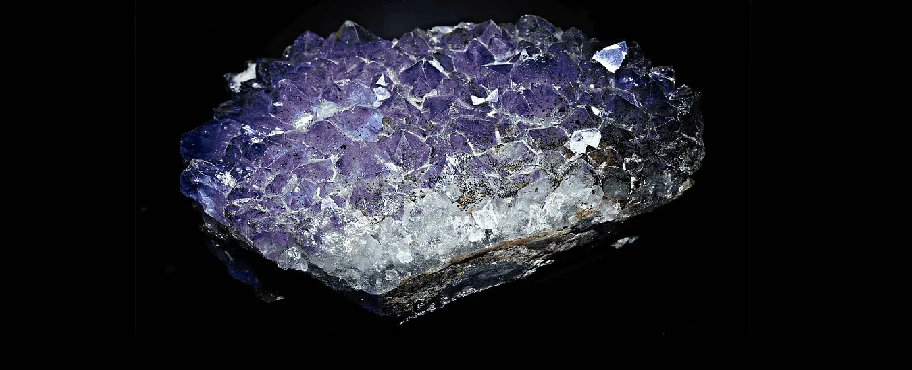
Amethyst is one of the most widely recognised and deeply worked crystals in the world, and its reputation is earned. It sits at the intersection of the spiritual and the psychological in a way that few stones match — simultaneously calming the surface noise of the mind and opening the deeper channels through which genuine insight and spiritual connection become available. Its purple colouration, ranging from pale lilac to rich violet, has long been associated with the higher mind and with the bridging of the ordinary and the sacred.
It is a stone of the third eye and crown chakras, and this placement tells you most of what you need to know about its primary function: Amethyst works at the level of perception and awareness. It does not push or provoke — its action is more like a gradual clearing, a quieting of the internal static that prevents us from seeing clearly what is actually present.
Physical Appearance and Structure
Amethyst is a variety of quartz, coloured by iron impurities within its hexagonal crystal structure. The colour varies considerably depending on origin: Brazilian Amethyst tends toward deep violet; African varieties often produce a more saturated, darker purple; Uruguayan specimens are prized for their intense colour and fine crystal points. The pale lavender variety sometimes called Rose de France sits at one end of the spectrum; the deepest Siberian grades at the other.
As a member of the quartz family, Amethyst inherits quartz's amplifying properties alongside its own distinct qualities. It does not merely carry energy — it increases the intensity of what is already present in the field around it. This means it works well in combination with other stones, amplifying their effects, and also that it rewards intentional placement and clear intention-setting by the practitioner.
The Third Eye and Crown Chakras
Amethyst's primary associations are with the third eye — the centre of intuitive perception and inner vision — and the crown, the point of connection with the higher self and divine consciousness. Working with Amethyst at these centres during meditation supports two related but distinct capacities: the ability to perceive clearly what is happening in one's inner life, including the root causes of habitual patterns; and the ability to open to guidance and spiritual connection beyond the personal mind.
It is particularly helpful for those who feel disconnected from the earth plane — who carry a persistent sense of not quite belonging here, or a longing for a home they cannot locate in ordinary life. This quality of homesickness for somewhere undefined is a recognised experience in spiritual traditions, and Amethyst addresses it not by anchoring the person more firmly to the physical world but by strengthening the connection to their spiritual source — which tends to reduce the longing by replacing its root cause.
Placed at the crown during meditation, Amethyst facilitates communication with guides and with one's higher self. It supports the quality of surrendered attention that genuine spiritual contact requires — not passive, but open; not effortful, but alert. It assists in what some traditions call assuming one's spiritual power: the recognition and embodiment of one's own deeper nature rather than a continued search for it outside oneself.
Emotional Properties
At the emotional level, Amethyst is most effective in situations of confusion, compulsion, and misalignment — where the person knows, at some level, that their behaviour or thought patterns are not serving them, but cannot seem to interrupt them through willpower alone. It works by illuminating rather than suppressing: bringing the root causes of behaviours, habits, and emotional patterns into clearer view, so that the pattern can be seen for what it is rather than simply felt as an irresistible force.
Its calming quality is genuine and consistent. Placed near the bed or under a pillow, it reduces the quality of anxious, circling thought that can prevent sleep — not by inducing unconsciousness but by settling the mind's tendency to rehearse and anticipate. For nightmares specifically, it is one of the most widely used crystals, and many people report a noticeable improvement in the quality and content of dreams within a few nights of consistent use.
It also assists in reducing the dominance of emotion-based decision making — the pattern of choosing based on how something feels in the moment rather than on genuine guidance or considered values. This is not about suppressing emotion, which Amethyst does not do, but about introducing a quality of spaciousness between the emotional impulse and the response, so that choice becomes available where before there was only reaction.
Spiritual Properties
Amethyst creates what is often described as a cocoon of light around the aura — a quality of energetic protection that filters what enters the field without closing it down. This is distinct from heavy shielding, which tends to reduce receptivity alongside reducing intrusion. Amethyst's protection is more discriminating: it supports openness to genuine spiritual input while reducing the absorption of psychic noise and others' energetic material.
Clusters, geodes, and larger natural pieces placed around the home extend this quality into the environment. A room with Amethyst present tends to carry a different quality of atmosphere — quieter, more settled, with a subtle sense of being held — that many people notice even without knowing the stone is there. This is the practical expression of the bubble of light quality that practitioners describe: not a theatrical effect but a genuine shift in the energetic character of a space.
For those developing intuitive and psychic abilities, Amethyst stimulates the mind centres in a way that increases sensitivity and receptivity while maintaining a quality of calm discernment. It supports the connection to the spirit realm without the quality of ungroundedness that can accompany opening the higher centres too quickly or without sufficient support.
Physical Healing Associations
Amethyst has one of the longest traditions of use as a stone for addiction and addictive behaviour. The etymology of its name reflects this — from the Greek amethystos, meaning not intoxicated — and the traditional use predates modern crystal healing by millennia. In contemporary practice it is understood to work on the energetic and neurological patterns underlying addiction rather than on the chemical dependency itself, supporting the individual's connection to their higher self and reducing the compulsive quality of habitual behaviour.
It is also associated with the nervous system and brain, supporting balance and regulation. Insomnia, safe travel, stress and anxiety, creativity, and the easing of nightmares are all within its traditional range of associations. As an amplifier, it works well alongside other stones chosen for specific physical concerns, enhancing their effect without overriding their particular quality.
Working with Amethyst
The most direct use is in meditation, held in the hands or placed at the third eye or crown. Even a few minutes of deliberate contact with clear intention will establish a working relationship with the stone's qualities. For sleep and dream work, place it near or under the pillow, with a simple intention set before sleeping.
For environmental use, a cluster or geode placed in the main living space shifts the quality of the entire room's atmosphere. Points directed inward toward the centre of a space concentrate the effect; points directed outward extend it. Amethyst placed in the four corners of a room creates a continuous and stable field that many practitioners find supportive for meditation, creative work, and genuine rest.
Carried in a pocket or worn as jewellery, it maintains a continuous quality of calm clarity and auric protection throughout the day — particularly useful during periods of emotional difficulty, demanding social situations, or any context in which you need to remain clear and centred under pressure.