🕉️ What Is Vedic Astrology?
A clear guide to Jyotisha — its history, its terms, and how the system works
Vedic astrology, known in Sanskrit as Jyotisha — "the science of light" — is
the astrological tradition that grew up alongside the Vedas in the Indian subcontinent. It maps
the positions of the Sun, Moon, and planets at the exact moment of a person's birth, and reads
that configuration through a body of classical rules refined over more than two thousand years.
This page sets out where that tradition comes from, what its core terms actually mean, and how
the system fits together, so that the rest of the Vedic tools on this site make sense whether
or not you've encountered any of this before.
History
Jyotisha's roots reach back to the Vedas themselves, the oldest sacred texts of the Indian
subcontinent, where getting ritual timing right mattered enough to become one of the six
Vedanga — the traditional support disciplines built up around Vedic study. The earliest
surviving astronomical text, the Vedanga Jyotisha, attributed to the sage
Lagadha, was concerned chiefly with the calendar: tracking the Sun and Moon closely enough to
fix the correct days for sacrifice and ceremony.
The system grew into a full art of chart reading over the centuries that followed. The
Brihat Parashara Hora Shastra, attributed to the sage Parashara, is treated as
the foundational classical text, setting out the framework of grahas, houses, and planetary
periods still in use today. A few centuries later, the astronomer-mathematician
Varahamihira (6th century CE) consolidated and extended this material in works
such as the Brihat Jataka and the Brihat Samhita, drawing on India's own long observational
tradition alongside ideas that had reached the subcontinent through trade and travel — a
genuine exchange of knowledge rather than a one-way borrowing.
Jyotisha never faded into obscurity as it aged. It stayed in continuous use through the
medieval and colonial periods and into the present, and in 1952, independent India's Calendar
Reform Committee formally adopted the Lahiri ayanamsa as the national standard
— the same reference point this site's tools use. Today, Jyotisha is practised daily across
India and its diaspora, consulted for naming ceremonies, marriage compatibility, and the timing
of significant events, by professional astrologers, family elders, and temple priests alike.
Key Terms
Several Sanskrit and Hindi terms recur throughout this site's Vedic tools, and it helps to have
them in plain terms before working with a chart.
A Graha is one of the nine points Jyotisha tracks: the Sun (Surya), Moon
(Chandra), Mercury (Budha), Venus (Shukra), Mars (Mangal), Jupiter (Guru), Saturn (Shani), and
the two lunar nodes, Rahu and Ketu. The nodes aren't physical
bodies — they mark where the Moon's path crosses the Sun's — but the system works on the
principle that they carry real influence in their own right, and they're read alongside the
seven visible grahas as a complete set of nine.
Your Rashi is your Moon sign: the sign the Moon occupied at the moment of your
birth. In Jyotisha, the Rashi is treated as at least as significant as the Sun's position,
since it's read as the seat of mind and emotional temperament — it's the placement most people
mean when they ask for someone's "sign" in a Jyotisha context.
The Lagna, or Ascendant, is the sign rising on the eastern horizon at the
exact moment of birth. It sets the frame for the twelve Bhava — the houses —
which map different areas of life onto the chart, starting from the Lagna itself as the first
house.
A Nakshatra is one of 27 lunar mansions, each spanning 13°20' of the zodiac,
that give Jyotisha its finer resolution. Each Nakshatra divides further into four
Pada. The system works on the principle that the Moon's Nakshatra at birth is
the single most load-bearing placement in a chart — it's what many Indian naming conventions
are built from, and it's the starting point for the Dasha timing system below.
A Dasha is a planetary period. Vimshottari Dasha, the system
used across this site's tools, shares a person's life out across a fixed 120-year cycle divided
among the nine grahas, with the sequence and starting point set by the birth Nakshatra. Each
major period (Mahadasha) breaks down further into nine sub-periods (Antardasha), giving a
detailed timeline of which planetary influence is considered most active at any given point in
a person's life.
A Dosha is a specific planetary pattern that classical Jyotisha associates
with particular challenges — Mangal Dosha and Kaal Sarp Dosha are the two most commonly
checked. The tradition works on the principle that a Dosha isn't a verdict so much as a flag:
most classical texts pair each Dosha with remedies, and many Doshas are considered reduced or
cancelled outright by other factors elsewhere in the same chart.
The Ayanamsa is the angular gap between the sidereal and tropical starting
points of the zodiac, caused by the slow wobble of the Earth's axis over long timescales. This
site's tools use the Lahiri Ayanamsa, the value adopted as India's national
standard.
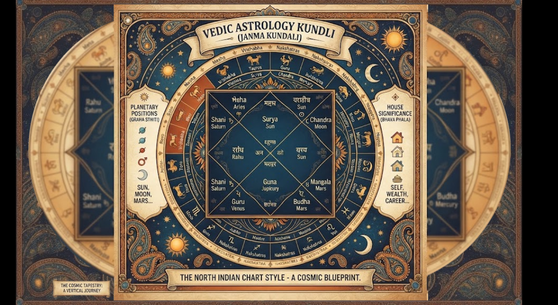
Finally, a Kundli is simply the finished chart itself — a map of where every
graha sat, by Rashi, Bhava, and Nakshatra, at the moment you were born.
How the System Works
Jyotisha works on the principle that the exact configuration of the nine grahas at the moment
of birth leaves a lasting imprint, and that this configuration can be read back out through a
consistent, rule-based method rather than guesswork. Four pieces come together to do that: the
sidereal zodiac fixes where each graha actually sat against the visible constellations, using
the Ayanamsa as its reference offset; the Navagraha supply the nine influences being tracked;
the Nakshatra and Pada divide the zodiac finely enough to place the Moon with real precision;
and the Vimshottari Dasha turns that Nakshatra placement into a timeline, sequencing which
influence is considered most active across a lifetime. Read together, a Rashi, a Lagna, a set
of Bhava, and a running Dasha describe not just a static picture of a person but an unfolding
one.
Frequently Asked Questions
What is Vedic astrology?
Vedic astrology, known in Sanskrit as Jyotisha ("the science of light"), is the astrological tradition that developed alongside the Vedas in the Indian subcontinent. It maps the positions of the Sun, Moon, and planets at the moment of birth and reads that configuration through a body of classical rules built up over more than two thousand years.
How is Vedic astrology different from Western astrology?
The clearest technical difference is the zodiac each system anchors itself to. Western astrology uses the tropical zodiac, fixed to the seasons; Jyotisha uses the sidereal zodiac, fixed to the actual constellations. Because the Earth's axis slowly precesses, the two have drifted about 24 degrees apart over the centuries — the gap known as the Ayanamsa. Beyond that starting point, Jyotisha also brings its own distinct tools, particularly the Nakshatra system and Vimshottari Dasha timing, that don't have a direct Western equivalent.
What is a Kundli?
A Kundli is a Vedic birth chart — a record of exactly where each planet sat, by sign, house, and Nakshatra, at the date, time, and place of a person's birth. It's the starting point for every other reading in the system.
Why does my exact birth time matter so much?
The Lagna (Ascendant) — which sets the entire house framework of the chart — shifts roughly once every two hours. An inaccurate birth time can place the wrong sign on the horizon and throw off every house placement that follows, so Jyotisha treats a precise, ideally certificate-sourced birth time as essential rather than optional.
What is a Nakshatra?
A Nakshatra is one of 27 lunar mansions that divide the zodiac more finely than the twelve signs alone. Your Moon's Nakshatra at birth is considered the most detailed personal placement in the chart, and it's the basis for the Vimshottari Dasha timeline.
What is a Dasha period?
A Dasha is a planetary period — a stretch of time during which one of the nine grahas is considered the dominant influence in a person's life. Vimshottari Dasha, the standard system, lays out a fixed 120-year cycle determined by the birth Nakshatra, broken into major and minor sub-periods.
What is a Dosha, and is it something to worry about?
A Dosha is a specific planetary combination — Mangal Dosha and Kaal Sarp Dosha are the most commonly discussed — that classical texts associate with particular challenges. Traditionally a Dosha comes paired with remedies, and many are considered reduced or cancelled by other factors elsewhere in the same chart, so it's read as one factor among many rather than a fixed outcome.
Is Vedic astrology part of Hinduism?
Jyotisha grew up alongside Vedic ritual and Hindu religious practice, and it's still used today to time ceremonies such as weddings and namings. But it's studied and practised as its own discipline, with its own texts, calculations, and professional tradition, and people outside any particular faith engage with it as a chart-reading system in its own right.
Is there any science behind it?
The astronomy behind Jyotisha — the sidereal positions of the Sun, Moon, and planets — is calculated using genuine, verifiable orbital mechanics; this site's tools use the Swiss Ephemeris for that part. The interpretive layer — what a given placement is said to mean — is a traditional framework refined over centuries of recorded practice, not a claim tested by the scientific method, and it's worth approaching it with that distinction in mind.
Can Vedic astrology predict the future?
Jyotisha is traditionally used less to predict fixed, unavoidable outcomes and more to describe tendencies, timing, and the kind of influences likely to be active during a given period — most classical guidance pairs a difficult placement with a remedy, on the premise that awareness and action can shape how it plays out.
🕉️ Vedic Tools
Jyotisha: Generate your full Vedic birth chart (Kundli).
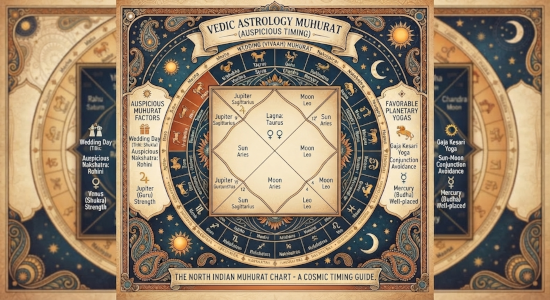
Muhurat: Check whether a given date is generally astrologically favourable.
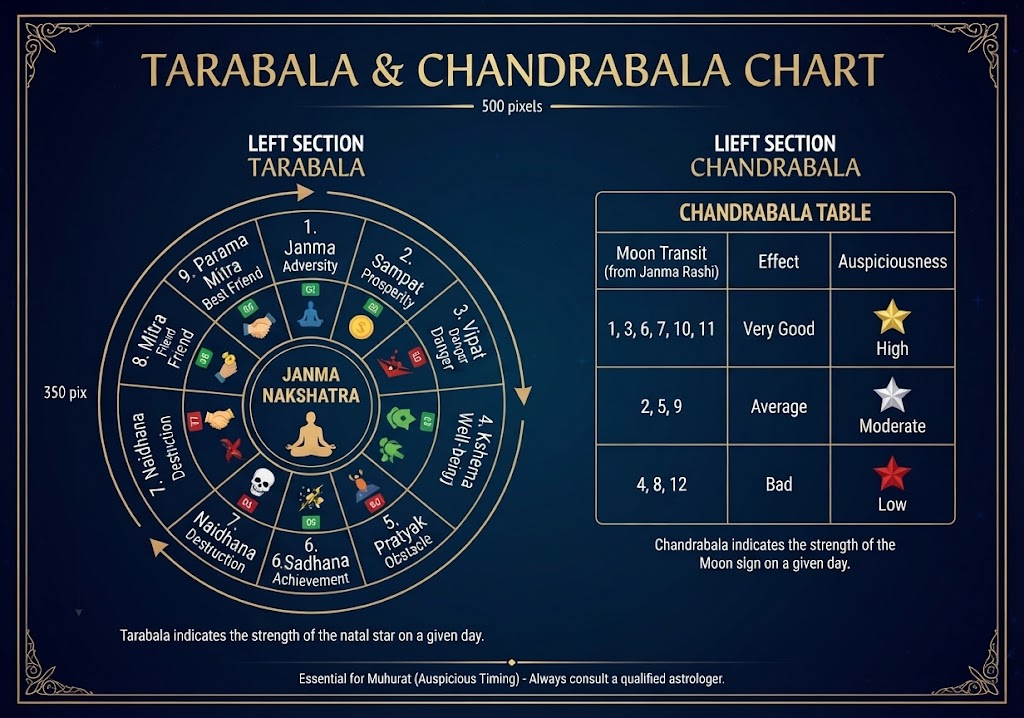
Tarabala & Chandrabala: Check whether a date favours you personally, using your own Nakshatra and Moon sign — premium members can go further with a full 7-day Gochara transit report from there.