Notifications (Click to mark read)
 The Ifá system contains sophisticated mathematical structures that reveal deep connections between spiritual wisdom and mathematical principles. These patterns encompass binary logic, fractal geometry, probability theory, and algorithmic processes that demonstrate advanced understanding of mathematical concepts.
Beyond simple binary representation, Ifá mathematics includes complex symmetries, transformational matrices, statistical distributions, and geometric progressions that parallel discoveries in modern mathematics and quantum physics.
Mathematical Foundation:
The system operates on multiple mathematical levels simultaneously: combinatorial (256 patterns), probabilistic (casting outcomes), geometric (visual patterns), and algebraic (transformation rules).
Explore Binary Patterns...
Sacred Geometric Structures
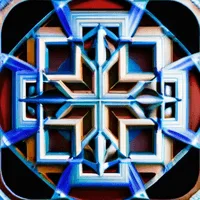
Ifá patterns embody fundamental geometric principles that create visual harmonies and structural relationships reflecting cosmic order and natural law.
Symmetry and Balance:
• Vertical Symmetry:
The 16 Major Odù display perfect vertical symmetry with identical top and bottom halves, representing perfect balance and self-contained energies.
• Horizontal Reflection:
Complementary Odù pairs (like Ogbe 1111 and Oyeku 0000) demonstrate horizontal reflection principles creating cosmic balance through opposition.
• Rotational Patterns:
Certain Odù maintain their identity under 180-degree rotation, revealing rotational symmetry that suggests cyclical natural processes.
Fractal Properties:
• Self-Similarity:
Individual Odù patterns repeat at different scales within combination structures, creating fractal-like recursive patterns.
• Scale Invariance:
The same mathematical relationships appear at the level of individual marks, complete Odù, and combinations of multiple readings.
Golden Ratio Relationships:
• Proportional Harmony:
The 16:256 ratio (major to total Odù) approximates golden ratio proportions found throughout natural systems and aesthetic compositions.
• Fibonacci Connections:
Certain Odù sequences follow Fibonacci-like progressions when analyzed numerically, suggesting deep connections to natural growth patterns.
Mandala Structures:
When arranged circularly, the 16 Major Odù create mandala-like patterns that demonstrate radial symmetry and geometric harmony.
Numerical Relationships and Sequences

The numerical structure of Ifá reveals sophisticated mathematical relationships that govern pattern generation, combination rules, and interpretive hierarchies.
Powers of Two Foundation:
• Binary Progression:
The system is built on powers of 2: 2¹ (marks), 2⁴ (leg patterns), 2⁸ (complete Odù), creating a perfect binary mathematical structure.
• Information Theory:
Each additional bit doubles the information capacity, following Claude Shannon's information theory principles with 8 bits providing exactly 256 states.
Prime Number Relationships:
• 16 as Base:
The 16 Major Odù represent fundamental prime-like elements that cannot be further reduced, serving as building blocks for all combinations.
• Factorization Patterns:
The 256 total patterns factor as 16², revealing the elegant mathematical relationship between components and totality.
Modular Arithmetic:
• Cyclic Operations:
Odù transformations follow modular arithmetic rules, creating predictable cycles and transformation sequences.
• Group Theory:
The set of Odù transformations forms mathematical groups with identity elements, inverses, and closure properties.
Statistical Distributions:
• Equal Probability:
Each bit position has exactly 50% probability of being open or closed, creating uniform distribution across all possible patterns.
• Combinatorial Analysis:
The number of ways to achieve specific patterns follows precise combinatorial formulas, enabling probability calculations for any configuration.
Algorithmic Processes and Transformations

Ifá contains algorithmic processes that transform patterns according to precise mathematical rules, creating systematic methods for generating guidance and interpretation.
Boolean Operations:
• XOR Transformations:
Exclusive OR operations between Odù patterns reveal hidden relationships and generate new combinations following logical rules.
• AND/OR Logic:
Boolean AND and OR operations create families of related Odù that share specific characteristics or ancestral patterns.
• NOT Operations:
Binary complement operations (flipping all bits) create Odù pairs that represent perfect opposites and complementary energies.
Matrix Transformations:
• Rotation Matrices:
Specific mathematical matrices can rotate Odù patterns to reveal rotational relationships and cyclic transformations.
• Reflection Matrices:
Transformation matrices create mirror images and symmetric relationships between different Odù patterns.
Recursive Algorithms:
• Self-Referential Patterns:
Certain Odù generation processes reference previous patterns in their creation, following recursive mathematical principles.
• Iterative Refinement:
Divination processes use iterative algorithms that refine interpretation through successive approximations and pattern matching.
Error Correction Codes:
• Redundancy Checks:
Traditional casting methods include verification procedures that parallel error-correcting codes in digital communication systems.
• Parity Verification:
Multiple casting rounds create parity checks that ensure accuracy and detect potential errors in pattern recognition.
Quantum Mathematical Parallels

The mathematical structure of Ifá demonstrates remarkable parallels with quantum mechanics, suggesting fundamental principles that govern both spiritual and physical reality.
Superposition Principles:
• State Uncertainty:
Before casting, all 256 Odù exist in superposition, with the observation (divination) collapsing the system into a specific configuration.
• Wave Function Analogies:
The probability distributions of Odù outcomes follow wave-like mathematical patterns similar to quantum wave functions.
Entanglement Mathematics:
• Correlated Patterns:
The two legs of an Odù demonstrate mathematical correlation where changing one affects the meaning of the other instantaneously.
• Non-Local Connections:
Ifá mathematics suggests non-local correlations between patterns that transcend spatial and temporal limitations.
Uncertainty Relations:
• Complementary Variables:
Certain aspects of Odù interpretation follow uncertainty principles where precise knowledge of one aspect limits knowledge of complementary aspects.
• Observer Effects:
The mathematical formalism includes observer effects where the diviner's consciousness influences the probability distributions of outcomes.
Quantum Computing Analogies:
• Parallel Processing:
Ifá interpretation processes multiple possibilities simultaneously, similar to quantum parallel processing capabilities.
• Quantum Gates:
Odù transformations function like quantum logic gates, manipulating information according to precise mathematical rules.
Information Processing:
The 8-bit Odù structure provides exactly the information density needed for complex guidance while maintaining practical usability, paralleling optimal quantum information encoding.
Advanced Mathematical Applications

The mathematical principles of Ifá find applications in modern computational theory, artificial intelligence, and complex systems analysis, demonstrating the universal nature of these ancient insights.
Machine Learning Parallels:
• Pattern Recognition:
Ifá practitioners develop pattern recognition capabilities similar to neural network training, learning to identify subtle relationships and configurations.
• Training Algorithms:
The traditional learning process follows algorithms similar to supervised machine learning, with experienced practitioners providing labeled examples.
Cryptographic Applications:
• Random Number Generation:
Traditional casting methods generate sequences with cryptographic-quality randomness suitable for secure applications.
• Hash Functions:
Odù patterns can serve as hash functions that compress complex questions into specific guidance patterns with minimal collision probability.
Systems Theory:
• Complex Adaptive Systems:
Ifá mathematics models complex adaptive systems where simple rules generate emergent complexity and self-organization.
• Network Analysis:
The relationships between Odù create network structures amenable to graph theory analysis and network science methods.
Optimization Algorithms:
• Decision Trees:
Ifá interpretation follows decision tree algorithms that optimize guidance selection based on pattern matching and contextual analysis.
• Genetic Algorithms:
The evolution of Odù interpretations over time follows processes similar to genetic algorithms with selection, mutation, and crossover operations.
These mathematical insights suggest that Ifá represents an intuitive understanding of fundamental computational and information-theoretic principles that modern science is only beginning to fully appreciate and formalize.
Explore Combination Meanings...