Notifications (Click to mark read)
Poet's Stone
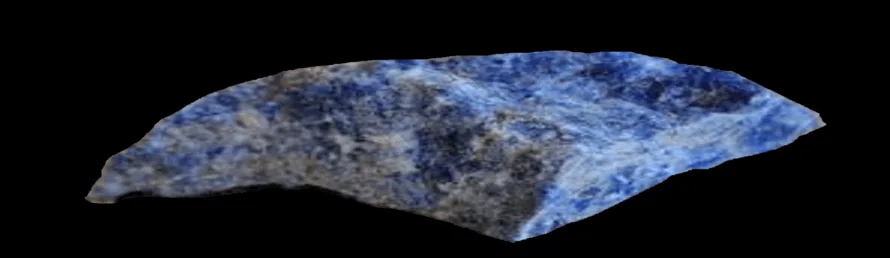
Sodalite earns its common name — the Poet's Stone — honestly. Where many blue stones are prized for dreamy, floating qualities, Sodalite's reputation runs in almost the opposite direction: it is a stone of clarity, logic, and articulate expression. Deep royal blue, often threaded with white calcite veining, it has a grounded, almost architectural presence that reflects its function — this is a stone for organising thought, not dissolving it.
It belongs to the same mineral family as Lapis Lazuli, and the two are often confused at a glance, but their working qualities diverge in an important way. Lapis leans toward mystical insight and royal, ceremonial connection to higher truth; Sodalite leans toward the practical application of insight — taking what intuition surfaces and giving it clear, communicable shape. This is why writers, teachers, and anyone who needs to translate inner knowing into words gravitate toward it specifically.
Physical Appearance and Structure
Sodalite forms in an isometric lattice, most often found massive rather than in well-formed individual crystals, which is why it's typically worked as tumbled stones, carvings, and cut cabochons rather than points or clusters. Its deep blue colour comes from its sodium chloride content, and the characteristic white veining is calcite, present in varying amounts depending on the deposit — Brazilian material tends toward a richer, more uniform blue, while Canadian sodalite (sometimes called Princess Blue) often shows bolder white striping.
It is frequently mistaken for Lapis Lazuli in photographs, but the two are easy to tell apart in hand: Lapis typically carries flecks of golden pyrite, while Sodalite's inclusions are white calcite. This distinction is more than cosmetic — it reflects genuinely different mineral compositions and, in crystal work, different qualities of energy.
The Throat and Third Eye Chakras
Sodalite bridges the throat and third eye chakras — the centre of expression and the centre of inner sight — and its core function is to connect the two directly. Insight that stays only at the third eye remains private, unshared, sometimes even unclear to the person having it. Sodalite's work is to move that insight downward into a form that can be spoken, written, and communicated without losing its truth in translation.
This makes it a particularly useful stone during any period of preparing to speak or write something that matters — a difficult conversation, a piece of creative work, a teaching, an argument that needs to be made clearly. Worn at the throat, it supports steady, considered expression rather than reactive or scattered speech; held at the third eye during quiet reflection beforehand, it helps clarify what actually needs to be said before you try to say it.
Emotional Properties
Sodalite cultivates detachment — specifically, detachment from the smaller, circling concerns of daily life that can crowd out perspective. It doesn't numb feeling; it creates distance from the reactive intensity of a worry so that it can be seen from a calmer, more elevated vantage point. Many people describe this as being able to see their situation rather than being fully inside it, which reliably reduces the felt intensity of stress and anxiety even before anything about the situation itself has changed.
It is also traditionally used to steady mood swings, particularly where those swings are driven by overthinking or looping mental patterns rather than external circumstance. Because Sodalite's action is primarily on the rational mind rather than the emotional body, it tends to work well alongside more emotionally-focused stones rather than in place of them.
Spiritual Properties
Sodalite acts as what many practitioners call a signpost stone — it doesn't tell you where to go, but it sharpens your ability to notice where your own path is already pointing. This is a subtly different function from stones that deliver visions or dramatic insight; Sodalite's contribution is closer to mental hygiene, clearing away noise and confusion so that a path already present in your inner knowing becomes visible.
It also serves as a steady companion for inner travel — meditation and dream work aimed at exploration rather than passive rest. Practitioners often keep a piece nearby specifically for dream recall and lucid dreaming practices, where the stone's clarifying quality is thought to carry over into the dream state itself, producing dreams that are more coherent and easier to remember and interpret on waking.
Physical Healing Associations
In energy work, Sodalite is associated with the regulation of blood pressure and with easing water retention and cellular hydration. It is also linked to the throat and thyroid more broadly, in keeping with its chakra placement, and to the metabolic balance that the throat centre is traditionally understood to govern.
Working with Sodalite
Worn as jewellery — a pendant at the throat, or earrings near the head — Sodalite maintains continuous contact with both of its associated centres throughout the day, which is part of why it's so often worked with in this form rather than simply carried or placed. For focused sessions, holding a piece at the throat while journaling or preparing notes for a difficult conversation is a direct and practical use of its expressive quality.
For writers, teachers, and public speakers specifically, keeping a piece on the desk or lectern is a long-standing practice — not as a talisman for eloquence, but as a steady reminder of the stone's core function: to keep what's said connected to what's actually known and felt underneath it.
The Noble Silence

“I'll forgive them when I understand why they did it.” Few sentences sound more reasonable than this one. It carries the weight of fairness rather than resentment, as though forgiveness should be earned honestly instead of handed out because enough time has passed. To forgive before understanding…
Read More..
Feelings

A picture is worth a thousand words. - Fred R. Barnard.
Read More..
Oshun – Goddess

...
Read More..
Are You Washing The Dishes
Time to reconnect to this NOW, this time and place.
Read More..
Ebook Download
Download it here
Read More..