Notifications (Click to mark read)
Idocrase
Origin: Italy, Cyprus, Canada and the United States
Lattice: Tetragonal
Shapes: Natural, tumbled, polished
Chakra: Heart
Placement: Anywhere near the heart
Pairing: Green Selenite to aid in forgiveness
Element: Earth
Affirmation: Allow me to find and follow my heart's desire
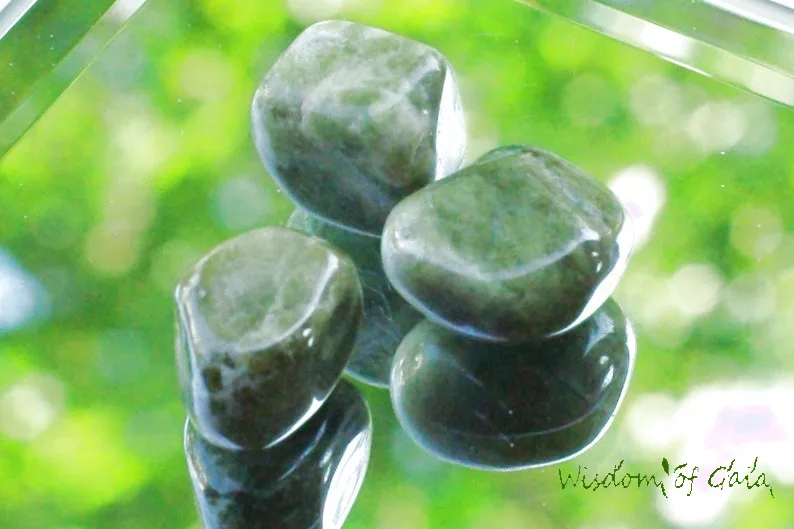
This benign-looking gem was first discovered on the slopes of Mount Vesuvius in Italy, found within lava deposits — hence its name. Also known as idocrase, it forms under conditions of intense heat and pressure, where limestone comes into contact with magma and is transformed through a process called contact metamorphism. That fiery origin is not merely geological trivia. It points to something about the stone's character: Vesuvianite is a transformer.
Its colours range from olive and yellow-green through to brown, blue, and occasionally purple, with the vivid green variety sometimes marketed as californite. The stones found in gem-quality deposits in Canada and the United States tend toward a cleaner, more translucent appearance, while Italian specimens often carry the deeper, earthier tones of their volcanic matrix.
Vesuvianite is tied to the Heart Chakra, where it is thought to aid the smooth flow of energy and clear blockages that accumulate through unexpressed emotion or prolonged stress. Unlike many heart stones that work primarily through softening — encouraging receptivity and gentleness — Vesuvianite has a more active quality. It does not simply calm chaos. It reorders it.
Its most commonly cited gift is the transmutation of difficult states: anger redirected into purposeful action, confusion resolved into clarity and focus. For those who find themselves cycling through the same emotional loops without resolution, Vesuvianite is considered a useful working stone — one that helps break the pattern rather than simply soothe it.
It is also associated with the release of fear and old conditioning, including patterns absorbed in childhood or carried from earlier periods of life that continue to operate below conscious awareness. In this sense it works as much on the subconscious as on the surface mood.
Aids in releasing fear and old patterns that may be held in the subconscious and continue to shape present behaviour. Supports the kind of honest self-examination that makes genuine change possible rather than simply temporary relief.
Thought to furnish a connection to the higher self and support access to deeper understanding of one's present path and purpose. Useful in contemplative practice where the aim is clarity of direction rather than comfort alone.
Traditionally associated with the thyroid and endocrine system, and worked with when these areas are under stress. Also linked to the sense of smell, skin health, and the body's capacity to assimilate minerals effectively from food.
Vesuvianite works well held in the hand during meditation or placed near the heart during rest. Because of its active, reordering quality it suits moments of genuine difficulty more than purely contemplative sessions — bring it to situations where you are stuck, reactive, or circling. Its energy is not loud, but it is persistent.
Paired with Green Selenite, which carries a gentler, more forgiving quality, the combination addresses both the release of old patterns and the softer emotional work of self-forgiveness that follows. This pairing is particularly useful when working through grief, resentment, or long-held anger toward oneself or others.
The affirmation traditionally paired with this stone — allow me to find and follow my heart's desire — points to its deeper purpose. Not the desire that is merely impulse or preference, but the desire that is aligned with genuine purpose. Vesuvianite, in its working tradition, is a stone for those who are ready to move.