Notifications (Click to mark read)
Satin Spar
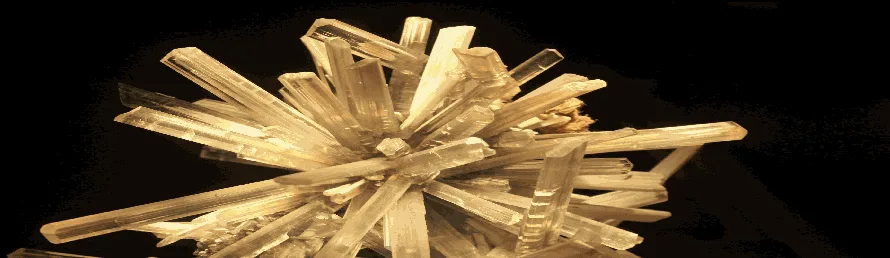
Selenite takes its name from Selene, the Greek goddess of the moon, and the association is easy to see the moment you hold a piece up to the light. It has a soft, luminous quality unlike almost any other mineral — a translucent white-grey glow that seems to hold light rather than simply reflect it. Where Amethyst works by amplifying and directing energy, Selenite works by clearing: it is one of the few stones with a genuine reputation for dissolving stagnation rather than transmuting it.
It is a variety of gypsum, chemically distinct from quartz-family stones, and this difference shows up in how it behaves both physically and energetically. Selenite is soft — around 2 on the Mohs scale, softer than a fingernail can sometimes mark — and this softness is not incidental to its spiritual reputation. Practitioners often describe it as a stone with almost no resistance, energetically or physically, which is precisely why it moves stuck energy so readily.
Physical Appearance and Structure
Selenite forms in evaporite deposits, typically where ancient seas or saline lakes have dried, leaving behind long fibrous crystals with a distinctive silky sheen — hence its other common name, Satin Spar. Its monoclinic structure produces the characteristic straight, elongated forms found in wands and blades, though it also occurs as the flower-like Desert Rose formation and, in its coarser variety, as the more familiar translucent slabs used for lamps and carvings.
Because it is a form of gypsum rather than quartz, Selenite has a fundamentally different relationship with water than most crystals in your collection. It is water-soluble and will begin to dissolve or cloud with prolonged exposure, and salt will damage its surface even faster. This is worth stating plainly rather than glossing over: never cleanse Selenite in water or salt, and store it away from other methods that involve moisture.
The Crown and Third Eye Chakras
Selenite's primary work is at the crown and third eye, but its effect there is distinct from Amethyst's. Where Amethyst opens these centres gradually, through calming and quieting, Selenite opens them more directly, through clearing — removing what is blocking the connection rather than soothing the noise around it. Many practitioners experience this as a sensation of lightness or spaciousness above the head when working with the stone, sometimes described as a felt connection extending upward beyond the crown into what some traditions call the soul star.
A specific and widely reported practice involves lying flat with a piece of Selenite placed so it touches the crown of the head during meditation. Practitioners frequently describe this as a doorway practice — a way of meeting guides, or receiving symbolic messages, more readily than through seated meditation alone. Whether approached as literal contact or as a deepened state of receptivity, the consistency of the reports across traditions makes it one of the stone's most distinctive uses.
Emotional Properties
Selenite's emotional signature is movement. It is used specifically for situations of stagnation — where a person has settled into a pattern, a relationship, or a way of living that no longer serves them but has become comfortable enough that leaving it feels unnecessary or frightening. Selenite is said to gently but persistently unsettle that false comfort, making the cost of staying still more visible and the possibility of moving forward more available.
This is not a gentle lulling stone in the way Amethyst can be. It has an activating quality — less about soothing distress and more about breaking the inertia that keeps distress unaddressed. For anyone who feels they know exactly what needs to change in their life but cannot seem to start, Selenite is traditionally reached for over most other crystals in the collection.
Spiritual Properties
Selenite's most practically useful spiritual property is one that sets it apart from almost every other stone: it does not require cleansing, and it can be used to cleanse other crystals. Placing other stones on or near a piece of Selenite — a slab, a charging plate, or simply a cluster — is a standard practice for clearing accumulated energy from a whole collection at once, without water, salt, sun, or smoke.
Beyond its own boundaries, Selenite clears etheric blockages and debris from the energy field, opening a freer channel through the higher chakras. This clearing quality is why it is so often used as the base layer in energy grids: it doesn't compete with the stones placed alongside it, it clears the ground for their properties to move without obstruction, and amplifies what they are doing.
Physical Healing Associations
In energy work, Selenite is associated with directing high-frequency energy into the body and clearing blockages that may be contributing to physical tension or discomfort. It is traditionally used in a sweeping motion just above the body's surface, rather than resting in one place, as a way of drawing stagnant energy out along the length of the body rather than concentrating on a single point.
Working with Selenite
Wands are the most common working form — used to sweep the energy field, to direct energy toward a specific chakra, or to clear a room by moving the wand through the space with intention. Slabs and charging plates serve as a resting place for other crystals between uses. Larger towers and lamps, placed in a living space, offer a continuous, gentle clearing presence in the room, similar in principle to Amethyst's atmosphere-shifting quality, but with a lighter, more clarifying character rather than a settling one.
Because of its softness and water sensitivity, care matters more with Selenite than with most stones: keep it dry, store it separately from harder crystals that could scratch its surface, and avoid prolonged direct sunlight, which can cause some pieces to become brittle over time.
Sacred Sexuality Divine Feminine

...
Read More..
Who Holds The Reins

Most people have sat in a passenger seat beside somebody whose driving made them uncomfortable. The speed feels slightly wrong. The distance between cars seems too short. The route is not the one we would have chosen. Small corrections begin forming in the mind almost automatically. We notice…
Read More..
Sounds
The Power Of Sound
Read More..
Clear Quartz

Such a grand name for what is the most basic of crystals. Any good collection should contain one or more Clear Quartz crystals. They are both a source of healing energy but also an excellent channeling stone.
Read More..
Fear And Self

"Fear comes from the selfish idea of cutting one's self off from the universe." - Swami Vivekananda. Selfishness represents itself in many ways, but there is one repeated basis for this kind of behavior, that of fear. The instinct of survival is a primal need in all living things. The dangers of…
Read More..