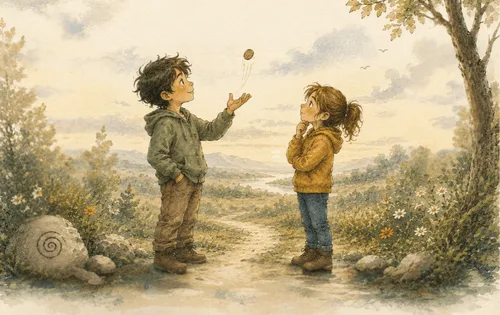
The coin promises something we secretly long for — not certainty, but relief.
Then it leaves your hand. It spins upwards, catches the light, and for one brief moment the future appears suspended alongside it. Something curious happens while it is still in the air. A quiet voice whispers,
"Please let it be heads."
Or perhaps,
"Please don't let it be heads."
The coin has not answered the question.
It has interrupted the noise.
For a fraction of a second, before fear gathers itself together again, desire slips through unnoticed. The hope arrives first. The judgement follows afterwards.
Perhaps we have misunderstood what happens inside us. When the decision is deeply personal, recognition often arrives before thought. We do not think our way towards what we want. We recognise it, and then thought begins its work. It explains why we should not want it. It reminds us who may be disappointed. It rehearses every possible failure. It calculates every risk.
Thought is no longer discovering the answer.
It is negotiating with it.
This becomes obvious whenever the coin disagrees with us. Sometimes it lands on the side we did not want, and something quietly revealing happens next. We do not stay with it. We do not own it. We say,
"Best of three."
It hardly feels dishonest. One toss seems too small to carry such an important decision. Surely another chance is only fair.
But notice what the request reveals.
We surrendered the decision on the condition that chance would agree with us.
We were never asking the coin to decide.
We were asking it to absolve us of responsibility for what we already wanted.
The moment chance disagreed, the agreement was over.
Someone who had truly handed the decision away would have nothing left to negotiate. There is no rematch with a coin that has already spoken. Asking for one is not surrender — it is bargaining, and bargaining is something only an author does with a decision they are pretending belongs to someone else.
Most people believe they toss a coin because they cannot decide. That is rarely the real reason. More often, they already know which future they hope to see, and what they fear is becoming the person who must answer for choosing it.
Every meaningful decision creates two lives. One is lived, the other survives only in imagination — and the mind has a remarkable habit of granting that unlived life a perfection it never possessed. The career never pursued becomes the career that would have fulfilled us. The relationship we left becomes the one that might have worked. The city we never moved to becomes the place where happiness was waiting.
Our imagination is generous to the lives we never had to test.
Reality is required to prove itself.
Fantasy never is.
This makes every genuine decision uncomfortable — not because we cannot see the options.
Because we can.
We understand what each path will ask of us. One may require us to disappoint people we love. Another may require us to abandon an identity that has quietly become too small. Another may demand that we begin again when everyone else believes we have already arrived. None of these are easy.
So we begin searching for permission — from parents, partners, and friends; from experts, religion, and society; from fate. Sometimes we even ask a coin.
There is nothing wrong with seeking perspective. Wisdom grows through reflection. The danger begins when reflection quietly becomes surrender, and the difference is almost invisible — one helps us see more clearly, the other hopes someone else will carry responsibility on our behalf.
Yet responsibility cannot be transferred.
Only decisions can.
You may allow another person to choose your direction. You may follow expectations that were never truly your own. You may convince yourself that circumstances left you with no alternative. But when the years pass, it is still your life that has been lived, and the consequences always return to the person who wakes each morning inside them.
This is why blame has such a long memory.
"I stayed because you wanted me to." "I never followed my dream because my parents expected something different." "I didn't leave because it would have upset everyone."
These sentences appear to hand responsibility to someone else.
They never succeed.
Instead, they reveal something far sadder — a person trying to escape authorship of their own life.
Listen carefully to how people describe themselves: "I ended up here." "It just happened." "I suppose this is where life took me." The language is almost passive, as though life were weather passing overhead rather than something built, choice by choice, year after year.
The strange thing is that avoiding responsibility never frees us from it. It simply changes its shape. Instead of carrying the weight of a difficult decision, we spend decades carrying the weight of wondering who is to blame.
Neither burden disappears.
One simply lasts much longer.
Perhaps this is why so many people spend years searching for the right decision, as though somewhere ahead exists a future untouched by sacrifice.
It does not.
Every meaningful choice excludes another meaningful life. The question has never been which path costs nothing — such a path has never existed. The question is whether the life you choose is one whose costs you are willing to carry without resentment.
Responsibility is unavoidable.
Ownership is voluntary.
Not certainty. Not confidence. Not fearlessness.
Ownership.
Confidence is rarely present before the decision. It grows afterwards, when your actions and your inner life finally begin walking in the same direction.
Fear does not disappear.
It simply loses its authority.
The next time you find yourself tempted to toss a coin, watch it carefully as it climbs into the air. Pay no attention to how it lands. Instead, notice the hope that appears before it does. That hope is older than your fear. It speaks before judgement has time to interrupt. Then the familiar voices return — what will people think, what if I'm wrong, what if I regret it, what if I disappoint someone.
By then, the quiet knowing has already spoken.
The rest is negotiation.
Perhaps that is why so many answers feel difficult to find.
Not because they are hidden.
Because every answer asks the same question in return: are you willing to become the author of what happens next?
Until the answer is yes, every coin, every sign, every opinion and every certainty will simply become another place to hide.