A traveller discovers a purse beside a road. The owner is nowhere to be seen. Inside is enough money to solve several immediate problems. Rent is due. Work has been inconsistent. The money would relieve pressures that have occupied his thoughts for weeks.
Who Teaches the Judge?
Several arguments emerge almost immediately. One suggests that fortune has presented an opportunity. Another insists that the contents belong to someone else. He imagines the relief the money would bring him and the frustration its loss may cause another person. He wonders whether the owner is wealthy enough not to notice. He wonders whether the owner may be struggling even more than he is. The longer he considers the situation, the more complex it becomes.
Most readers form an opinion long before the traveller reaches a decision. Some conclude that the purse should be returned without hesitation. Others begin introducing conditions and exceptions. A few may feel uncertain from the beginning. Whatever conclusion is reached, something interesting is already taking place. The reader is not observing the situation passively. They are evaluating it.

Now imagine that the traveller returns the purse and discovers that it belongs to a parent who desperately needed the money. The decision appears admirable and the outcome confirms the judgement.
Imagine instead that the purse is returned and the owner responds with irritation rather than gratitude. The traveller receives neither recognition nor appreciation. The certainty of the earlier judgement often begins to weaken.
Imagine a third ending in which the traveller keeps the money, nobody discovers what happened, and his circumstances genuinely improve as a result.
The facts have changed remarkably little. The purse remains the same purse. The traveller remains the same traveller. What changes is the reader's confidence. An action that initially appeared straightforward becomes more difficult to evaluate because the relationship between behaviour and consequence has become less clear.
This is where the story becomes more interesting than the decision, and where something easy to miss is actually happening. The reader's judgement is not simply uncertain. It is moving. The first ending confirms what was already believed. The second introduces friction — gratitude was expected, and its absence forces a reconsideration of why the purse was returned at all. Was it returned because returning it was right, or because returning it was expected to feel good? The third ending forces something sharper still: an admission that the world does not always settle accounts in ways that match a verdict reached in advance.
That capacity to be unsettled by an outcome, rather than simply asserting a verdict and defending it regardless of what follows, is the detail worth pausing on. A judgement that cannot be moved by new information is not really judging anything. It is repeating itself.
This distinction matters because it answers a question that any account of an internal judging faculty eventually has to face. If judgement is built from exposure to competing values, and those values genuinely conflict — one tradition praising forgiveness, another honouring vengeance — what stops the resulting faculty from simply absorbing the conflict unresolved? What separates a person who has practised judging from a person who has merely become confident in their habits?
The difference is not the content of the verdict. It is whether the verdict survives contact with consequence.
A faculty that revises itself when an outcome contradicts its expectation is doing something different from a faculty that reaches a conclusion and then defends that conclusion against all subsequent evidence. The second pattern has a familiar name: rationalisation. It feels like judgement from the inside — it produces confident verdicts, it cites reasons, it can be quite articulate — but it does not update. The traveller's irritated stranger and unpunished theft are tests of exactly this. A reader whose certainty holds steady through every version of the story was never weighing the situation in the first place. They had already decided, and the story was decoration.
This gives the disagreement between traditions a different significance than it first appears to have. One tradition praising forgiveness and another honouring vengeance are not simply incompatible answers sitting side by side, waiting for someone to declare a winner. Within each tradition, the praised response has usually been arrived at the same way — through stories whose endings did not always cooperate with the audience's first instinct: forgiveness tested against the case that seems unforgivable, vengeance tested against the feud that refuses to end once the blood has actually been spilled. Each tradition was forced, by its own severest stories, to reconsider what its preferred response accomplishes once pushed that far. The content differs. The mechanism by which each tradition arrived at its content does not. Wisdom, wherever it appears, looks less like a fixed conclusion and more like a conclusion that has already survived several attempts to overturn it.
This is also why a story resists being reduced to a lesson. A lesson, once learned, is held. It does not need to be tested again. A judgement, by contrast, has to keep being tested, because the situations it will eventually meet are never quite identical to the ones that formed it. What a story actually offers, repeatedly, is practice at letting a conclusion be wrong — at noticing when an outcome doesn't fit the verdict, and adjusting the verdict rather than the facts.
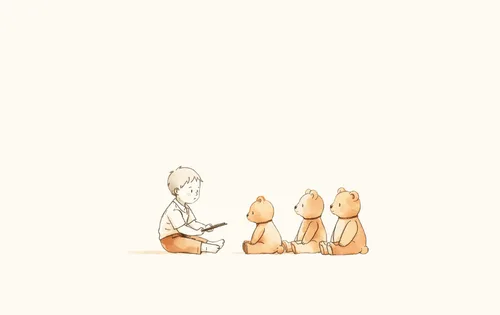
A child exposed to many such stories is not simply accumulating examples of good and bad behaviour. They are accumulating something more specific: practice noticing when their own first reaction to a situation turns out, on reflection, to have missed something. That noticing is not automatic. It can also fail to develop, in which case a person reaches adulthood holding the same verdicts they reached at the age of nine, fully armed with reasons, untouched by forty years of evidence.
This is the clearest way to see what separates judgement from its most common impostor.
The two are easy to confuse because they arrive in the same disguise: an unbidden internal voice, speaking with apparent authority about something you have just done. From the inside, a verdict and a condemnation can sound identical in the first instant they appear. Many people possess such a voice, and it is tempting to assume it is the same faculty being described here. It is not. The distinction is not about tone or harshness. It is about whether the voice can be moved.
An inner critic reaches its verdict before the facts are in, because the verdict was never really about the facts. A mistake confirms what the critic already believed — that the person is careless, or inadequate, or not enough. New information rarely changes this conclusion, because the conclusion was not produced by the information to begin with. The critic, in other words, fails the exact test the traveller's three endings apply: it does not revise.
Judgement fails differently when it fails, and succeeds differently when it succeeds. It asks what assumptions produced a decision, what was overlooked, what the actual consequence turned out to be — and it is willing to let the answer to that last question change the verdict. This is why someone capable of mature judgement can examine a failure honestly without being defined by it: the failure is treated as new evidence about the situation, not as confirmation of an identity that was decided long before the situation occurred.
The traveller's decision remains unresolved here, and that is not a missing piece of the story. It is the part of the story doing the work. The purse creates the conditions under which a reader's judgement becomes visible and revisable — and by the time the three endings have been considered, the reader has rehearsed, in miniature, exactly the process this essay has been describing. They reached a verdict. They were given a reason to doubt it. They adjusted, or they didn't.
Human beings inherit values, absorb lessons, encounter examples, and accumulate experience throughout their lives. Beneath all of this, something quieter and more demanding is also taking place, when it takes place at all: a habit of letting outcomes talk back to conclusions. Stories may endure not simply because they expose us to conflict, and not simply because they exercise some general evaluative muscle, but because they are one of the few tools patient enough to keep handing us a verdict, then an ending that complicates it, then another ending that complicates it again — until the only thing left standing is whatever in us was actually willing to listen.
That willingness, more than any specific conclusion it eventually reaches, is what deserves to be called judgement. It is not memorised. It is not exercised in the abstract sense of a muscle lifted for its own sake. It is tested, repeatedly, against consequences that do not always cooperate — and what survives that testing is simply whatever in us has kept letting outcomes talk back to conclusions, rather than the other way around. That, more than any name we give it, is the closest thing available to an answer for who teaches the judge.
Reflection Quiz
1. When a judgement you've made turns out to be wrong, what usually happens?
2. Which feels closest to your own inner critic?
3. Which idea stayed with you most?