Notifications (Click to mark read)
Vishuddha — Where Truth Becomes Sound
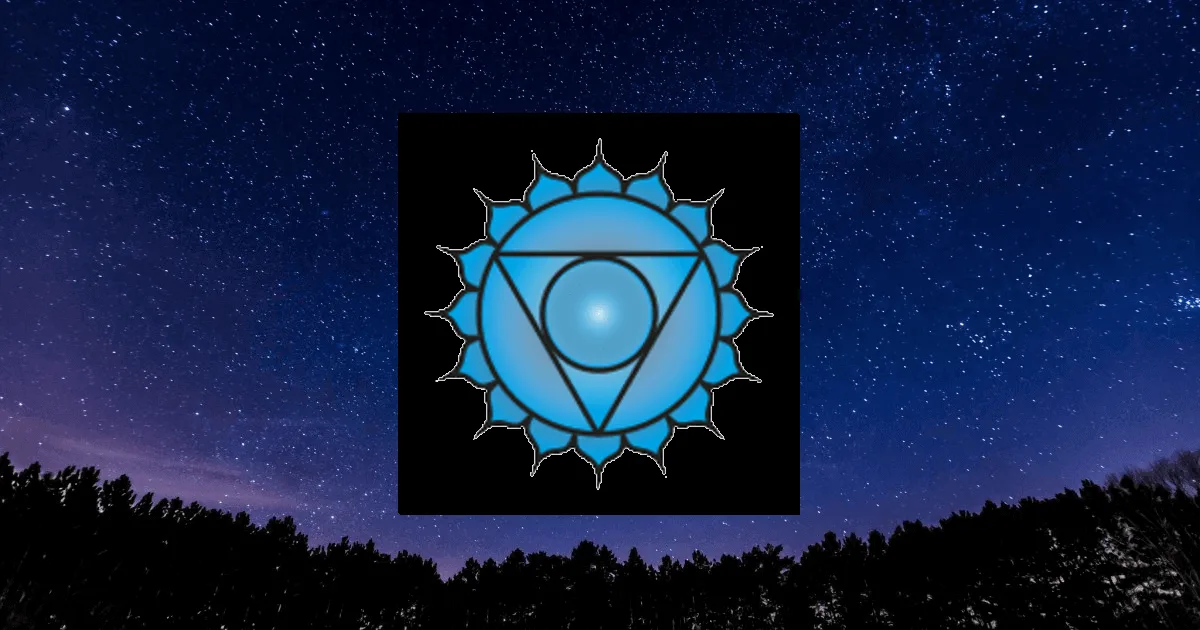
Vishuddha translates from Sanskrit as "especially pure" or "the purification centre" — a name that points immediately to something more demanding than the popular image of the throat chakra as simply the communication chakra. Purification in this context means the refinement of expression: the process by which what is true within you becomes what is actually said, without the distortions introduced by fear, social pressure, the desire to be liked, or the habit of saying what is expected rather than what is real.
Located at the hollow of the throat, Vishuddha is the fifth chakra — the first of the three upper chakras, sitting above the heart and below the third eye and crown. It is the point at which the inner life meets the outer world through the medium of language, sound, and creative expression. Everything you have felt, thought, perceived, and understood in the lower four chakras ultimately arrives at the throat seeking expression. What emerges — or what is suppressed — shapes both your relationship with the world and your relationship with yourself.
The Element of Ether
Vishuddha's element is Ether — known in Sanskrit as Akasha, the fifth element and the most subtle of all. Where Earth, Water, Fire, and Air are all physically perceptible, Ether is the space in which the other elements exist and through which they interact. It is not empty space in the modern sense — in the Vedic understanding, Akasha is the medium of sound, the invisible substance through which vibration travels. Everything that exists first arises in Akasha as vibration before it takes on the denser forms of the other elements.
This makes Ether precisely the right element for the throat chakra. Sound is vibration through a medium — and language, the most refined form of sound that human beings produce, is the means by which inner reality is made perceptible to others. The throat chakra governs this translation: from the formless (thought, feeling, perception) into form (word, sound, creative expression). The Ether element reflects the fact that this translation happens in a space between the purely inner and the purely outer — a threshold space where what is real within you either does or does not find its way into the world.
The sixteen petals of Vishuddha's lotus are the most of any chakra below the crown, and they represent the extraordinary complexity of the expressive faculty — the range of sounds, tones, and communicative modes available to the human voice and the human creative capacity.
What Vishuddha Actually Governs
Communication is Vishuddha's domain, but the word needs to be held in its fullest sense. This is not merely the mechanics of speech — it is the entire range of ways in which inner experience finds outward form: spoken language, written language, music, visual art, movement, silence, and the quality of listening that makes genuine communication possible in the first place.
Honesty is at the core of Vishuddha's function — specifically, the alignment between what is true within you and what you actually express. This alignment is rarer than it might appear. Most people have learned, through years of social conditioning, to modulate their expression based on what is acceptable, what will be well received, what will keep the peace, and what will not invite judgement or rejection. Some of this modulation is appropriate social intelligence. But when it becomes habitual and pervasive — when you consistently say what you think others want to hear rather than what you actually think and feel — the throat chakra begins to close, and the cost is significant.
The courage to speak truth is a throat chakra quality — not aggressive truth-telling regardless of consequence, but the willingness to give honest expression to your genuine perspective even when it is uncomfortable to do so. This requires a functioning solar plexus (enough self-worth to believe your perspective has value) and a functioning heart chakra (enough care for the relationship to choose how truth is expressed). Vishuddha is where all of this arrives and is given voice.
Listening is equally part of Vishuddha's domain — the quality of receptive attention that allows another person's expression to actually land rather than simply waiting for your turn to speak. Sound is the sense associated with this chakra, and it operates in both directions: expression and reception, speaking and hearing. A throat chakra imbalance can affect either or both.
Signs of Imbalance
A blocked or underactive throat chakra typically manifests as difficulty expressing yourself — chronic shyness, the inability to say what you mean or mean what you say, a tendency to swallow opinions rather than voice them, and a pervasive sense that your voice does not matter or will not be received well. There may be a pattern of agreeing outwardly while disagreeing inwardly, of communicating around the truth rather than through it, and of creative suppression — the sense that you have something to express but no clear or permitted channel for it.
Physically, a closed throat chakra often shows up in the body exactly where you would expect: recurring throat problems, persistent hoarseness, neck tension, thyroid irregularities, and jaw tightness — the body expressing the effort of holding back what wants to be said.
An overactive throat chakra presents as a different kind of problem: talking too much, too loudly, or without adequate regard for the effect on others; the compulsive need to fill silence; gossip and the expression of others' private matters; or a quality of verbal dominance that does not allow space for anyone else's voice. Paradoxically, an overactive throat chakra can also produce the particular kind of dishonesty that comes from talking constantly without actually saying anything real — the performance of communication as a defence against genuine contact.
Both imbalances share the same root: a disrupted relationship between inner truth and outer expression. Whether the throat is chronically closed or compulsively open, what is missing is the alignment between what is real and what is said.
Working with the Throat Chakra
Because Vishuddha governs sound and vibration, practices that work directly with the voice are its most natural medicine. Chanting — including the simple repetition of the seed mantra Ham — creates resonance in the throat region that directly engages the chakra at a physical and energetic level simultaneously. You do not need to be a skilled singer for this to be effective; the vibration is what matters, not the musical quality.
Speaking aloud things that have been kept internal — in journal entries read aloud, in honest conversations that have been postponed, or simply in the practice of saying to yourself what you actually think — is one of the most direct throat chakra practices available. The throat chakra does not distinguish between an audience of thousands and an audience of one. What it responds to is the act of giving voice to what is true.
Writing — particularly journalling and any form of creative writing that is not performed for others — is throat chakra work. It is expression without the social stakes of spoken communication, which makes it a useful starting point for someone whose throat chakra is significantly blocked by fear of others' judgement.
Silence, deliberately chosen rather than merely endured, is also Vishuddha practice. The throat chakra is responsible for both sound and its absence, and the quality of your silence is as expressive as the quality of your speech. Learning to be comfortable with silence — in conversation, in creative work, in daily life — develops the receptive aspect of Vishuddha that the compulsively verbal world consistently undervalues.
Crystals for the Throat Chakra
Blue Kyanite is one of the few crystals that does not accumulate negative energy and does not need cleansing — a quality that reflects its exceptional clarity of vibration. Its primary gift for Vishuddha work is alignment: it supports the connection between thought and speech, helping to bridge the gap between what you know internally and what you actually say. It is particularly useful for situations where honest expression feels difficult — before challenging conversations, during creative work that requires vulnerability, or in any context where you need to trust your own voice.
Lapis Lazuli has been associated with truth and royal communication across several ancient civilisations — Egyptian, Mesopotamian, and Chinese traditions all used it as a stone of authority and honest counsel. Its energy is deepening rather than merely clarifying: it supports not just the expression of truth but the discovery of it, helping to bring to consciousness what you actually think and feel beneath the habitual surface responses. For anyone whose throat chakra imbalance involves disconnection from their own genuine perspective, Lapis Lazuli works at a level that Blue Kyanite's surface clarity does not always reach.
Turquoise is one of the oldest protective and communicative stones in human use — found in jewellery, amulets, and ceremonial objects across Native American, Persian, Tibetan, and Egyptian traditions. Its energy is both grounding and opening, bridging the throat chakra's expressive quality with the root chakra's physical stability. This makes it particularly useful for the kind of throat chakra work that requires not just honesty but courage — speaking truth in situations where the social or personal cost is real. Turquoise has a long history of being worn by those who needed to speak with authority and without fear.
Wear these stones at throat level for sustained effect — a pendant or choker brings them into direct contact with the chakra's location. Blue Kyanite is most effective during active communication; Lapis Lazuli during reflection and self-inquiry; Turquoise when courage and grounded authority are specifically what is needed.
Interpretive Skills - Developing Ifá Interpretation Abilities

Learn to develop interpretive skills for understanding Ifá verses. Master the art of extracting wisdom from traditional teachings through systematic interpretation methods.
Read More..
Menstrual Cycle Spirituality

...
Read More..
Ogun - The Iron Master of Technology, Labor, and Warriors

Explore Ogun (Ogún), the powerful Yoruba Orisha of iron, technology, war, labor, and hard work. Learn about his protective strength and mastery.
Read More..
Changing Woman

...
Read More..
Ten Steps To Zen

A simple ten step guide to finding inner peace and serenity. Let the Divine show you the way.
Read More..