Notifications (Click to mark read)
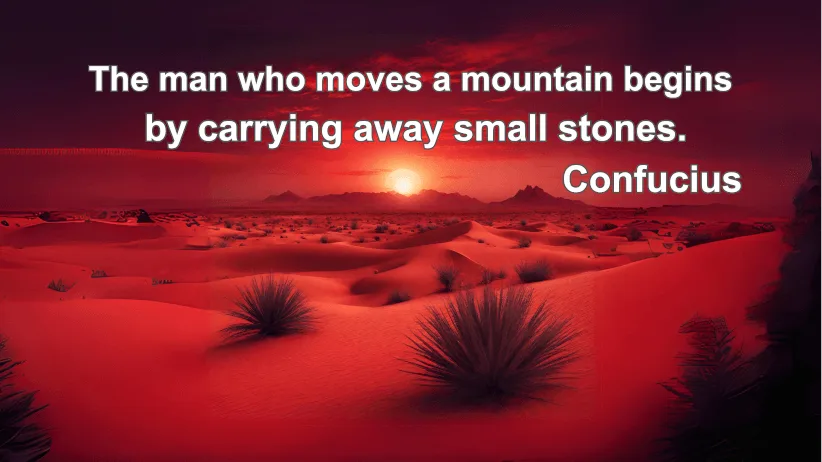
"The man who moves a mountain begins by carrying away small stones." — Confucius
There's a particular kind of stillness that comes over a person right before they give up. Not dramatic — no shouting, no tears, sometimes not even a visible change in the face. Just a quiet settling, like sediment finding the bottom of a glass. The work in front of them hasn't shrunk. It has simply stopped looking like something a person could do.
This is what overwhelm actually is, underneath the word we use for it. Not too much to feel — too much to see clearly. The mind, faced with a mountain, does the sensible thing and refuses to look at it as a mountain. It looks at it as an impossibility instead, which is smaller to hold but far heavier to carry.
Confucius knew something about mountains that the overwhelmed mind forgets: they were never moved as mountains. They were moved as stones. One, then another, then another, each one small enough to lift, none of them announcing what they were building toward. The person carrying the first stone away rarely knows they are the same person who will, eventually, stand on flat ground where a mountain used to be. They only know the stone in their hands.
We tend to treat feeling overwhelmed as a kind of failure — evidence that we are too fragile for the life we are living. But the body doesn't overwhelm easily or without reason. It is a stress response doing precisely its job, flagging that the current load exceeds the current capacity. That's not weakness. That's an accurate instrument.
What tends to make it worse is what we do next, which is usually nothing, because nothing feels like the only response equal to a mountain. We wait for the feeling to lift on its own, or for the mountain itself to somehow become smaller while we're not looking. It doesn't. Mountains are patient. They will still be there in a week, in a year, exactly as large, while we've spent all that time carrying nothing at all.
The way through isn't dramatic either. It rarely is. It's the five things you can name in the room around you, said slowly enough that the noise in your head has to quiet down to let them through. It's the page that fills with whatever's actually there, unfiltered, because the mind unclenches slightly the moment it's no longer the only place holding the weight. It's the walk that goes nowhere in particular and somehow arrives somewhere calmer than it left. It's the breath, deliberately slowed, telling a nervous system still braced for danger that the danger has, for now, passed. None of these move the mountain. They are simply how a person becomes someone capable of lifting a stone again.
There's a temptation to treat these as fixes — techniques to deploy, boxes to tick, a plan for the overwhelmed to execute correctly. But that framing puts the mountain back in charge, just wearing a different disguise: instead of I can't do this, it becomes I'm not doing the coping right. Neither version is true. The stones don't require correct technique. They only require that you pick one up.
And when even that feels beyond reach — when the mountain has grown large enough to eclipse the very idea of stones — that's usually the moment something larger than the immediate situation is worth remembering. Call it a Higher Power, call it the part of you that has survived every other mountain that once looked permanent, call it whatever name fits the shape of your own belief. It doesn't have to arrive as certainty. It only has to arrive as enough — enough to ask for help, enough to accept it when offered, enough to believe, even provisionally, that the ground you're standing on has held before and will hold again.
Because it will still be there afterward — the strange, quiet truth that no one tells you about mountains, which is that they are never moved all at once, and never moved alone, and never moved by someone who could see the whole climb from the bottom. Only by someone who could see the next stone, and then the one after that, until one day they looked up and the sky was simply sky again.
Beginning With Crystals
Our basic guide is a great beginning to choosing, cleansing and learning of the power of your first crystals. Learn more
Read More..
Who Holds The Reins
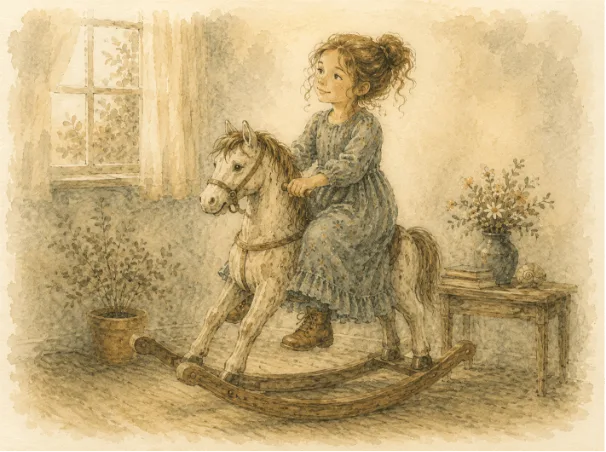
Most people have sat in a passenger seat beside somebody whose driving made them uncomfortable. The speed feels slightly wrong. The distance between cars seems too short. The route is not the one we would have chosen. Small corrections begin forming in the mind almost automatically. We notice…
Read More..
Binary Patterns in Ifá - Sacred Mathematical System
Explore the binary mathematical system underlying Ifá divination. Understand how four-bit patterns create the foundation of Yoruba spiritual mathematics.
Read More..