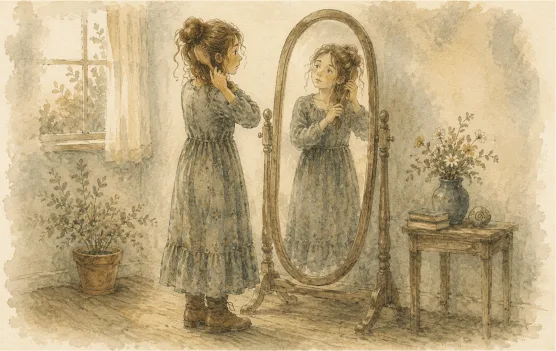
There is truth in that explanation, but it leaves something unanswered. Many people who express this feeling are not ignored. They are loved by their families, valued by their friends and appreciated by their partners. Their existence is acknowledged every day. They receive reassurance, encouragement and affection, yet the feeling remains stubbornly present. If the problem were simply a lack of validation, these experiences would resolve it more often than they do.
Perhaps the problem is not that other people fail to see us. Perhaps it begins earlier than that — with us, and how thoroughly we have already stopped looking at ourselves.
Consider how much of an ordinary life is shaped by repetition. The same responsibilities arrive each morning, the same routines follow, the same conversations open and close in the same order. A person gets up and goes to work and comes home and manages what needs managing, and does it again tomorrow, and again after that. There is nothing inherently wrong with routine; civilisation depends on it. The difficulty arises when repetition stops staying in behaviour and starts shaping identity.
Most people do not consciously decide who they are going to become. They accumulate roles. A person becomes a parent, a partner, an employee, a friend, a provider, a caregiver. Each role carries its own expectations, and each expectation quietly trains a particular way of being. Eventually the training works so well that the distinction between the role and the person inside it starts to disappear.
Picture a woman at her kitchen counter on an ordinary weekday evening. Her son needs help with a maths problem. Her partner is asking where the car keys went. The pan in front of her needs stirring before it catches. She answers all three without turning her head, without raising her voice, without appearing to think. It is not a special skill. It is years of the same evening, compressed into a single fluent motion. She has become extremely good at being needed.
This is the role of the reliable one. She organises, remembers, plans and solves. Everyone around her depends on it. In time, she depends on it too — it has become the shape she knows how to occupy. The role works. It serves a purpose. But somewhere in the years of performing it so well, she may have stopped noticing what, if anything, exists underneath it. When she says she feels unseen, she may not be describing how others perceive her. She may be circling something closer to the truth: that she has not really looked at herself in a long time either.
The role works for another reason too, one she would not put into words if asked. Some evenings the kitchen goes quiet a beat longer than it should — no maths problem, no missing keys, nothing left on the stove — and something in her starts to surface that has no task attached to it. She has learned what to do with that kind of quiet. She wipes a counter that is already clean. She checks a phone that has not buzzed. The feeling passes, the way most feelings do when they are given nowhere to land, and she is rarely aware that she has just looked away from something rather than at it. It is easier, most days, to be needed than to find out what is there when nobody needs anything from her at all.
We assume that when someone feels unseen, a partner has stopped paying attention, a friend has stopped listening, a family has started taking someone for granted. These things happen. But they may not be the centre of it. The deeper problem may be that a person has become so familiar to themselves that they no longer experience anything resembling discovery. Life continues, responsibilities are met, relationships endure — and all of it begins to feel like a rerun of something already known by heart.
The body learns this kind of fluency before the mind does — the hands find the gear stick, the fingers find the keys, without instruction. Psychologically, the same shortcut forms. People learn how they will react, what they believe, which stories they tell about themselves, long before any particular situation calls for it. The process is efficient — it removes the friction of deciding everything fresh each time — but it carries a quiet cost.
The more practised a person becomes at being themselves, the easier it is to mistake the practice for the person.
When this happens, being seen stops being able to help. Another person can admire the reliable woman, thank her, even tell her how much they depend on her — but they are responding to what she presents, and what she presents is the rehearsed version.
Their recognition confirms the performance.
It does not interrupt it.
The relief, when it comes, never lasts long, because what she was actually missing was never approval. It was contact with something that hadn't already been decided in advance.
It may be the dread of this rerun that pushes people toward sudden change — a new relationship, a new job, a different city, a different belief system. For a while the novelty works, because it disrupts the pattern enough to feel like waking up. But six months into the new job, the reliable woman is the one organising the new break room rota before anyone has thought to ask her.
The furniture changed.
The person rearranging it did not.
And yet, something in her survived the move. The role she'd built at the old job vanished the day she left it, and she was still there the following Monday, in a new building, before the new role had even formed around her. Whatever continued through that gap was not the role. It could not have been, since the role was gone and she remained.
It is easy to overstate what that means.
It is harder to ignore that it happened at all.
Most evenings, nothing interrupts the fluency. But once, while she's still stirring, someone doesn't ask her where the keys are. They ask, instead, if she's alright. And for a second — less than a second — she has no answer ready. The pan is still on the heat. Her son is still waiting on the maths problem. But for that one beat, she is not managing anything. She is just standing there, caught without a rehearsed reply, and something in her face changes that has nothing to do with how well she is being looked after.
It is the closest thing to being seen she has felt in years — not because anyone finally looked at her closely enough, but because, for once, she did not already know what she was about to say.