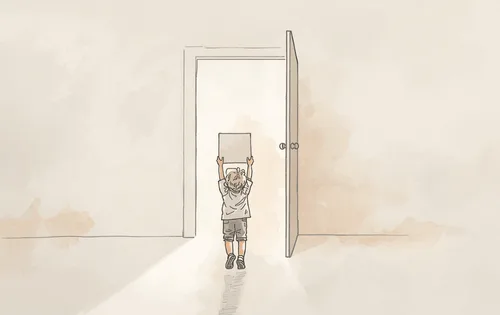
A child finishes a drawing and runs to find a parent before the crayon is even capped. What matters is not really the drawing. What matters is the face that receives it — the flash of attention, the words of approval, the sense of having been noticed. Most adults stop running across rooms with drawings, but the underlying transaction never disappears. It simply changes shape: a job title, a number of likes, a partner's compliment, an audience's silence or applause.
The Hunger to Be Seen
Most people believe they are pursuing success, happiness, love, security, or achievement. Beneath these ambitions sits something more basic: the wish for confirmation that we matter — evidence that we are seen, accepted, and significant in the lives of others.
This desire shapes behaviour far more than most people admit. It colours opinions, relationships, careers, purchases, and the private stories people tell about who they are. It governs how people present themselves in public and how they judge themselves alone in a room. The need operates so quietly and so constantly that it becomes invisible even while steering important decisions.
The origins reach well beyond modern life. Early humans survived inside groups, not as individuals — food gathered together, children raised together, danger faced together. A person's standing within that group had direct consequences. Acceptance meant access to protection and resources. Exclusion meant exposure and risk. The stakes were not emotional; they were existential.
Modern conditions have changed almost beyond recognition, but the machinery built during that period is still running. The sociologist Charles Cooley described the self as a kind of mirror — we come to know who we are partly through how we imagine others see us. A century later, the psychologist Mark Leary proposed something similar in clinical terms: self-esteem, in his account, functions as a sociometer, an internal gauge constantly tracking one question — how do others currently value me? Brain-imaging research on social rejection adds a blunter footnote: the regions activated by being excluded overlap with the regions activated by physical pain. The mind does not always distinguish cleanly between a bruised body and a bruised reputation.
None of this makes validation a flaw to be engineered out. It serves a real purpose. It helps people understand how they're perceived. It reinforces behaviours that strengthen relationships. It steadies confidence during learning and growth. Children depend on it while building an identity; adults depend on it while building trust and connection. Every healthy relationship contains some current of mutual recognition, because people need to feel understood by those closest to them.
The trouble starts when validation stops being feedback and starts being a verdict.
At first the shift is invisible. Approval feels good, so more of it is sought. Recognition becomes important. Criticism becomes uncomfortable in a new way. Slowly, the reactions of others gain more authority over self-perception than a person's own judgment holds. Confidence begins rising and falling on a schedule set by other people.
This is an unstable foundation, because external approval can never be fully secured. Other people arrive at every interaction with their own histories, moods, and blind spots; their opinions shift, their attention moves on. Building self-worth on terrain that volatile guarantees a recurring kind of insecurity — not because something is wrong with the person seeking approval, but because the ground itself was never load-bearing.
The problem compounds because the mind adapts to good news almost as fast as it receives it. An achievement that once felt remarkable becomes the new normal within weeks; praise that once felt satisfying loses its charge through repetition. This is tolerance, in the clinical sense of the word — the same dose stops producing the same effect, so a larger one is required next time. Validation produces only temporary relief; it answers the question for a while, then the question reopens. A promotion satisfies until the next deadline; recognition feels good until attention drifts elsewhere. Yesterday's achievement quietly becomes today's minimum, and the doubt it resolved returns wearing a new shape.
Many people spend years inside this without noticing that the pursuit itself is the problem. The more self-worth depends on approval, the more approval is required to sustain it — and supply never quite catches up with demand. Confidence turns conditional; achievement stops being able to satisfy, because it's been handed a job it was never built to do.
No quantity of praise can permanently establish self-worth. Recognition can acknowledge value; it cannot manufacture it. Approval can reinforce confidence; it cannot install confidence that wasn't already there. External validation is information about how others currently perceive you. It is not a ruling on who you are.
This is also why insecurity turns up so reliably among people who, by any outside measure, have "enough" — successful people, admired people, people surrounded by recognition. Public acknowledgment doesn't dissolve private doubt, because the doubt was never actually about a shortage of praise. It was about expecting praise to answer a question only the person themselves can answer.
None of this means the goal is indifference. A person who insists they need no one's approval is rarely free of the need — more often they've buried it, or flipped it into its mirror image: contempt for whoever might dare to judge them. That isn't independence; it's the same dependency wearing armour. Genuine freedom from validation doesn't look like coldness. It looks like someone who can receive praise and criticism with roughly the same steadiness — neither inflated by one nor flattened by the other. The goal isn't to stop caring what others think. It's to stop needing their verdict in order to know what you think.
Tolerance is only half the addictive structure; the other half is withdrawal, and it's worth naming directly. The same machinery that makes praise less satisfying over time also makes its absence harder to sit with — the unanswered message checked twice in a minute, the restlessness when a room goes quiet, the small relief when a notification finally lands. That isn't a borrowed metaphor. It's the same reward circuitry every dependence runs on, responding to a different supply. Validation behaves like a social drug because it was built on the same pathway every drug hijacks, and naming it plainly is more honest than calling it merely a "need."
Given that, full immunity isn't a realistic target. The sociometer doesn't switch off because a person decides to stop caring, any more than a craving switches off because someone decides to quit. What's achievable is smaller and more durable: not silencing the pull, but refusing to let the pull's reading set the verdict. That's a skill exercised under provocation, repeatedly — closer to the daily practice of sobriety than the flip of a light switch. The person who gets there still feels the itch to check, to be praised, to be missed. They just stop mistaking the itch for proof of their worth.
A sturdier kind of confidence appears when people measure themselves against standards that don't depend on an audience. This isn't a new prescription — centuries before sociometers and brain scans, the Stoics drew the same line in blunter terms: what is "up to us" and what is not. Our judgments, our intentions, our effort belong to us; other people's opinions never do. Integrity keeps its value whether or not it's noticed. Courage keeps its value whether or not it's rewarded. These qualities draw their worth from the act itself, not from whoever happens to be watching it.
People who build this kind of internal footing don't stop enjoying encouragement. They still welcome praise and recognition — there's nothing unhealthy in wanting to be appreciated. The difference is narrower than it sounds but changes everything: approval stops being the source of their worth and becomes, instead, something pleasant that arrives on top of it.
Human beings will keep seeking acceptance, because acceptance is woven into the structure of social life, not layered on top of it. There's nothing to fix about wanting to be understood. The difficulty only begins when validation is asked to carry weight it was never designed to carry.
Its job is to inform, encourage, and connect people to one another. Its job is not to determine worth. That gets built elsewhere — in the relationship a person has with their own standards, sustained whether or not anyone is watching.
The child eventually grows up. What changes, when things go well, isn't the wish to be seen — that never fully disappears, and it shouldn't. What changes is the place such recognition is asked to sit. It stops being the foundation and becomes what it was always suited to be: a welcome guest in a house whose walls were built by someone else.
If you want to look more closely at where this tends to show up for you, the validation quiz walks through it in ten short reflections.
Reflection Quiz
1. What usually pulls your attention toward needing to be seen?
2. Which statement feels closest to your experience?
3. Which idea stayed with you most?