Notifications (Click to mark read)
A Sanctuary for Spiritual Practice
A sacred space is not primarily about objects or aesthetics. It is about intention — the deliberate act of setting something apart from the ordinary flow of daily life and designating it as a place where a different quality of attention is possible. It does not need to be elaborate. It does not need to be permanent. What it needs is to be genuinely yours: shaped by your own sense of what invites stillness, reflection, and connection rather than assembled from someone else's idea of what a spiritual space should look like.
The word "sacred" does not require a religious framework. At its most basic, a sacred space is simply a threshold — a place you cross that signals to the whole of you, not just the thinking mind, that something has shifted. The quality of that crossing accumulates over time. A space used regularly for genuine practice develops a character, a felt quality, that becomes itself an invitation. You sit down and something in you remembers how to settle.
The ideal location is wherever you will actually use it. This sounds obvious but it is easy to create a beautiful space in a corner of the house you rarely visit and wonder why the practice doesn't take hold. Proximity to your daily life matters — a small shelf in your bedroom that you pass every morning is more useful than an elaborate arrangement in a spare room you enter once a week.
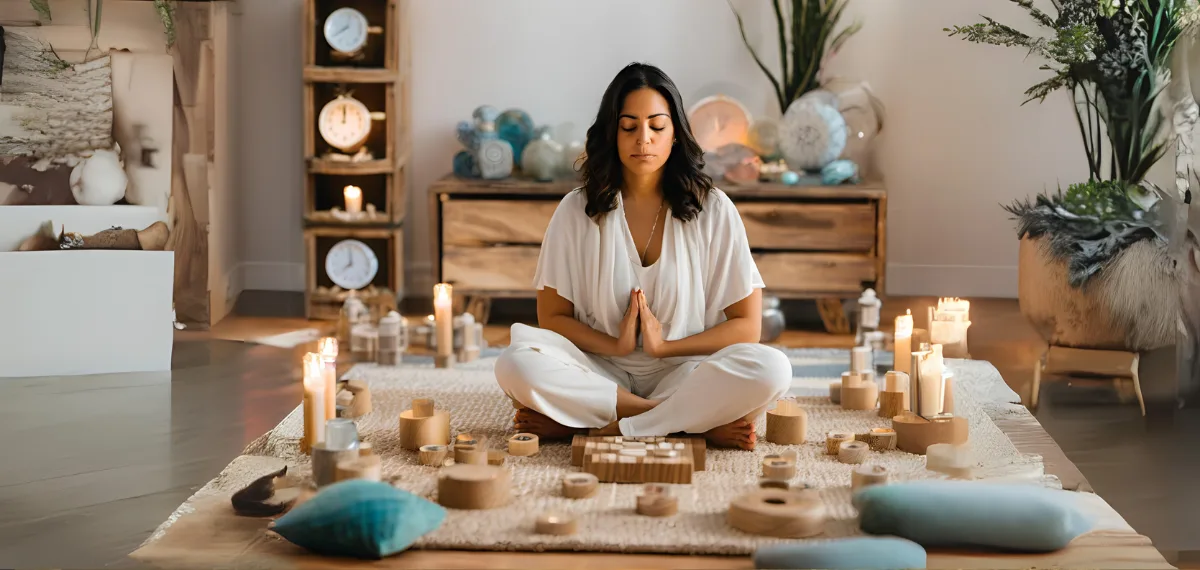
If you live in a shared space and privacy is limited, a portable arrangement is not a compromise — it is a genuinely viable approach. A dedicated cloth or mat, a small set of objects kept together in a box, the ritual of setting them out and putting them away: these can carry as much weight as a permanent altar. The act of assembly becomes part of the practice itself, a moment of deliberate transition from ordinary activity into something more intentional.
Think also about what the space faces. Natural light has a quality that artificial light does not replicate. Proximity to a window, to a view of sky or trees, to something that changes through the day — these are not luxuries. They connect the space to the natural world in a way that feeds practice rather than insulating it.
One of the most useful questions to ask when designing a sacred space is: which sense is my primary doorway? Some people settle through the eyes — a focal point, a particular quality of light, symmetry or colour. Others settle through sound — the tone of a singing bowl, silence with a specific texture, or the ritual of music. Others come home through the body — the right surface to sit on, an object that feels good to hold, temperature and physical comfort. And for some the doorway is smell — a particular incense, an oil, something that immediately signals a different state.
A focal point is essential — a candle flame, a crystal, a piece of imagery that draws the eye without demanding it. Colour choice matters: blue and purple tend to support contemplative states, green invites healing and calm. Sacred geometry, mandalas, or simple symmetrical arrangements give the visual mind something to rest on rather than move across.
Keep sound tools within reach — a singing bowl, a small bell, chimes. Consider the acoustics of the space: soft surfaces reduce echo and create a quality of containment that supports inner listening. If you practise mantra or prayer aloud, choose a location where you can make sound without self-consciousness. Silence, when it is chosen rather than endured, is also an auditory practice.
Physical comfort is not indulgence — it is the foundation. A meditation cushion or bench that actually supports your body, a mat with the right texture underfoot, objects chosen as much for how they feel in the hand as how they look. If movement is part of your practice, the space needs room for it. Mala beads, smooth stones, and fabric with pleasing texture all serve the kinesthetic orientation well.
Scent is the most direct sensory route to altered states of attention — it bypasses the analytical mind in a way that visual and auditory cues do not. Incense, resin, essential oils in a diffuser, fresh flowers, or a particular herbal bundle can become an immediate trigger for the quality of awareness you are cultivating. Choose scents deliberately rather than by default, and allow them to become associated with this space and no other.
The objects with the most power in a sacred space are almost never the most expensive or the most aesthetically impressive. They are the ones that carry genuine personal significance — something collected from a place that mattered, a gift from someone whose care you still feel, an object present during a moment of real change. These things are already charged. You do not need to do anything to them except place them where you can see them.
Beyond personal objects, the four elements offer a useful structural framework: something of the earth (stone, crystal, salt, a plant), something of water (a small vessel, a shell), something of fire (a candle, or simply the quality of sunlight), something of air (incense, a feather, a chime). This is not a requirement — it is an invitation to think about whether your space feels grounded, alive, and in relationship with the natural world rather than separate from it.
Living elements matter more than most people realise. A plant, fresh flowers, water that is changed regularly — these connect the space to natural cycles of growth and renewal in a way that a collection of permanent objects does not. A sacred space with nothing living in it can begin to feel static over time.
A sacred space that is not tended loses its quality. This does not mean elaborate maintenance — it means regular, attentive presence. Dusting, refreshing water, replacing flowers, occasionally clearing and re-laying the objects with fresh intention. Energetic cleansing — with incense smoke, sound, or simply open windows and fresh air — removes what has accumulated and restores a quality of openness.
An arrival ritual, however small, makes the threshold real. Lighting a candle, ringing a bell, taking three deliberate breaths before sitting — these micro-practices tell the nervous system that something has changed, and over time that signal becomes reliable. You do not have to manufacture a particular state; you simply have to arrive, and the space and the ritual will do part of the work.
Allow the space to change as you change. A sacred space that remains identical year after year is one that has stopped growing with you. Seasonal adjustments, the arrival of a new object, the removal of something that no longer resonates — these keep the space alive rather than static.
Limited space: Think vertically. A single floating shelf can hold a complete practice. The surface area of a windowsill is enough. What matters is the quality of attention brought to a space, not its size.
Shared living: A portable arrangement in a box or bag, deployable anywhere and stored away cleanly, is a genuine solution rather than a fallback. Many practitioners find that the portability makes the practice more intentional, not less.
Children or pets: Position fragile or flame-based elements out of reach, and consider whether the space can have a physical boundary — a closed door, a shelf at height — when it is not in active use.
Inconsistent practice: Reduce the minimum. A sacred space used for five minutes every day develops faster than one used for an hour once a week. The threshold effect builds through frequency, not duration.
Our full course on Creating Sacred Space covers everything from choosing and cleansing your location to building daily rituals, working with the elements, and developing a practice that evolves with you over time.
Explore the Course →
Perhaps the most honest thing to say about sacred space is that it becomes a relationship — and like any relationship, it is shaped by the quality of attention you bring to it. A space used with genuine presence, tended with genuine care, develops a character that goes beyond the sum of its objects. It begins to feel like somewhere, rather than just somewhere you happen to sit.
Many practitioners describe the experience of their sacred space beginning to call to them — a quality of pull toward the practice when they have been away too long. This is not mystical in any dramatic sense. It is simply what happens when a habit is cultivated with enough care that it acquires weight: the body remembers, the attention recognises its home, and returning becomes easier than not returning.
Start simply. One object that genuinely matters to you, one location you will actually return to, one small ritual of arrival. Add to it only when something presents itself as genuinely right rather than when you think it ought to have more. The most powerful sacred spaces are usually not the most elaborate.