Notifications (Click to mark read)
Manipura — The Radiant Jewel
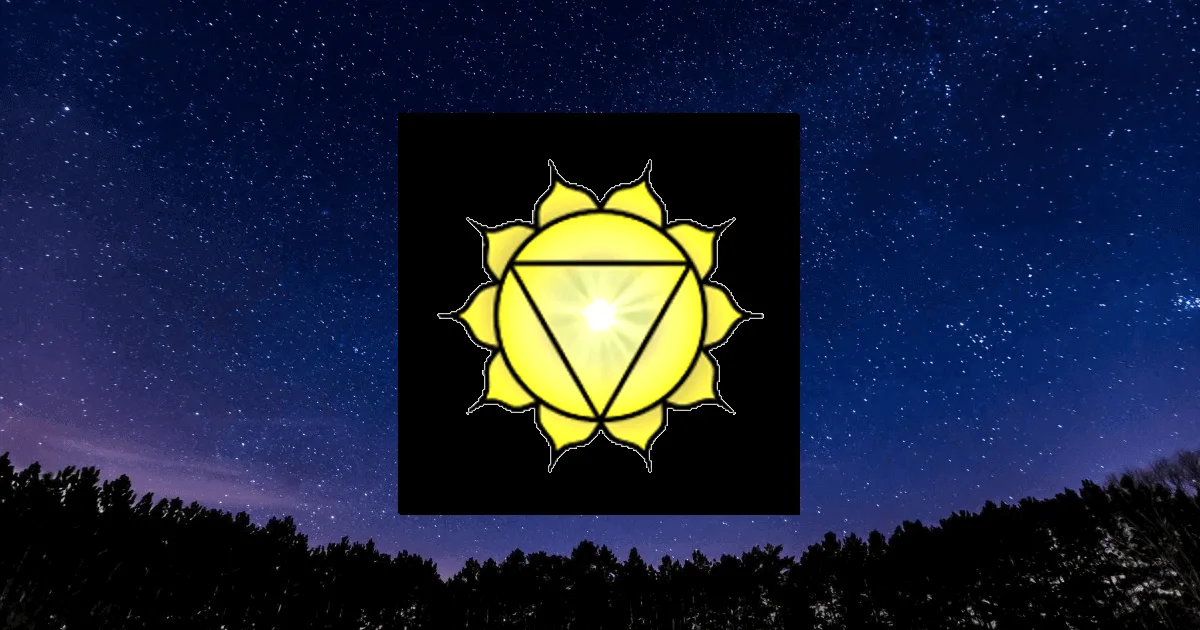
Manipura translates from Sanskrit as "city of jewels" or "lustrous gem" — an image of concentrated brilliance, of something precious held at the centre of a complex structure. The name points directly at what this third chakra governs: the radiant core of personal identity, the sense of self that knows its own worth and acts from that knowing rather than from fear of what others think.
Located in the upper abdomen between the navel and the base of the ribs, the solar plexus chakra is the seat of personal power in the chakra system. Where the root chakra establishes your right to exist and the sacral chakra develops your capacity to feel and create, Manipura is where you become someone in particular — a person with a point of view, a will, a capacity to act on your own terms rather than simply reacting to whatever the environment presents.
This is the chakra most directly concerned with the question of selfhood: not who you are in relation to others (that is more the heart chakra's territory), but who you are in yourself. It is the chakra of the autonomous individual.
The Fire Element and Personal Power
Manipura's element is Fire — the force that transforms, that generates heat and light, that drives action and burns away what is no longer useful. The solar plexus is literally the body's solar centre: the region where metabolic fire processes food into energy, where the digestive system performs its fundamental act of transformation. This physical function is a direct expression of the chakra's energetic principle — Manipura takes raw material and converts it into power.
Fire in the elemental framework is the most active and the most volatile of the four elements. It gives light and warmth and the energy to act, but it requires fuel and containment to sustain itself. Too little and it goes cold; too much and it consumes everything around it. The solar plexus chakra works exactly this way: the challenge is not to have power, but to hold it in a form that is generative rather than destructive.
The sense associated with Manipura is sight — not the inner vision of the third eye, but direct visual perception of the world as it is. This is the chakra that sees things clearly and acts on what it sees. There is a directness to healthy solar plexus energy that is neither aggressive nor passive: it perceives a situation accurately, forms a response, and moves.
What Manipura Actually Governs
The solar plexus chakra governs what is commonly called personal power — but this phrase has been so thoroughly absorbed into self-help language that it has lost its precision. What Manipura actually governs is the capacity for self-determination: the ability to choose your own direction rather than being swept along by others' expectations, external pressure, or the unexamined conditioning of your past.
Self-esteem, at its healthiest, is a solar plexus quality — not the brittle performance of confidence that depends on external validation, but the quiet, durable sense of your own worth that does not require constant replenishment from others' approval. The person with a healthy Manipura does not need to be the most important person in the room; they simply know what they think, what they value, and what they are willing to do and not do.
Will is another Manipura quality — the capacity to sustain effort toward a chosen direction even when circumstances are uncomfortable, when no one is watching, when the immediate result is not gratifying. Will in this sense is not the white-knuckled self-discipline of suppressed desire; it is the alignment between what you genuinely value and how you actually spend your energy. When those two things are in agreement, effort feels purposeful rather than punishing.
Opinions are also Manipura territory — specifically, the ability to hold a genuine point of view and express it without either aggressing on others or collapsing under their disagreement. This is a more demanding skill than it appears. It requires both the self-respect to believe your perspective has value and the security to remain open to challenge without experiencing it as an attack on your identity.
Signs of Imbalance
A blocked or underactive solar plexus chakra typically manifests as low self-esteem, chronic indecisiveness, difficulty asserting needs and opinions, a tendency toward people-pleasing at the expense of genuine self-expression, and a pervasive sense of powerlessness — the feeling that things happen to you rather than being shaped by you. There may be a strong susceptibility to others' opinions and moods, an inability to maintain your own perspective under social pressure, and a deep discomfort with conflict that leads to avoidance of any situation where disagreement is possible.
Physically, an underactive Manipura can contribute to digestive difficulties, fatigue, sluggish metabolism, and a general sense of low energy that has no obvious medical cause — the body reflecting in its own terms the chakra's diminished fire.
An overactive solar plexus presents as its own kind of problem: domineering behaviour, the compulsive need to control situations and people, excessive criticism of others (which usually reflects unprocessed self-criticism), aggression under pressure, and a rigidity of opinion that cannot be moved by new information because it is being held as an identity rather than a perspective. The person with an overactive Manipura may have significant outward achievements and still carry a deep, unacknowledged anxiety about their actual worth — the external dominance is the ego's attempt to compensate for an inner sense of inadequacy that the chakra's imbalance has never resolved.
Digestive disorders — particularly those related to the stomach, liver, and pancreas — are frequently associated with solar plexus imbalance. The gut's well-documented sensitivity to psychological stress reflects the direct relationship between Manipura's emotional territory and the digestive system it governs.
Working with the Solar Plexus Chakra
Because Manipura's element is Fire, practices that generate heat and activate the core body are its most natural medicine. Core-strengthening exercises — yoga poses such as Boat, Warrior III, and the various Plank variations — directly engage the solar plexus region physically while building the quality of focused, sustained effort that the chakra governs energetically. The connection between a physically strong core and a psychologically strong sense of self is not merely metaphorical.
Breathwork — particularly the forceful exhalation practices used in Kundalini yoga such as Breath of Fire — activates Manipura's Fire quality directly. These practices are energising rather than calming, and their effect on self-confidence and clarity of purpose can be immediate and marked.
At the psychological level, solar plexus work involves the gradual reclamation of your own authority over your own life. This means practising the expression of genuine opinions rather than defaulting to agreement, making decisions and standing by them rather than endlessly deferring, and examining the places where you have allowed others' definitions of your worth to override your own direct experience of yourself.
Setting and maintaining boundaries is core solar plexus practice — not aggressive boundary-setting, but the quiet, consistent communication of what you will and will not engage with. Each time you hold a boundary that social pressure is pushing against, you are directly exercising and strengthening the Manipura muscle.
Crystals for the Solar Plexus Chakra
Citrine is the primary stone for Manipura, and its correspondences are unusually direct. Its bright yellow colour resonates with the chakra's frequency, its energy is activating and uplifting, and it is one of the few crystals in common use that does not accumulate negative energy and therefore does not require regular cleansing. Citrine is associated with confidence, creativity, and the willingness to claim your own power without apology. It is particularly useful for the underactive solar plexus — it brings warmth and activation to a centre that has gone cold.
Yellow Labradorite — distinct from the more commonly known blue-grey Labradorite — carries the solar quality of its colour with the additional Labradorite property of enhancing intuition and perception. It supports the clarity of self-knowledge that healthy Manipura requires: not just the confidence to act, but the discernment to know what you genuinely think and want, beneath the layers of conditioning and social expectation.
Lemon Quartz brings a clarifying, focusing quality to solar plexus work. Where Citrine activates and Yellow Labradorite perceives, Lemon Quartz organises — it supports mental clarity, the ability to prioritise, and the translation of personal values into concrete decisions and actions. For anyone whose solar plexus imbalance shows up primarily as scattered energy or chronic indecision, Lemon Quartz is a precise and useful tool.
Place these stones on the upper abdomen during lying meditation, carry Citrine in a right pocket to keep its activating energy close throughout the day, and use Yellow Labradorite specifically during periods of self-reflection or decision-making. All three can be used together without competing frequencies.