Notifications (Click to mark read)
The Wisdom Keeper
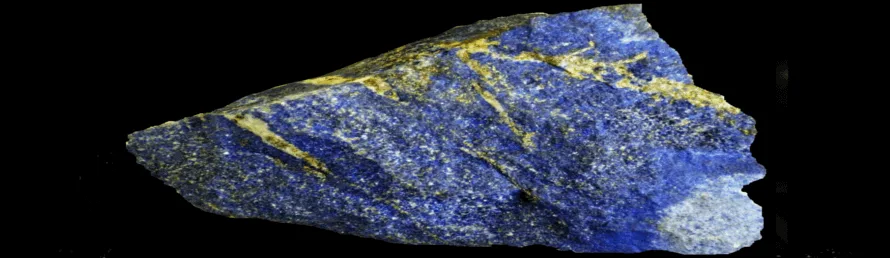
Lapis Lazuli is not technically a crystal. It is a metamorphic rock — a composite material formed under intense heat and pressure deep in the earth — composed primarily of lazurite (which gives it its characteristic deep blue), alongside calcite (white) and pyrite (gold). The flecks of pyrite that scatter across the surface of a good piece of lapis have been compared to stars against a night sky, and the comparison is ancient: the Egyptians used lapis to represent the vault of heaven, and ground it into powder for use in sacred cosmetics and pigments.
The primary source of the finest lapis lazuli in the world has been the Sar-i Sang mines in the Badakhshan province of northeastern Afghanistan, where it has been mined continuously for approximately 9,000 years — making them among the oldest known gemstone sources on earth. Marco Polo described them in 1271. The mines are still producing today. The route to them remains long and difficult, and the stone has always been expensive precisely because it comes from so remote a place.
The Blue That Painted the Virgin Mary
The cultural history of lapis lazuli is extraordinary, and understanding it deepens the stone's significance considerably. When ground and processed into pigment — a laborious process involving mixing the pulverised stone with wax, pine resin, and linseed oil, then kneading and washing it repeatedly to separate the pure lazurite from the colourless calcite — lapis produces ultramarine, the most prized blue pigment in the history of Western art.
The name ultramarine means "beyond the sea" in Latin, a reference to its origin in Afghanistan, far beyond the Mediterranean from the perspective of European artists. For centuries it was more expensive than gold by weight. Renaissance painters reserved it for the most significant elements of their compositions — and most often, for the robes of the Virgin Mary. Vermeer used it. Michelangelo used powdered lapis for the blue passages in the Sistine Chapel frescoes. Masaccio, Perugino, and Titian used it for their most important figures.
In 2019, researchers analysing the dental calculus of a medieval woman buried near a German monastery found lapis lazuli embedded in her teeth — evidence that she had been licking her brush while painting illuminated manuscripts. The finding pushed back the known use of ultramarine by religious women artists by centuries, and was a striking reminder of how thoroughly lapis permeated the material culture of devotion across many centuries.
Its use ended as a pigment only in the early 19th century, when a chemically identical synthetic version became available at a fraction of the cost. Before that, the deep blue of the heavens in European religious art was almost always lapis from the mountains of Afghanistan.
Ancient Egypt and the Funerary Tradition
Lapis was prized by the Egyptians for thousands of years before the Renaissance. Beads have been found at Neolithic sites dating to before 3000 BCE. Egyptian women used powdered lapis as a cosmetic eye shadow. The stone adorned countless objects of ritual and ceremonial significance — and most famously, it forms the striped headdress and eye markings on the funerary mask of Tutankhamun, where it represents both heaven and the divine.
The Egyptians understood lapis as a stone of royalty and of the sacred — connecting the wearer to higher truth, to divine authority, and to the clarity of perception that genuine leadership requires. This is not metaphorical window-dressing: the stone was used specifically in contexts where a claim to divine connection was being made, and its colour — the blue of sky and cosmos — was the vehicle for that claim.
Reading the Stone
The quality of lapis lazuli varies considerably, and understanding what you are looking at is useful. The most prized material has a deep, even royal blue with no visible white calcite streaks. The golden pyrite flecks, when small and evenly distributed, are considered desirable — they add character and contribute to the stone's starry quality without disrupting the blue. A heavy concentration of pyrite, however, can give the stone a greenish or dull cast, reducing its value. Pronounced white calcite veining also reduces quality.
Lapis is often dyed or treated to produce an unnaturally uniform colour, and it is also commonly confused with sodalite, which is a similar blue but without the pyrite flecks and typically paler and more violet in tone. If you are sourcing lapis for serious work, look for the characteristic gold and the depth of the blue rather than a too-perfect uniformity.
Throat and Third Eye
Lapis is associated primarily with the throat chakra — the energy centre governing authentic expression, truth-telling, and the alignment between what is known internally and what is communicated outwardly. Its secondary association is with the third eye, the centre of intuitive perception and inner vision.
The combination is coherent. Lapis is understood as a stone of wisdom in the specific sense of wisdom that can be articulated — not just felt or intuited but brought into language and shared. The affirmation that accompanies it is direct: I claim the sovereignty and power of my highest self, and I align myself with my highest truth. This is a statement about the relationship between inner knowing and outer expression — the willingness to speak from genuine understanding rather than from habit, expectation, or fear.
Its emotional quality involves helping to move consciousness beyond the mundane — past the surface concerns that can occupy the whole of attention — and toward a clearer perception of the patterns and habits that are actually operating beneath the surface. This is the wisdom keeper quality: not simply absorbing information, but facilitating the kind of honest self-perception that genuine wisdom requires.
Working with Lapis
Worn as a necklace, lapis sits at or near the throat and works continuously in the background — supporting clarity and honesty in communication over sustained periods. As earrings, it works more directly with the third eye energy, supporting perceptual clarity and the ability to receive and trust visual intuition.
For public speaking, performance, or any situation requiring clear and authentic expression under pressure, lapis is consistently associated with supporting the quality of presence and self-trust that those situations demand. Its absorptive energy draws in what is scattered or unclear, and its association with truth supports the alignment between what you know and what you say.
Paired with Moldavite — a stone of rapid transformation and high vibrational shift — lapis provides a quality of grounding wisdom to what can otherwise be an overwhelming energy. Moldavite accelerates; lapis clarifies direction and purpose, helping to ensure that transformation moves toward genuine highest expression rather than simply change for its own sake.
As an absorbing stone, lapis benefits from regular cleansing. It is sensitive to water and prolonged exposure can damage the surface, so dry cleansing methods — moonlight, sound, or resting on selenite — are preferable.