The human mind is an extraordinary thing. It remembers, predicts, compares, judges, imagines and solves problems with a sophistication unmatched anywhere else in the natural world. Every civilisation, every invention and every philosophy owes something to its remarkable ability to think.
From the Back Seat
It is therefore understandable that we have come to trust it so completely.
Whenever something feels uncertain we think about it. Whenever something feels difficult we think about it for longer. If the answer does not appear immediately we continue thinking, convinced that another hour, another day or another week of reflection will eventually produce the clarity we are looking for. Thought has become our first response to almost every aspect of life because, so often, it works.
Yet there is something rather curious about the way we use it: the problems that genuinely require thought occupy only a small part of an ordinary day. Deciding how to respond to a difficult conversation requires thought. Repairing a broken machine requires thought. Designing a building requires thought. Writing an article requires thought. These are moments when the mind is performing exactly the task for which it evolved.
The rest of the time, it simply keeps going: it revisits conversations that are already over, imagines conversations that may never happen, examines choices that can no longer be changed and anticipates situations that may never arrive. We are not consciously deciding to do any of this. The thoughts simply appear, one after another, until we become so accustomed to their presence that we barely notice them.
That, I suspect, is where the misunderstanding begins.
We have become so familiar with the activity of the mind that we quietly assume life is meant to be experienced through it. Experience arrives first, thought follows afterwards, yet we gradually reverse the order. We begin to know the world less through direct experience than through our endless commentary upon it.
Modern life encourages this without ever quite saying so. There is always another opinion to hear, another article to read, another decision to make, another improvement to pursue. Even when the room falls quiet, a notification glows on the table, a headline waits behind a locked screen, a podcast murmurs on in one ear � and the mind has already learned to continue the conversation with or without them. It comments, evaluates, predicts and compares until commentary begins to feel indistinguishable from reality itself.
I sometimes wonder what would happen if we simply allowed experience to arrive before explaining it to ourselves.
Not as an exercise.
Not as a technique.
Not because someone claims it reduces stress or improves wellbeing.
Simply because it is possible.
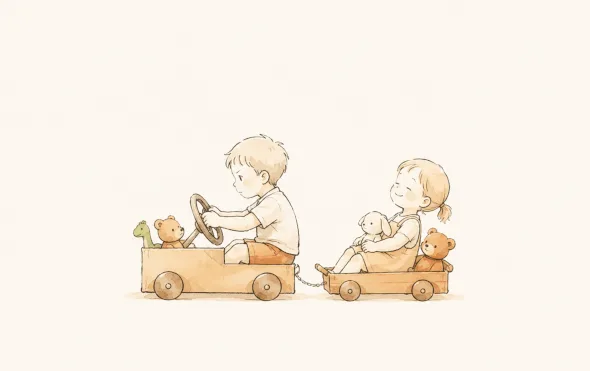
As children, many of us chose the back seat without quite knowing why. It was where the view was widest, and where nobody expected anything of us. The adults sat at the front: watching the road, making the decisions, responsible for arriving somewhere on time. We watched everything else instead. Not because we thought less than they did, but because we attended differently � we didn't narrate what we saw, we simply saw it. We stared out of windows. We watched strangers and invented stories about them that dissolved as quickly as they'd arrived. Our attention moved wherever it wanted, fluid rather than managerial, with nothing to decide and nothing to defend.
Somewhere along the way, without quite noticing, we all migrated forwards. The decisions became ours to make. The route became ours to worry about. And the kind of watching that asks nothing and expects nothing became something we had to go looking for again, rather than something we were simply given.
Perhaps that is why I have always liked sitting in the back seat of a bus.
There is very little to do there. Someone else is responsible for the route. Someone else worries about traffic and junctions and timetables. Freed from all of that, your attention drifts naturally towards everything else. A woman reading a novel. A boy staring out of the opposite window. Rain changing the appearance of familiar streets. A dog waiting patiently outside a shop. None of these moments is important in the ordinary sense of the word. None changes the direction of your life. None demands an opinion. They simply happen.
It occurs to me that life itself is largely made from moments like these. Not the promotions, weddings, bereavements and milestones that stand out in memory, but the thousands of ordinary moments that pass between them. A kettle boiling. A bird crossing the garden. The sound of children leaving school. The changing colour of the evening sky. They ask almost nothing of us except that we are there while they occur.
The mind has no particular interest in such moments because there is nothing to solve. It naturally turns instead towards yesterday or tomorrow, searching for somewhere more useful to direct its attention. That is not a failure of the mind. It is simply what minds do.
The question is whether we always have to follow.
It may be that one of the quiet skills of living is learning that thought and attention are not the same thing. Thoughts will continue to come and go for as long as we are alive. They need no encouragement from us. Attention, however, remains ours to place.
Children already know this, long before anyone teaches it to them. It is adulthood that has to relearn it � usually by accident, in the back seat of a bus, with nowhere left to drive.
Every now and then it is possible to let the mind continue whatever conversation it has decided to have while we quietly return our attention to the world itself. There is no achievement in this and no destination waiting at the end of it. There is only the slightly surprising discovery that while the mind has been busy describing life, life has continued patiently without requiring the description.
Perhaps that is what I have always enjoyed about the back seat.
Sometimes, watching the window, I catch my own reflection laid faintly over the glass, drifting across whatever street happens to be passing through it. For a moment I can't tell which one I'm looking at � the man on his way somewhere, or the boy who never really stopped watching.
Then the bus turns a corner, and they're both gone.
Reflection Quiz
1. When do you most notice your mind taking over?
2. Which statement feels closest to your experience?
3. What would help you spend more time in the back seat?