Notifications (Click to mark read)
Ralph Waldo Emerson is one of the most important American writers who ever lived. He is often claimed by the manifestation industry as an early advocate of the Law of Attraction. He was not. What Emerson actually wrote about was something harder and more valuable: the power of a mind that has been trained to think for itself.
Emerson's central argument, repeated across his essays and journals, is that most people do not think. They inherit opinions, follow convention, and surrender their judgment to institutions, traditions, and the comfort of agreement. The disciplined mind — the mind that has done the work of self-examination — is the only tool capable of genuine change.
This is not an abstract philosophical position. Emerson lived it. He resigned his ministry in 1832 because he could not in good conscience perform a ritual he no longer believed in. He delivered lectures that made his audiences uncomfortable. He took positions on abolition, on education, on the nature of the soul that put him at odds with the respectable opinion of his day. The disciplined mind was not, for Emerson, a theory. It was a daily practice with real costs.
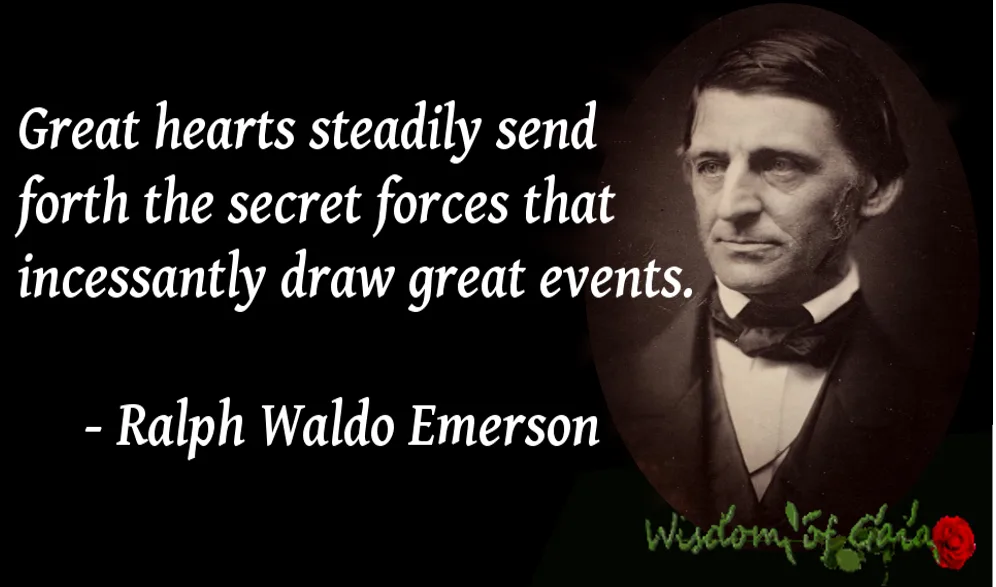
In Self-Reliance, Emerson writes that man "does not live in the present, but with reverted eye laments the past, or, heedless of the riches that surround him, stands on tiptoe to foresee the future." He argues that a person "cannot be happy and strong until he too lives with nature in the present, above time."
This is not manifestation. This is mental discipline. Emerson is describing a mind that has stopped rehearsing the past and stopped performing the future — a mind that is actually here. Eckhart Tolle said something remarkably similar a century and a half later, but Emerson arrived there first, and he arrived there not through mysticism but through the hard philosophical work of examining how the mind deceives itself.
The deception Emerson is most interested in is the one we perform on ourselves. We convince ourselves that our distraction is necessary — that the past requires continued examination, that the future requires constant rehearsal. But this is simply the mind's preference for anywhere but here. The present moment is demanding in a way the past and the future are not. It asks you to actually deal with what is in front of you rather than what you wish had been or hope will be.
For Emerson, the ability to be genuinely present is not a spiritual achievement available only to the enlightened. It is a practical capacity that any person can develop through honest self-examination and the willingness to catch themselves in the act of mental escape. It is, in other words, work.
Emerson's most famous essay is not about believing good things will happen to you. It is about trusting your own perception over the inherited opinions of others. "Trust thyself: every heart vibrates to that iron string." The iron string is not optimism. It is the sound your own mind makes when it stops deferring to everyone else's.
This is uncomfortable work. Self-reliance means accepting that your own thoughts may put you at odds with your community, your upbringing, and your own previous beliefs. Emerson understood that most people would rather be consistently wrong than endure the discomfort of thinking independently. The power of the mind, for Emerson, was not in what you could attract but in what you were willing to see clearly and act on honestly.
The essay contains one of the most quoted and least understood lines in American literature: "A foolish consistency is the hobgoblin of little minds." What Emerson is attacking is not consistency itself but the refusal to change one's position when one's understanding has genuinely changed. The person who holds a view because they held it yesterday — who cannot admit that they were wrong because admission would be embarrassing — has prioritised social comfort over intellectual integrity. This, Emerson says, is a small mind. Not stupid, but small: unwilling to grow.
The self-reliant person, by contrast, is willing to contradict themselves publicly because they are following their actual understanding rather than the performance of a previous understanding. This requires something most people find genuinely difficult: the ability to be wrong without shame, and to change without pretending the change was always the plan.
Emerson's spiritual dimension is real and should not be dismissed. In his essay The Over-Soul, he describes a universal consciousness that underlies and connects all individual minds — a source from which genuine insight, creativity, and moral clarity flow when the individual mind is quiet enough to receive them.
This is closer to what the manifestation industry claims to be teaching than anything in Self-Reliance. But Emerson's version is significantly more demanding. The Over-Soul is not a vending machine for desires. It is a source of truth — and truth, in Emerson's understanding, is often inconvenient. What flows through the quiet mind is not what you want to hear but what is actually the case. The discipline required is not the discipline of positive visualisation but the discipline of making yourself quiet enough and honest enough to receive something real.
Emerson believed that every person has access to this source, and that the moments of genuine inspiration, genuine moral clarity, and genuine creative breakthrough that people experience are moments of contact with it. The tragedy, in his view, is that most people dismiss these moments as flukes rather than recognising them as the signal they are following when they are most fully themselves.
Strip away the modern appropriation and Emerson's message is direct: your mind is the most powerful instrument you possess, and most people never learn to use it properly. Not because they lack intelligence but because they lack the courage to think thoughts that haven't been pre-approved by someone else.
The disciplined mind — present, self-trusting, willing to be wrong, willing to stand alone — is not a tool for getting what you want. It is a tool for seeing what is actually in front of you. And that, as Emerson understood, is where genuine transformation begins. Not in the wishing. In the seeing.
This is why Emerson remains genuinely useful rather than merely quotable. His work does not offer comfort — it offers clarity, which is harder to come by and more valuable when you find it. The person who reads Emerson carefully and honestly will not come away feeling reassured. They will come away with a sharper sense of where they have been deferring when they should have been deciding, and where they have been performing a self rather than actually being one.
That is a more demanding gift than the Law of Attraction. But it is also a more honest one. And Emerson, above all things, was honest.