Notifications (Click to mark read)
The Setting Sun
Napoleon Bonaparte carried an octagonal carnelian seal engraved with Arabic script from his
Egyptian campaign until his death. He wore it consistently through the most consequential
years of his life, and it passed afterward to his nephew, who used it as Emperor Napoleon III.
Whether Napoleon attributed direct protective power to the stone or simply valued it as a
trophy and talisman of Egyptian conquest, it never left him.
That is the kind of history carnelian carries. It has been in continuous use for over five
thousand years — worn by Egyptian pharaohs as burial jewellery, carried by Roman soldiers
for courage in battle, set in the breastplates of high priests, worn by master architects
in ancient Egypt to indicate their rank, and used by alchemists of the Middle Ages as a
boiling stone to activate the energy of other chalcedonies. Every civilisation that
encountered it found in its warm translucence something they recognised: the fire of the
living body, the courage required to act, the generative force behind every act of creation.
The Setting Sun
The ancient Egyptians called carnelian "the setting sun" — and that name carries more
meaning than it might appear. In its orange hues they saw the receptive, feminine energy
of the goddess Isis, and associated the stone with the fertile life force she represented.
The setting sun is not an ending; in Egyptian cosmological understanding, it is the moment
of transition before renewal — the passage that precedes resurrection. Carnelian was placed
in tombs precisely because it was understood as a stone of that passage, carrying the soul
safely through transformation.
This ancient understanding maps surprisingly well onto how carnelian is experienced in
practice. It is not a stone of passive comfort but of active transition — the energy that
moves you from hesitation into action, from creative block into creative flow, from
exhaustion into renewed vitality. The fire in it is not destructive; it is generative.
The Sacral Chakra Connection
Carnelian is most closely associated with Svadhisthana — the sacral chakra — located
approximately two inches below the navel. The name translates roughly as "one's own abode"
or "sweetness," and the chakra governs the energetic territory of creativity, pleasure,
desire, emotion, and the relationship between self and others. It is also associated with
the root chakra at the base of the spine, which governs stability, groundedness, and the
most fundamental sense of physical safety and belonging.
The combination is coherent with what carnelian is traditionally understood to do. It
grounds physical energy while simultaneously igniting creative and emotional vitality —
anchoring you in the present moment while giving you the courage and momentum to act
from it. This is why it works well on the desk during creative work: it keeps you present
and energised rather than scattered or avoidant.
When the sacral chakra is underactive, the effects are recognisable: creative blocks,
emotional flatness, difficulty with pleasure and desire, a general sense of going through
the motions. Carnelian's absorbing energy draws in stagnation and replaces it with warmth
and forward momentum. It does not work by calming, the way many crystals do — it works
by restoring fire.
Action, Courage, and the Voice
The emotional quality carnelian addresses most directly is the fear of taking action —
specifically the particular paralysis that comes from being afraid of doing the wrong
thing. This is different from simple procrastination. It is the hesitation of someone who
cares deeply about getting it right and has allowed that care to become an obstacle. Carnelian
does not make the decision for you; it dissolves the energetic obstruction that was
preventing you from making it yourself.
Its traditional use for vocalists and public speakers follows the same logic. The voice
requires not just technical skill but the willingness to be heard — a kind of courage that
is surprisingly easy to lose and surprisingly difficult to recover through effort alone.
Carnelian placed at the throat or worn as a necklace before performance is a long-standing
practice, and the stone's association with both root-chakra grounding and sacral-chakra
vitality gives the combination a coherent rationale.
Physical Properties and Practical Use
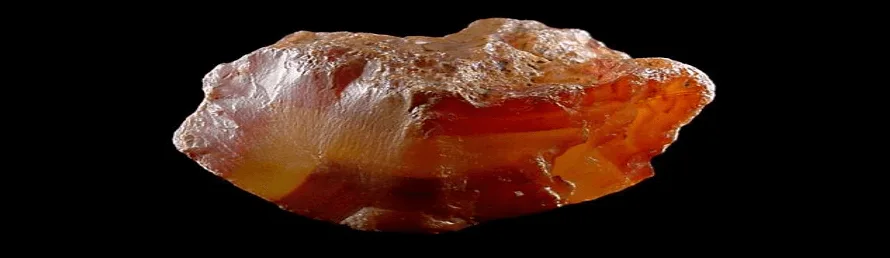
Carnelian is a variety of chalcedony — microcrystalline quartz coloured by iron oxide
impurities — ranging from pale orange through deep red-brown depending on the concentration
and oxidation state of the iron. It sits at 6.5–7 on the Mohs scale, making it durable
enough for regular wear. Unlike some crystals, it is safe for water cleansing.
One property worth knowing: carnelian is one of the few stones traditionally understood
to be capable of cleansing other crystals. Placing carnelian with other chalcedonies
or absorbing stones is said to restore their energy without requiring separate cleansing —
the alchemical boiling stone function the medieval practitioners understood it to perform.
For physical vitality, carnelian is associated with circulation, metabolism, and stamina.
It is frequently recommended as a support during detoxification — the breaking of entrenched
physical habits — and its root-chakra grounding makes it useful during any period of bodily
change that requires sustained commitment to something difficult.
Working with Carnelian
On the desk or workspace, carnelian functions as a continuous source of low-level energetic
support — warming, activating, keeping the creative channel open. It is better placed away
from the bedroom: its activating quality can interfere with sleep and the restorative
stillness the night requires.
Worn as a bracelet on the dominant wrist, it works with the energy of outward action and
creative expression. Placed near the root chakra at the base of the spine during meditation
or rest, it works more directly with grounding and physical vitality.
Paired with citrine — which amplifies and illuminates — carnelian's fire gains direction.
The combination supports the full arc of creative work: the sacral spark that generates
the idea, and the solar plexus will that carries it through to completion.