Notifications (Click to mark read)
Anahata — The Sound That Was Never Struck
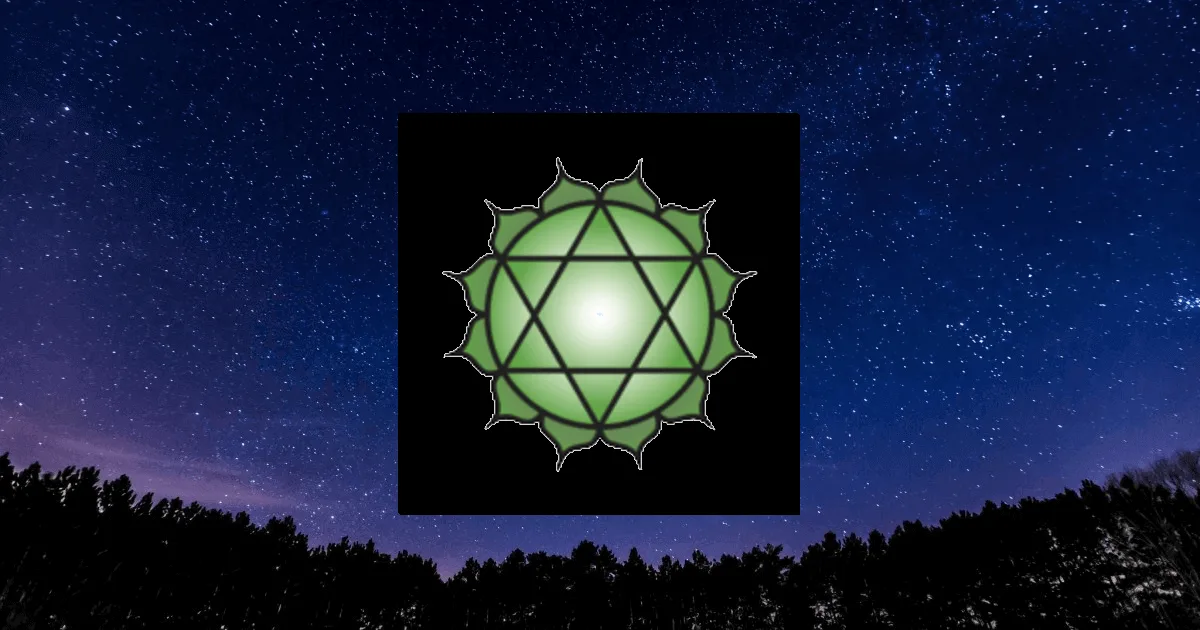
Anahata translates from Sanskrit as "unstruck" or "unhurt" — a name that refers not to the physical heart but to a sound that exists without being caused by the collision of two things. In Indian philosophical tradition, all ordinary sound arises from impact: bow on string, hand on drum, voice on air. But beneath all struck sound, the tradition holds, there is a sound that was never created and can never be destroyed — the primordial vibration of consciousness itself. Anahata is the chakra through which that sound can be heard.
This is a more interesting and more demanding concept than the heart chakra's popular image tends to suggest. The heart chakra is widely presented as the chakra of love, which is accurate as far as it goes — but love in the Anahata sense is not primarily about romantic feeling or even personal affection. It is about the quality of consciousness that perceives the essential connectedness of all things and responds to that perception with openness rather than contraction. That is what "unconditional" actually means in this context: not unlimited tolerance of mistreatment, but love that does not depend on circumstances being arranged a particular way before it can be present.
The Bridge Between Earth and Heaven
The heart chakra occupies the fourth position in the seven-chakra system — the exact centre, with three chakras below it and three above. This is not an accident of counting. Anahata is understood as the bridge between the lower chakras, which govern our relationship with the physical world and the personal self, and the upper chakras, which govern communication, perception, and transcendence.
The lower three chakras — root, sacral, and solar plexus — are concerned with survival, feeling, and personal power. They are oriented toward the individual's navigation of physical existence. The upper three — throat, third eye, and crown — are concerned with expression, insight, and spiritual connection. Without a functioning heart chakra in the middle, these two realms remain disconnected: you can be physically functional and emotionally reactive without any access to broader perspective, or you can have intellectual spiritual understanding without any of it landing in the body as lived experience.
Anahata is where personal experience and universal principle meet. It is where the individual self begins to feel its connection to something larger than itself — not as a philosophical position, but as a direct, felt reality.
The Air Element and Touch
The heart chakra's element is Air — which may seem counterintuitive for a chakra associated with feeling and warmth. But Air is the element of connection and movement, of the invisible medium through which things reach each other. Sound travels through air. Breath — the most intimate form of exchange between the body and the world — is air. The heart literally moves air through the lungs with every beat. The correspondence is precise.
Air is also the element associated with thought and ideas at the solar plexus level, but at the heart level it takes on a different quality: it becomes the capacity to move between inner and outer, to remain open to experience rather than defended against it. The heart chakra person meets the world with a quality of spaciousness — a willingness to let things in and let things move through — that reflects Air's fundamental nature.
Touch is the sense associated with Anahata, and again the correspondence is exact. Touch is the sense of contact and boundary simultaneously — it is both the means by which we connect with the physical world and the way we know where we end and another begins. The heart chakra, which governs both love and healthy self-regard, embodies this paradox: to love fully you must be able to make contact, and to make contact without losing yourself you must know where your boundary is.
What Anahata Actually Governs
Love is Anahata's domain, but it is worth being precise about what kind of love. The heart chakra governs the movement from personal attachment — which is conditional, dependent on the other person behaving in ways that meet our needs — toward something broader. This is not a movement away from personal love but a deepening of it: love that has worked through its own needs and fears enough to be genuinely present with another person, rather than primarily with its own reflection in them.
Compassion is distinct from love but closely related — it is the capacity to feel the reality of another's suffering without either turning away from it or being overwhelmed by it. A healthy heart chakra does not require that you suffer because someone else is suffering; it requires that you remain present with their pain without retreating into numbness or projection.
Forgiveness is perhaps the most demanding of the heart chakra's territories. Not the social performance of forgiveness — the declaration that something is resolved when it is not — but the internal process of releasing the grip of a grievance, not because what happened was acceptable, but because continuing to hold it is costing more than it is returning. This is active work, not passive acquiescence, and the heart chakra is where that work happens.
Signs of Imbalance
A blocked or underactive heart chakra tends to manifest as emotional withdrawal, difficulty with intimacy, a chronic sense of loneliness even in company, the inability to receive love or care even when it is genuinely offered, and a defensive quality in relationships — the anticipation of hurt that prevents genuine connection. Grief that has been suppressed rather than processed often lives here, creating a kind of armour around the chest that feels like protection but functions as isolation.
Physically, a closed heart chakra can contribute to respiratory difficulties, circulatory problems, and tension in the chest and shoulders — the body expressing in its own language what the energy centre is doing.
An overactive heart chakra presents as its own kind of imbalance: emotional dependency, the loss of self in relationship, a compulsive need to be needed, difficulty maintaining boundaries with others' emotional states, and the particular exhaustion of someone who gives endlessly without being able to receive. This is sometimes mistaken for spiritual generosity; it is more accurately a heart chakra that has opened without adequate root chakra grounding to hold it stable.
Working with the Heart Chakra
Because the heart chakra's element is Air, breath practices are among the most direct ways of working with it. Conscious breathing — particularly slow, full exhalations that consciously release tension from the chest — directly engages Anahata's territory. Many meditation traditions place their primary focus on the breath precisely because of this connection.
The heart chakra is also responsive to acts of genuine giving — not giving as performance or obligation, but giving that costs something real and is offered freely. This activates the chakra's generative quality, its capacity to move energy outward without depleting the self.
Perhaps most importantly, the heart chakra opens through the practice of self-compassion — extending to yourself the same quality of understanding and patience you would offer to someone you love. This is harder than it sounds for most people, and it is the foundation of everything else. A heart that has no compassion for itself cannot sustain genuine compassion for others; the openness drains out rather than flowing from a replenished source.
Green spaces, contact with nature, and time spent in genuine silence — not distracted quiet but chosen stillness — all support Anahata's natural tendency toward openness.
Crystals for the Heart Chakra
Rose Quartz is the most widely associated stone with the heart chakra, and its reputation is well earned. Its energy is gentle, consistent, and deeply nourishing — it works primarily on self-love and self-worth, softening the inner critic and creating the quality of warmth toward oneself that is the prerequisite for genuine warmth toward others. It does not overwhelm; it dissolves, slowly and persistently, the places where the heart has closed around an old wound.
Green Aventurine brings a different quality — it is the stone of the heart chakra's outward-facing energy, of optimism and the willingness to engage with new possibilities. Where Rose Quartz works inward, Green Aventurine works at the threshold between self and world. It supports emotional courage — the willingness to open to experience even when previous experience has given reason for caution.
Green Calcite is the clearing stone of the three — it is particularly effective at dissolving emotional patterns that have calcified: old resentments, habitual defences, the frozen quality of grief that was never given permission to move. It brings a quality of gentle dissolution rather than force, making it useful during periods when the heart chakra needs to release something that has been held too long.
Place these stones on the centre of the chest during meditation, or carry them close to the body during periods of emotional challenge. Rose Quartz and Green Aventurine work well together; Green Calcite is most effective when used alone during specific clearing work.